
June
2010

AutomatedBuildings.com
[an error occurred while processing this directive] (Click Message to Learn More)
 Measurement and Verification
Jim Sinopoli PE, RCDD, LEED AP
Managing
Principal,
Smart Buildings LLC
Contributing Editor
 M
easurement
and verification (M&V) sounds so simple. After all, how difficult can it be to
calculate energy savings by measuring energy usage before and after energy
conservation measures (ECM) are implemented? The reality is very different. M&V
is a methodical, scientific process which leads to the best available metrics
for energy conservation measures and in turn affects financial transactions and
other issues related to energy and water use. Some examples of financial effects
would be energy performance contracting where the ESCO is paid based on verified
energy savings; carbon emission trading where the emissions are the focus of a
financial transaction; and even the piloting of a limited ECM (such as a
lighting retrofit) where the result of the pilot is used to determine the
building owner?s Return on Investment (ROI) and whether or not the pilot is
extended to other spaces or buildings.

|

|

|

|

|

|
| [an error occurred while processing this directive] |

|

|

|

|

|

|

|
| [an error occurred while processing this directive] |
-
Option A ? Partially Measured Retrofit Isolation ? These are specific ECMs, such as a lighting retrofit for a specific floor or space, where partial measurements may provide adequate accuracy. For example, we may only be interested in the electricity savings of a light retrofit in which case we may periodically measure the power draw of the lighting circuit and calculate energy savings on that one measure. Our ECM ?boundary? is just electricity saved. We know however that reducing the power demand of the lighting also reduces the heat generated, therefore decreases the need for cooling which is additional energy savings. We could widen the boundary of the ECM to electricity and cooling reductions by reasonably stipulating the cooling reductions rather than measuring them. With stipulations one has to take into account possible errors and what that may mean for the accuracy of energy savings.
-
Option B ? Retrofit Isolation ? This option is similar to Option A, but only uses measurements, no stipulations. This option may cost more because more is being measured but provides more accurate results. Most ECMs would be covered or use Option B. An example would be replacing an older boiler with a new more efficient boiler where the boundary of the ECM and the measurements are exclusively focused on the boiler?s fuel systems.
-
Option C ? Whole Building ? In this option ECMs are addressed collectively, not individually or in isolation. This option works best when the projected savings is significant or when ECMs interact or affect other ECMs. For example, a set of ECMs for one building encompassing a lighting retrofit, HVAC upgrades, plug load control, building envelope and a public awareness initiative. The boundary for the ECMs would be the main electrical and natural gas consumption. The time period to measure energy savings for Option C is typically in years as opposed to months, therefore adjustment to energy calculations such as weather and occupancy become significant.
-
Option D ? Calibrated Simulation ? This option is similar to Option C in that it addresses the whole building; however it deals with buildings with no baseline data. Software simulation models are used to predict energy usage either for the base year, the post-retrofit condition or both. An example would the deployment of ECMs in a building that is part of a larger campus that does not have an individual building meter.
Energy Savings Calculations
and Adjustments
Energy savings are essentially base year energy use, minus
post-retrofit energy use, with adjustments. Base year and post-retrofit energy
use is supported by hard data from calibrated meters and sensors. It?s the
adjustments that "normalize? the base year and post-retrofit energy use into the
same set of conditions.
Adjustments are typically used to restate the base year energy use. Some
adjustments are anticipated, such as weather or occupancy, while others are
unforeseen such as a change in equipment operations. Other factors that could
affect energy use include occupant acceptance of the ECM, equipment
deterioration, the design and implementation of the ECM, user demand for
services, schedules, etc. The goal of this exercise is to obtain reliable and
accurate data on the energy savings. Unknown variables and variances or ?noise
levels? of the data result in less accurate, less reliable data, so to a large
extent, the effort in calculating savings is focused on reducing and addressing
uncertainty. In addition, the M&V approach has to balance the cost with the
uncertainty; for instance, would you spend $20,000 to improve the accuracy of
the overall cost savings by $10,000? Probably not.
[an error occurred while processing this directive]
Metering, Sensors and the BAS
Metering is obviously a key component to measurement of energy usage.
Building meters should be calibrated and should replicate the method of the
meter being provided by the local utility. The ?energy/pulse? meters common in
buildings should be calibrated with the utility?s revenue grade meter, as well
as calibration standards and procedures developed by the National Institute of
Standards and Technology. Some meters are self-calibrating. If, for example, the
utility meter is calculating peak demand with a 10 minute sliding window, the
building equipment should do the same. BTU meters and sensors for temperature,
humidity, flow, pressure, light levels and equipment runtime may also need to
obtain data on the conditions of the ECM and make adjustments to the energy
savings.
Eventually all the meters and sensors are tied together in a building automation
system that will collect the data using an embedded or third-party energy
management software application to analyze and provide reports on the energy
consumption and costs.
M&V Costs
Studies by the US Department of Energy suggest that the average cost
of M&V services is in the range of 3-5% of total costs. IPMVP shows the cost to
determine the energy savings is typically less than 10% of the total energy
savings. Cost will vary by the Option used. A study by NAESCO and the US EPA
found the cost for Options B and D to be around 3-10%, Option A to be 1-5% and
Option C to be 1-3% depending if meters were already installed. Cost will vary
based on the amount of equipment, the value of energy savings, the interaction
between energy consuming systems, the level of uncertainty, the availability of
an energy management systems, etc.
The M&V Plan
A M&V plan will vary depending on not only the Option selected but
the purpose and the level of accuracy required. An M&V plan to be used as part
of a contract between a building owner and an ESCO will be different than a plan
developed by the facilities department to test a lighting retrofit ECM. Major
elements of the plan should contain:
-
A description of the ECM(s) and the anticipated effect
-
The boundaries of the ECM
-
Base year conditions and energy data
-
Proposed changes to the base year
-
The duration of the post-retrofit period
-
The set of conditions that adjustments will be applied to
-
The commissioning procedures for the ECM
-
The IPMVP Option that will be used
-
The analysis procedures and assumptions that will be used
-
The specifics of the meters that are to be used (calibration, commissioning, time periods, etc.)
-
The quantification of the expected accuracy of the measurement, noting factors that cannot be quantified
-
How results will be reported and documented
-
Dependencies of third-parties
-
The budget and resources required for the total M&V process
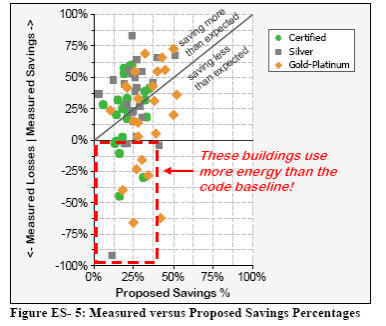
The astounding fact that only 22% of a sample of LEED
certified buildings have one-year of post-occupancy energy data, tells a lot
about the changes needed in building operations. We need to focus on results and
M&V is the means to that end. M&V and energy reporting must be ingrained in the
design and operation of buildings.
For more information, write us at info@smart-buildings.com
[an error occurred while processing this directive]
[Home Page] [The Automator] [About] [ Subscribe ] [Contact Us]
