
November 2013
Article
AutomatedBuildings.com
[an error occurred while processing this directive] (Click Message to Learn More)
Smart
Building Synergy
Through
Building Energy Management Systems and Enterprise Energy Management
Software

B
oth Building Energy Management Systems (BEMS) and Enterprise Energy
Management (EEM) have major parts to play in delivering Distributed
Energy and Demand Response services connecting across Smart Buildings
and Smart Grid. This reinforces that together they can also reach
across associated applications. This must be synergy personified.
Integrating the technical services in buildings is not a new
development but more recently advances in technology together with the
need to reduce CO2 emissions from buildings has spurred on demand and
opened up new business opportunities. Memoori’s new research report
“ The Market for BEMS and EEM 2013 to 2017
”
” seeks to establish how this will develop, and together how they will
achieve more than the sum of their parts when they are fully
integrated, not just interfaced; delivering more benefits and a better
return on the clients investment.
There is no doubt that through alliance, acquisition and integration;
these two separate businesses will play a vital role in maximizing
energy conservation in buildings whilst generating income and reducing
operating costs.
BEMS Market Sizing Data & Business Development
We estimate that the world sales of BEMS at installed prices was $15.6
billion in 2012 and we forecast that by 2017 it will have reached $23
billion. The figures are based on the total installed value and include
all controllers, valves actuators and sensors and supervisory software.
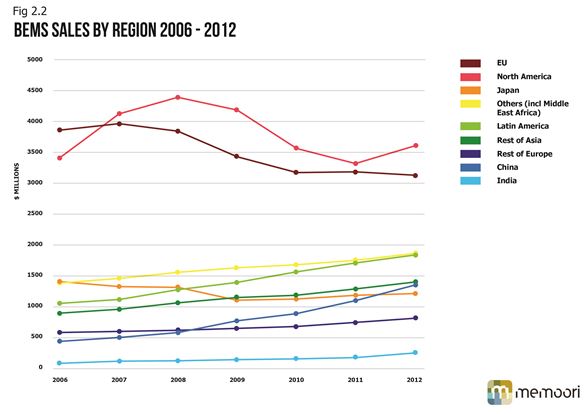
The largest market is North America with a share of 23.27% followed by
the EU at 20.25%. Demand in North America and the EU declined in 2007
and 2008 respectively as the construction of new buildings declined.
The BEMS market in North America returned to growth in 2012 and the EU is forecast to stabilize in 2013 and then return to growth in 2014. Asia will deliver the highest rates of growth. China and India are the fastest growing markets and they are expected to sustain current growth rates of around 18% to 2017. Latin America and the Middle East are forecast to grow at CAGR of 8% from 2013 to 2017.
This business is well established and dominated by 4 major
companies. However the channels of distribution have changed over
time and this has brought about better opportunities for the smaller
players as the reduction in direct sales to the end user has declined.
Open systems is putting Supervisory Software developed and maintained
by BEMS companies under pressure from outside sources and the medium
sized players struggle to keep up to date. Software is not their forte.
But the major challenge for BEMS suppliers is that their business is
morphing into the much wider Enterprise Energy Management (EEM)
business and at the same time interfacing with Smart Grid and they need
to accommodate this.
EEM Market Sizing Data & Business Development
The two major prongs of the EEM business lie in making Smart Buildings
much smarter and the Smart Grid fully ADR right across the transmission
and distribution network by providing a real time analysis of supply
and demand. These two markets alone have the potential to spend upwards
of $225 billion by 2030 with Smart Buildings looking the more
attractive and robust business because it will be funded by the private
sector and an attractive ROI can almost be guaranteed. The US market
for EEM solutions is estimated to be $6 billion in 2012, and could grow
to $15 billion by 2020.
The last decade has seen EEM develop from provided a specific energy
domain service delivering a data aggregation and consolidation service
to an enterprise scale service providing cost reduction and energy
efficiency applications in Smart Buildings. The more sophisticated
software package can deliver optimal energy solutions across all facets
of energy supply, consumption, conservation and total emissions control
in single, multi-buildings and multi-sites, across different countries.
Growth is being driven by the need to meet CO2 emissions in the low
carbon economy and large multi-national corporations are seeking
solutions to provide an enterprise view of energy use and associated
costs that can also be implemented across multiple facilities. This is
not a “one size fits all” solution as vertical markets by building type
have different needs and priorities in addition to vendor preferences.
We therefore expect that the Smart Building sub markets will be
targeted by type of vertical building. However EEM companies need to be
able take the data from the BEMS and this is where, for retrofitting
existing buildings, they will need to extract and join data from BEMS
systems that operate on different communication protocols.
Fundamental Structural Changes are Underway
[an error occurred while processing this directive]
[Home Page] [The Automator] [About] [ Subscribe ] [Contact Us]
