

Low Level Radioactive Waste Information Page
By EHSO.com, the site for free, objective, practical information about the environment, health and safety in 2026!
Low Level Radioactive Waste Information Page
Low Level Radioactive Waste

Low-level radioactive waste (LLW) is radioactively contaminated industrial or research waste such as paper, rags, plastic bags, protective clothing, cardboard, packaging material, organic fluids, and water-treatment residues. It is waste that does not fall into any of the three categories previously discussed. Its classification does not directly depend on the level of radioactivity it contains.
Low-level Radioactive Waste
Sources and Volume
LLW is generated by government facilities, utilities, industries, and institutional facilities. In addition to 35 major DOE facilities, over 20,000 commercial users of radioactive materials generate some amount of LLW. LLW generators include approximately 100 operating nuclear power reactors, associated fuel fabrication facilities, and uranium fuel conversion plants, which together are known as nuclear fuel-cycle facilities. Hospitals, medical schools, universities, radiochemical and radiopharmaceutical manufacturers and research laboratories are other users of radioactive materials which produce LLW. The clean-up of contaminated buildings and sites will generate more LLW in the future.
| Figure 7 provides a historical look at the overall volume of LLW produced through 1990. It also projects that the volume will double by 2020. Figure 8 below shows the volume of low-level radioactive waste disposed of by major sources in the United States. | Figure 7Historical and Projected AccumulatedVolumes of LLW 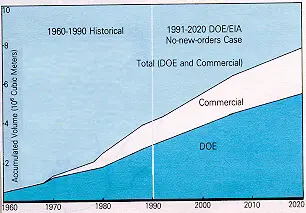 |
| Both commercial and defense-related LLW have been disposed of using shallow land disposal methods. There are currently 23 DOE and commercial LLW disposal sites in the U.S. The major sites are depicted in Figure 9. Although some LLW facilities are closed, they are continuously monitored to detect releases of radioactivity into the environment. | Figure 8Volume of LLW Disposed in 1990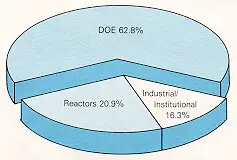 Total volume of LLW disposed in 1990: 86,900 m 3 |
Figure 9
Major LLW Disposal Sites
Disposal Management
The EPA has the authority to set generally applicable environmental standards for LLW disposal; such standards would be implemented by the NRC and the DOE. DOE is planning the clean-up of radioactively contaminated sites which will result in considerable volumes of LLW. Because of this, EPA is developing cleanup regulations as well as general environmental standards for LLW disposal. EPA plans to propose the disposal standards at the end of 1994. The standards will facilitate planning and reduce costs for clean-up and disposal.The NRC and some individual states that have regulatory agreements with NRC regulate all disposal of commercial LLW. In 1982, the NRC improved its regulatory requirements. That year, the NRC established disposal site performance objectives for land disposal of LLW technical requirements for the siting, design, operation, and closure for near-surface disposal facilities; technical requirements concerning waste packaging for land disposal; classification of waste; institutional requirements; and administrative and procedural requirements for licensing a disposal facility. Though the 1982 NRC regulations exempted existing NRC disposal site licensees, the NRC and the states are working to incorporate such requirements into those licenses.
In 1988, the DOE, which is self-regulating, issued its own orders governing the DOE disposal sites.
The general regulatory framework for the disposal of LLW has changed to account for new technology, what we have learned from past disposal practices, and current wisdom about environmental protection. As a result of increasing costs of LLW disposal at existing sites, pre-disposal waste processing (e.g., volume reduction) is a more common practice. The waste is processed by separating radioactive from nonradioactive components and by compacting bulk waste before packaging for disposal. Consequently, while the volume of waste to be disposed of is reduced, the concentration of radioactivity is greater. This waste requires more stringent safeguards for its disposal.
Site Selection for Disposal
The first of six regional, commercial LLW disposal sites was licensed in 1962. Since then, four of the commercial sites have closed, mainly because of problems with site instability. These problems included the collapse of the earth covering the waste and difficulties in managing surface- and ground-water contamination. Since then the technology and requirements governing disposal sites have been upgraded. New disposal facilities must be designed to avoid two kinds of failures: those caused by long-term processes such as subsidence and those caused by more unpredictable events such as human intrusion (either intentional or unintentional) and natural disaster.The Low-Level Radioactive Waste Policy Act of 1980 and subsequent amendments direct states to take care of their own LLW either individually or through regional groupings, referred to as compacts. The states are now in the process of selecting new LLW disposal sites to take care of their own waste. The selection process for these new sites is complex and varies because of many factors including the regulations for site selection. This selection process will be affected by EPA's new LLW standard.

Ways to save money AND help the environment:
Save water AND money
with this showerhead adapter, it lets the water flow until the water is hot, then shuts off water flow until you restart it, ShowerStart TSV Hot Water Standby Adapter
Eat healthier AND save money: Instant Pot Duo 7-in-1 Electric 8 QT Pressure Cooker, Slow Cooker, Rice Cooker, Steamer, Sauté, Yogurt Maker, Warmer, Sterilizer, Pot is Stainless Steel

Protect your health with these:
Mattress Dust mite-Bedbug protector
, 100% Waterproof, Hypoallergenic, Zippered 
Handheld Allergen Vacuum Cleaner with UV Sanitizing
for Allergies and Pet, Kills Mite, Virus, Molds, True HEPA with Powerful Suction removes Hair, Dander, Pollen, Dust ,
,
Immune Support
Supplement with Quercetin, Vitamin C, Zinc, Vitamin D3
GermGuardian Air Purifier with UV-C Light
and HEPA 13 Filter, R emoves 99.97% of Pollutants
HEPA Air Purifier
, HEPA Air Cleaner with Washable Pre-Filter, AQI Display, ECO Mode, Sleep Mode, Pet Mode for Pets, Dust, Pollen, Removes 99.97% of Particles, Smoke, Mold, Pet Dander, Dust, Odors
Interesting Reads:
THE PREPPER'S CANNING & PRESERVING BIBLE:
[13 in 1] Your Path to Food Self-Sufficiency. Canning, Dehydrating, Fermenting, Pickling & More, Plus The Food Preservation Calendar for a Sustainable Pantry 
The Backyard Homestead:
Produce all the food you need on just a quarter acre! P aperback
The Citizens' Guide to Geologic Hazards:
A Guide to Understanding Geologic Hazards Including Asbestos, Radon, Swelling Soils, Earthquakes, Volcanoes
The Uninhabitable Earth:
Life After Warming
Book: The Sixth Extinction:
An Unnatural History Paperback

