

Global Warming Information Center - Global Warming Trends and Climates Data
By EHSO.com, the site for free, objective, practical information about the environment, health and safety in 2026!
Global Warming Information Center - Global Warming Trends and Climates Data
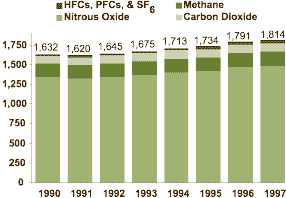
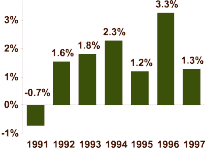
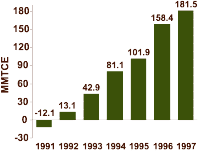
Total U.S. greenhouse gas emissions rose in 1997 to 1,813.6 million metric tons of carbon equivalents (MMTCE) 3 (11.1 percent above 1990 baseline levels). The single year increase in emissions from 1996 to 1997 was 1.3 percent (23.1 MMTCE), down from the previous year's increase of 3.3 percent. Figure ES-1 through Figure ES-3 illustrate the overall trends in total U.S. emissions by gas, annual changes, and absolute change since 1990. Table ES-1 provides a detailed summary of U.S. greenhouse gas emissions and sinks for 1990 through 1997.
Figure ES-1
U.S. GHG Emissions by Gas
Annual Percent Change
in U.S. GHG Emissions
Absolute Change in U.S.
GHG Emissions Since 1990
Emissions and Sinks (MMTCE)
| Gas - Source |
1990 |
1991 |
1992 |
1993 |
1994 |
1995 |
1996 |
1997 |
| CO 2 |
1,344.3 |
1,329.8 |
1,349.6 |
1,379.2 |
1,403.5 |
1,419.2 |
1,469.3 |
1,487.9 |
| Fossil Fuel Combustion | 1,327.2 |
1,312.6 |
1,332.4 |
1,360.6 |
1,383.9 |
1,397.8 |
1,447.7 |
1,466.0 |
| Natural Gas Flaring | 2.3 |
2.6 |
2.6 |
3.5 |
3.6 |
4.5 |
4.3 |
4.2 |
| Cement Manufacture | 8.9 |
8.7 |
8.8 |
9.3 |
9.6 |
9.9 |
9.9 |
10.2 |
| Lime Manufacture | 3.3 |
3.2 |
3.3 |
3.4 |
3.5 |
3.7 |
3.8 |
3.9 |
| Limestone and Dolomite Use | 1.4 |
1.3 |
1.2 |
1.1 |
1.5 |
1.9 |
2.0 |
2.1 |
| Soda Ash Manufacture and Consumption | 1.1 |
1.1 |
1.1 |
1.1 |
1.1 |
1.2 |
1.2 |
1.2 |
| Carbon Dioxide Manufacture | 0.2 |
0.2 |
0.2 |
0.2 |
0.2 |
0.3 |
0.3 |
0.3 |
| Land-Use Change and Forestry (Sink) a | (311.5) |
(311.5) |
(311.5) |
(208.6) |
(208.6) |
(208.6) |
(208.6) |
(208.6) |
| International Bunker Fuels b | 27.1 |
27.8 |
29.0 |
29.9 |
27.4 |
25.4 |
25.4 |
26.6 |
| CH 4 |
169.9 |
171.0 |
172.5 |
172.0 |
175.5 |
178.6 |
178.3 |
179.6 |
| Stationary Sources | 2.3 |
2.4 |
2.4 |
2.4 |
2.4 |
2.5 |
2.5 |
2.2 |
| Mobile Sources | 1.4 |
1.4 |
1.4 |
1.4 |
1.4 |
1.4 |
1.4 |
1.4 |
| Coal Mining | 24.0 |
22.8 |
22.0 |
19.2 |
19.4 |
20.3 |
18.9 |
18.8 |
| Natural Gas Systems | 32.9 |
33.3 |
33.9 |
34.1 |
33.5 |
33.2 |
33.7 |
33.5 |
| Petroleum Systems | 1.6 |
1.6 |
1.6 |
1.6 |
1.6 |
1.6 |
1.5 |
1.6 |
| Petrochemical Production | 0.3 |
0.3 |
0.3 |
0.4 |
0.4 |
0.4 |
0.4 |
0.4 |
| Silicon Carbide Production | + |
+ |
+ |
+ |
+ |
+ |
+ |
+ |
| Enteric Fermentation | 32.7 |
32.8 |
33.2 |
33.6 |
34.5 |
34.9 |
34.5 |
34.1 |
| Manure Management | 14.9 |
15.4 |
16.0 |
16.1 |
16.7 |
16.9 |
16.6 |
17.0 |
| Rice Cultivation | 2.5 |
2.5 |
2.8 |
2.5 |
3.0 |
2.8 |
2.5 |
2.7 |
| Agricultural Residue Burning | 0.2 |
0.2 |
0.2 |
0.2 |
0.2 |
0.2 |
0.2 |
0.2 |
| Landfills | 56.2 |
57.6 |
57.8 |
59.7 |
61.6 |
63.6 |
65.1 |
66.7 |
| Wastewater Treatment | 0.9 |
0.9 |
0.9 |
0.9 |
0.9 |
0.9 |
0.9 |
0.9 |
| International Bunker Fuels b | + |
+ |
+ |
+ |
+ |
+ |
+ |
+ |
| N 2 O |
95.7 |
97.6 |
100.1 |
100.4 |
108.3 |
105.4 |
108.2 |
109.0 |
| Stationary Sources | 3.8 |
3.8 |
3.9 |
3.9 |
4.0 |
4.0 |
4.1 |
4.1 |
| Mobile Sources | 13.6 |
14.2 |
15.2 |
15.9 |
16.7 |
17.0 |
17.4 |
17.5 |
| Adipic Acid | 4.7 |
4.9 |
4.6 |
4.9 |
5.2 |
5.2 |
5.4 |
3.9 |
| Nitric Acid | 3.3 |
3.3 |
3.4 |
3.5 |
3.7 |
3.7 |
3.9 |
3.8 |
| Manure Management | 2.6 |
2.8 |
2.8 |
2.9 |
2.9 |
2.9 |
3.0 |
3.0 |
| Agricultural Soil Management | 65.3 |
66.2 |
68.0 |
67.0 |
73.4 |
70.2 |
72.0 |
74.1 |
| Agricultural Residue Burning | 0.1 |
0.1 |
0.1 |
0.1 |
0.1 |
0.1 |
0.1 |
0.1 |
| Human Sewage | 2.1 |
2.1 |
2.2 |
2.2 |
2.2 |
2.3 |
2.3 |
2.3 |
| Waste Combustion | 0.1 |
0.1 |
0.1 |
0.1 |
0.1 |
0.1 |
0.1 |
0.1 |
| International Bunker Fuels b | 0.2 |
0.2 |
0.2 |
0.3 |
0.2 |
0.2 |
0.2 |
0.2 |
| HFCs, PFCs, and SF 6 |
22.2 |
21.6 |
23.0 |
23.4 |
25.9 |
30.8 |
34.7 |
37.1 |
| Substitution of Ozone Depleting Substances | 0.3 |
0.2 |
0.4 |
1.4 |
4.0 |
9.5 |
11.9 |
14.7 |
| Aluminum Production | 4.9 |
4.7 |
4.1 |
3.5 |
2.8 |
2.7 |
2.9 |
2.9 |
| HCFC-22 Production | 9.5 |
8.4 |
9.5 |
8.7 |
8.6 |
7.4 |
8.5 |
8.2 |
| Semiconductor Manufacture | 0.2 |
0.4 |
0.6 |
0.8 |
1.0 |
1.2 |
1.4 |
1.3 |
| Electrical Transmission and Distribution | 5.6 |
5.9 |
6.2 |
6.4 |
6.7 |
7.0 |
7.0 |
7.0 |
| Magnesium Production and Processing | 1.7 |
2.0 |
2.2 |
2.5 |
2.7 |
3.0 |
3.0 |
3.0 |
| Total Emissions |
1,632.1 |
1,620.0 |
1,645.2 |
1,675.0 |
1,713.2 |
1,733.9 |
1,790.5 |
1,813.6 |
| Net Emission (Sources and Sinks) |
1,320.6 |
1,308.5 |
1,333.7 |
1,466.5 |
1,504.7 |
1,525.4 |
1,582.0 |
1,605.0 |
a Sinks are only included in net emissions total. Estimates of net carbon sequestration due to land-use change and forestry activities exclude non-forest soils, and are based partially upon projections of forest carbon stocks.
b Emissions from International Bunker Fuels are not included in totals.
Note: Totals may not sum due to independent rounding.
Figure ES-4: 1997 Greenhouse Gas Emissions by Gas
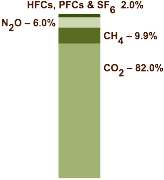 Figure ES-4 illustrates the relative contribution of the direct greenhouse gases to total U.S. emissions in 1997. The primary greenhouse gas emitted by human activities was CO 2
. The largest source of CO 2
and of overall greenhouse gas emissions in the United States was fossil fuel combustion. Methane emissions resulted primarily from decomposition of wastes in landfills, manure and enteric fermentation associated with domestic livestock, natural gas systems, and coal mining. Emissions of N 2
O were dominated by agricultural soil management and mobile source fossil fuel combustion. The substitution of ozone depleting substances and emissions of HFC-23 during the production of HCFC-22 were the primary contributors to aggregate HFC emissions. PFC emissions came mainly from primary aluminum production, while electrical transmission and distribution systems emitted the majority of SF 6
.
Figure ES-4 illustrates the relative contribution of the direct greenhouse gases to total U.S. emissions in 1997. The primary greenhouse gas emitted by human activities was CO 2
. The largest source of CO 2
and of overall greenhouse gas emissions in the United States was fossil fuel combustion. Methane emissions resulted primarily from decomposition of wastes in landfills, manure and enteric fermentation associated with domestic livestock, natural gas systems, and coal mining. Emissions of N 2
O were dominated by agricultural soil management and mobile source fossil fuel combustion. The substitution of ozone depleting substances and emissions of HFC-23 during the production of HCFC-22 were the primary contributors to aggregate HFC emissions. PFC emissions came mainly from primary aluminum production, while electrical transmission and distribution systems emitted the majority of SF 6
.
As the largest source of U.S. GHG emissions, CO 2
from fossil fuel combustion accounted for 81 percent of emissions in 1997 when each gas is weighted by its Global Warming Potential
. Emissions from this source grew by 11 percent (138.8 MMTCE) from 1990 to 1997 and were responsible for over three-quarters of the increase in national emissions during this period. The annual increase in CO 2
emissions from this source was 1.3 percent in 1997, down from the previous year when emissions increased by 3.6 percent.
The dramatic increase in fossil fuel combustion-related CO 2
emissions in 1996 was primarily a function of two factors: 1) fuel switching by electric utilities from natural gas to more carbon intensive coal as gas prices rose sharply due to weather conditions, which drove up residential consumption of natural gas for heating; and 2) higher petroleum consumption for transportation. In 1997, by comparison, electric utility natural gas consumption rose to regain much of the previous year's decline as the supply available rose due to lower residential consumption. Despite this increase in natural gas consumption by utilities and relatively stagnant U.S. electricity consumption, coal consumption rose in 1997 to offset the temporary shut-down of several nuclear power plants. Petroleum consumption for transportation activities in 1997 also grew by less than one percent, compared to over three percent the previous year (see Table ES-2). The annual increase in CO 2
emissions from petroleum in 1997 is based on motor gasoline sales data from the U.S. Energy Information Administration; it is expected to be revised upward with the publication of future energy statistics.
from Fossil Fuel Combustion for Selected Sectors and Fuels
Overall, from 1990 to 1997, total emissions of CO 2 , CH 4 , and N 2 O increased by 143.5 (11 percent), 9.7 (6 percent), and 13.4 MMTCE (14 percent), respectively. During the same period, weighted emissions of HFCs, PFCs, and SF 6 rose by 14.9 MMTCE (67 percent). Despite being emitted in smaller quantities relative to the other principle greenhouse gases, emissions of HFCs, PFCs, and SF 6 are significant because of their extremely high Global Warming Potentials and, in the cases of PFCs and SF 6 , long atmospheric lifetimes. Conversely, U.S. greenhouse gas emissions were partly offset by carbon sequestration in forests, which was estimated to be 11 percent of total emissions in 1997.
Other significant trends in emissions from additional source categories over the eight year period from 1990 through 1997 included the following:
| Aggregate HFC and PFC emissions resulting from the substitution of ozone depleting substances (e.g., CFCs) increased dramatically (by 14.4 MMTCE). This increase was partly offset, however, by reductions in PFC emissions from aluminum production (41 percent) and HFC emissions from HCFC-22 production (14 percent), both as a result of voluntary industry emission reduction efforts and, in the former case, from falling domestic aluminum production. |
| Combined N2O and CH4 emissions from mobile source fossil fuel combustion rose by 3.9 MMTCE (26 percent), primarily due to increased rates of N2O generation in highway vehicles. |
| Methane emissions from the decomposition of waste in municipal and industrial landfills rose by 10.5 MMTCE (19 percent) as the amount of organic matter in landfills steadily accumulated. |
| Emissions from coal mining dropped by 5.2 MMTCE (21 percent) as the use of methane from degasification systems increased significantly. |
| Nitrous oxide emissions from agricultural soil management increased by 8.8 MMTCE (13 percent) as fertilizer consumption and cultivation of nitrogen fixing crops rose. |
| An additional domestic adipic acid plant installed emission control systems in 1997; this was estimated to have resulted in a 1.4 MMTCE (27 percent) decline in emissions from 1996 to 1997 despite an increase in production. |
Box ES-1: Recent Trends in Various U.S. Greenhouse Gas Emissions-Related Data
Table ES-3: Recent Trends in Various U.S. Data (Index 1990 = 100)
Variable
1990
1991
1992
1993
1994
1995
1996
1997
Growth Rate (g)
GHG Emissions (a)
100
99
101
103
105
106
110
111
1.5%
100
100
101
104
106
108
112
112
1.6%
100
99
101
104
106
107
110
112
1.6%
100
102
102
105
108
111
114
115
2.0%
100
99
102
104
108
110
114
118
2.5%
100
101
102
103
104
105
106
107
1.0%
100
100
101
101
101
102
102
103
0.4%
(b) Energy content weighted values. Source: DOE/EIA
(c) Source: DOE/EIA
(d) Gross Domestic Product in chained 1992 dollars (BEA 1998)
(e) (U.S. Census Bureau 1998)
(f) Mauna Loa Observatory, Hawaii (Keeling and Whorf 1998)
(g) Average annual growth rate
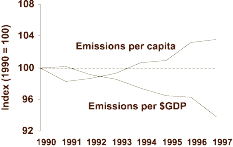
U.S. Greenhouse Gas Emissions
Per Capita and Per Dollar
of Gross Domestic Product
Box ES-2: Greenhouse Gas Emissions from Transportation Activities
One of the unintended consequences of these changes is a slowing of progress toward cleaner air in both urban and rural parts of the country. Passenger cars, trucks, motorcycles, and buses emit significant quantities of air pollutants with local, regional, and global effects. Motor vehicles are major sources of carbon monoxide (CO), carbon dioxide (CO 2 ), methane (CH 4 ), nonmethane volatile organic compounds (NMVOCs), nitrogen oxides (NOx), nitrous oxide (N 2 O), and hydrofluorocarbons (HFCs). Motor vehicles are also important contributors to many serious air pollution problems, including ground-level ozone or smog, acid rain, fine particulate matter, and global warming. Within the United States and abroad, government agencies have taken strong actions to reduce these emissions. Since the 1970s, the EPA has reduced lead in gasoline, developed strict emission standards for new passenger cars and trucks, directed states to enact comprehensive motor vehicle emission control programs, required inspection and maintenance programs, and more recently, introduced the use of reformulated gasoline to mitigate the air pollution impacts from motor vehicles. New vehicles are now equipped with advanced emissions controls, which are designed to reduce emissions of nitrogen oxides, hydrocarbons, and carbon monoxide.
This report reflects new data on the role that automotive catalytic converters play in emissions of N 2 O, a powerful greenhouse gas. The EPA's Office of Mobile Sources has conducted a series of tests in order to measure the magnitude of N2O emissions from gasoline-fueled passenger cars and light-duty trucks equipped with catalytic converters. Results show that N 2 O emissions are lower than the IPCC default factors, and the United States has shared this data with the IPCC. In this report, new emission factors developed from these measurements and from previously published literature were used to calculate emissions from mobile sources in the United States (see Annex C).
Table ES-4 summarizes greenhouse gas emissions from all transportation-related activities. Overall, transportation activities-excluding international bunker fuels-accounted for an almost constant 26 percent of total U.S. greenhouse gas emissions from 1990 to 1997. These emissions were primarily CO 2 from fuel combustion, which increased by 10 percent from 1990 to 1997. However, because of larger increases in N2O and HFC emissions during this period, overall emissions from transportation activities actually increased by 12 percent.
| Gas - Vehicle Type |
1990 |
1991 |
1992 |
1993 |
1994 |
1995 |
1996 |
1997 |
| CO 2 |
405.0 |
396.7 |
402.4 |
406.8 |
422.1 |
430.7 |
445.3 |
446.5 |
| Passenger Cars a | 169.3 |
167.8 |
172.0 |
173.5 |
172.5 |
175.6 |
160.8 |
162.6 |
| Light-Duty Trucks a | 77.5 |
77.2 |
77.2 |
80.5 |
87.2 |
89.2 |
109.9 |
111.1 |
| Other Trucks | 57.3 |
55.1 |
56.7 |
59.9 |
62.7 |
64.2 |
68.3 |
69.5 |
| Buses | 2.7 |
2.9 |
2.9 |
3.1 |
3.3 |
3.5 |
3.0 |
3.0 |
| Aircraft | 50.5 |
48.4 |
47.4 |
47.6 |
49.6 |
48.3 |
50.5 |
50.1 |
| Boats and Vessels |
16.4 |
15.9 |
16.4 |
11.7 |
13.9 |
16.8 |
18.5 |
15.4 |
| Locomotives | 7.5 |
6.9 |
7.4 |
6.8 |
8.0 |
8.1 |
8.8 |
9.0 |
| Other b | 23.8 |
22.5 |
22.4 |
23.8 |
24.9 |
24.9 |
25.5 |
25.8 |
| International Bunker Fuels c | 27.1 |
27.8 |
29.0 |
29.9 |
27.4 |
25.4 |
25.4 |
26.6 |
| CH 4 |
1.4 |
1.4 |
1.4 |
1.4 |
1.4 |
1.4 |
1.4 |
1.4 |
| Passenger Cars | 0.8 |
0.7 |
0.7 |
0.7 |
0.7 |
0.7 |
0.6 |
0.6 |
| Light-Duty Trucks | 0.4 |
0.4 |
0.4 |
0.4 |
0.4 |
0.4 |
0.5 |
0.5 |
| Other Trucks and Buses | 0.1 |
0.1 |
0.1 |
0.2 |
0.2 |
0.2 |
0.2 |
0.2 |
| Aircraft | + |
+ |
+ |
+ |
+ |
+ |
+ |
+ |
| Boats and Vessels | + |
+ |
+ |
+ |
+ |
+ |
+ |
+ |
| Locomotives | + |
+ |
+ |
+ |
+ |
+ |
+ |
+ |
| Other d | 0.1 |
0.1 |
0.1 |
0.1 |
0.1 |
0.1 |
0.1 |
0.1 |
| International Bunker Fuels c | + |
+ |
+ |
+ |
+ |
+ |
+ |
+ |
| N 2 O |
13.6 |
14.2 |
15.2 |
15.9 |
16.7 |
17.0 |
17.4 |
17.5 |
| Passenger Cars | 8.7 |
9.1 |
9.7 |
10.1 |
10.0 |
10.1 |
8.9 |
9.1 |
| Light-Duty Trucks | 3.4 |
3.7 |
3.9 |
4.2 |
5.1 |
5.2 |
6.8 |
6.8 |
| Other Trucks and buses | 0.7 |
0.7 |
0.7 |
0.7 |
0.8 |
0.8 |
0.9 |
0.9 |
| Aircraft d | 0.5 |
0.5 |
0.5 |
0.5 |
0.5 |
0.5 |
0.5 |
0.5 |
| Boats and Vessels | 0.1 |
0.1 |
0.1 |
0.1 |
0.1 |
0.1 |
0.1 |
0.1 |
| Locomotives | 0.1 |
0.1 |
0.1 |
0.1 |
0.1 |
0.1 |
0.1 |
0.1 |
| Other d | 0.2 |
0.2 |
0.2 |
0.2 |
0.2 |
0.2 |
0.2 |
0.2 |
| HFCs |
+ |
+ |
0.2 |
0.7 |
1.3 |
2.5 |
3.6 |
4.5 |
| Mobile Air Conditioners e | + |
+ |
0.2 |
0.7 |
1.3 |
2.5 |
3.6 |
4.5 |
| Total |
420.0 |
412.3 |
419.1 |
424.8 |
441.5 |
451.6 |
467.7 |
469.9 |
Note: Totals may not sum due to independent rounding.
a In 1996, the U.S. Federal Highway Administration modified the definition of light-duty trucks to include minivans and sport utility vehicles. Previously, these vehicles were included under the passenger cars category. Hence the sharp drop in CO2 emissions for passenger cars from 1995 to 1996 was observed. This gap, however, was offset by an equivalent rise in CO 2 emissions from light-duty trucks.
b OtherCO 2 emissions include motorcycles, construction equipment, agricultural machinery, pipelines, and lubricants.
c Emissions from International Bunker Fuels are not included in totals.
d OtherCH 4 and N 2 O emissions include motorcycles, construction equipment, agricultural machinery, gasoline-powered recreational, industrial, lawn and garden, light commercial, logging, airport service, other equipment; and diesel-powered recreational, industrial, lawn and garden, light construction, airport service.
e Includes primarily HFC-134a
| Gas - Fuel Type or Source |
1990 |
1991 |
1992 |
1993 |
1994 |
1995 |
1996 |
1997 |
| CO 2 |
476.8 |
473.4 |
472.5 |
490.7 |
494.8 |
494.1 |
513.2 |
532.3 |
| Coal | 409.0 |
407.2 |
411.8 |
428.7 |
430.2 |
433.0 |
457.5 |
470.9 |
| Natural Gas | 41.2 |
41.1 |
40.7 |
39.5 |
44.0 |
47.2 |
40.3 |
43.8 |
| Petroleum | 26.6 |
25.1 |
19.9 |
22.5 |
20.6 |
14.0 |
15.4 |
17.6 |
| Geothermal | 0.1 |
0.1 |
0.1 |
0.1 |
+ |
+ |
+ |
+ |
| CH 4 |
0.1 |
0.1 |
0.1 |
0.1 |
0.1 |
0.1 |
0.1 |
0.1 |
| Stationary Sources (Utilities) | 0.1 |
0.1 |
0.1 |
0.1 |
0.1 |
0.1 |
0.1 |
0.1 |
| N 2 O |
2.0 |
2.0 |
2.0 |
2.1 |
2.1 |
2.1 |
2.2 |
2.3 |
| Stationary Sources (Utilities) | 2.0 |
2.0 |
2.0 |
2.1 |
2.1 |
2.1 |
2.2 |
2.3 |
| SF 6 |
5.6 |
5.9 |
6.2 |
6.4 |
6.7 |
7.0 |
7.0 |
7.0 |
| Electrical Transmission and Distribution | 5.6 |
5.9 |
6.2 |
6.4 |
6.7 |
7.0 |
7.0 |
7.0 |
| Total |
484.6 |
481.4 |
480.8 |
499.3 |
503.7 |
503.3 |
522.5 |
541.7 |
Note: Totals may not sum due to independent rounding.
The following sections describe the concept of Global Warming Potentials (GWPs), present the anthropogenic sources and sinks of greenhouse gas emissions in the United States, briefly discuss emission pathways, summarize the emission estimates, and explain the relative importance of emissions from each source category.
3. Estimates are presented in units of millions of metric tons of carbon equivalents (MMTCE), which weights each gas by its GWP value, or Global Warming Potential .
Ways to save money AND help the environment:
Save water AND money
with this showerhead adapter, it lets the water flow until the water is hot, then shuts off water flow until you restart it, ShowerStart TSV Hot Water Standby Adapter
Eat healthier AND save money: Instant Pot Duo 7-in-1 Electric 8 QT Pressure Cooker, Slow Cooker, Rice Cooker, Steamer, Sauté, Yogurt Maker, Warmer, Sterilizer, Pot is Stainless Steel

Protect your health with these:
Mattress Dust mite-Bedbug protector
, 100% Waterproof, Hypoallergenic, Zippered 
Handheld Allergen Vacuum Cleaner with UV Sanitizing
for Allergies and Pet, Kills Mite, Virus, Molds, True HEPA with Powerful Suction removes Hair, Dander, Pollen, Dust ,
,
Immune Support
Supplement with Quercetin, Vitamin C, Zinc, Vitamin D3
GermGuardian Air Purifier with UV-C Light
and HEPA 13 Filter, R emoves 99.97% of Pollutants
HEPA Air Purifier
, HEPA Air Cleaner with Washable Pre-Filter, AQI Display, ECO Mode, Sleep Mode, Pet Mode for Pets, Dust, Pollen, Removes 99.97% of Particles, Smoke, Mold, Pet Dander, Dust, Odors
Interesting Reads:
THE PREPPER'S CANNING & PRESERVING BIBLE:
[13 in 1] Your Path to Food Self-Sufficiency. Canning, Dehydrating, Fermenting, Pickling & More, Plus The Food Preservation Calendar for a Sustainable Pantry 
The Backyard Homestead:
Produce all the food you need on just a quarter acre! P aperback
The Citizens' Guide to Geologic Hazards:
A Guide to Understanding Geologic Hazards Including Asbestos, Radon, Swelling Soils, Earthquakes, Volcanoes
The Uninhabitable Earth:
Life After Warming
Book: The Sixth Extinction:
An Unnatural History Paperback

