

Pollution Prevention Guidance Page - Links, Free Downloads and Interactive Guides to Reducing Toxicity & Waste
By EHSO.com, the site for free, objective, practical information about the environment, health and safety in 2026!
Pollution Prevention Guidance Page - Links, Free Downloads and Interactive Guides to Reducing Toxicity & Waste
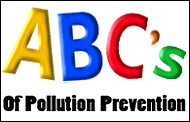
Pollution Prevention (P2) is a strategy of material use, processing, and management that reduces or eliminates the creation of pollutants and waste at the source--prior to recycling, treatment or disposal. P2 is also referred to as source reduction. Toxics Use Reduction (TUR) is similar in concept to P2, but more highly focused on toxic chemicals.
P2 and TUR can be achieved through chemical substitution, process redesign, product reformulation, improved operations and maintenance, and/or in-process recycling. Facility planning is a systematic approach to P2 implementation that consists of quantifying chemical use and waste generation, P2 options identification and evaluation, goal setting, and progress assessment.
Downloads & Links:
Household
Pollution prevention tools for
homeowners and renters
General:
Federal guide to resources and recycling companies.
Solvents:
Hazardous Solvent Substitution Data System (HSSDS)
was created to help end users find alternatives to using
hazardous chemicals for cleaning purposes. The system
contains vendor supplied information about each product,
as well as Material Safety Data Sheets that relate to each
product. All product information and MSDS's are in Adobe
Portable Document Format (PDF).
The Solvent Handbook Database System (SHDS)
was developed as an efficient, easily accessible,
electronic solvent utilization handbook. A solvent
evaluation methodology
was developed for the SHDS
program and is outlined below:
- Identify solvents (alternatives) that are not currently restricted
by government regulations for use at DOE-DP facilities,
DOD facilities, and private industry, evaluate their cleaning
performance, - evaluate their corrosivity,
- evaluate their air emissions,
- evaluate the possibility of recycling or recovering
all or portions of the alternative degreasers, - test substitute solvents compatibility with non-metallic materials,
- input all of the data gathered (including previous biodegradability information) into a database, and
- develop a mechanism for efficient, widespread access to the database information system.
Finally, if you don't see it here, click on the P2Gems link
for a searchable database of additional web pages.
General Tips:
A void chlorinated organic solvents, cyanide compounds, and petroleum-based compounds when water-based substitutes exist.
B uy drainboards and drip pans to enhance drip reuse in process baths.
C hoose closed-loop (i.e., fully enclosed) recycling designs to reduce wastes and worker exposures.
D ecrease the frequency of painting and paint removal to minimal levels.
E nsure a neat work environment to prevent spills of toxic chemicals.
F oster a regular program of pollution prevention planning and auditing.
G ive employees incentives to find new pollution prevention ideas.
H ave and use covers for all containers holding fluids that evaporate.
I nstruct employees in pollution prevention.
J ust use storage tanks with secondary containment (i.e., double-walled tanks and a barrier around loading/unloading areas).
K eep track of toxic chemical inventories to ensure fewer containers on-site, thus minimizing spills, spoilage, and evaporation.
L abel containers to prevent mistakes that could result in wastes requiring disposal.
M onitor and maintain the appropriate temperature for heated materials.
N ever allow leaks to persist.
O nly use sprays when absolutely necessary, since they waste chemicals through dispersion (e.g., paint overspray).
P reclean parts with physical methods (e.g., squeegees, rags) before using solvents.
Q uit disposing of baths without checking bath quality, and restore quality through the use of non-toxic additives.
R eformulate or redesign products so fewer toxic chemicals are used in production processes.
S elect continuous rather than batch processes whenever possible, to avoid start-up wastes.
T ry redesigning processes so they require fewer toxic chemicals.
U se machines instead of manual methods where toxicity concerns exist and process precision would reduce wastes significantly (e.g., paint spraying).
V arnish and other coatings that are not essential should be avoided.
W ash parts only when absolutely necessary.
X erox double-sided as often as possible.
Y ield maximization is one goal, and...
Z ero waste is the other.
By Lois Epstein, P.E.,
Environmental Defense Fund (Washington, D.C.)
May 1997, Version 1.4
Feel free to reproduce and postBrought to you by EHSO!
Ways to save money AND help the environment:
Save water AND money
with this showerhead adapter, it lets the water flow until the water is hot, then shuts off water flow until you restart it, ShowerStart TSV Hot Water Standby Adapter
Eat healthier AND save money: Instant Pot Duo 7-in-1 Electric 8 QT Pressure Cooker, Slow Cooker, Rice Cooker, Steamer, Sauté, Yogurt Maker, Warmer, Sterilizer, Pot is Stainless Steel

Protect your health with these:
Mattress Dust mite-Bedbug protector
, 100% Waterproof, Hypoallergenic, Zippered 
Handheld Allergen Vacuum Cleaner with UV Sanitizing
for Allergies and Pet, Kills Mite, Virus, Molds, True HEPA with Powerful Suction removes Hair, Dander, Pollen, Dust ,
,
Immune Support
Supplement with Quercetin, Vitamin C, Zinc, Vitamin D3
GermGuardian Air Purifier with UV-C Light
and HEPA 13 Filter, R emoves 99.97% of Pollutants
HEPA Air Purifier
, HEPA Air Cleaner with Washable Pre-Filter, AQI Display, ECO Mode, Sleep Mode, Pet Mode for Pets, Dust, Pollen, Removes 99.97% of Particles, Smoke, Mold, Pet Dander, Dust, Odors
Interesting Reads:
THE PREPPER'S CANNING & PRESERVING BIBLE:
[13 in 1] Your Path to Food Self-Sufficiency. Canning, Dehydrating, Fermenting, Pickling & More, Plus The Food Preservation Calendar for a Sustainable Pantry 
The Backyard Homestead:
Produce all the food you need on just a quarter acre! P aperback
The Citizens' Guide to Geologic Hazards:
A Guide to Understanding Geologic Hazards Including Asbestos, Radon, Swelling Soils, Earthquakes, Volcanoes
The Uninhabitable Earth:
Life After Warming
Book: The Sixth Extinction:
An Unnatural History Paperback

