
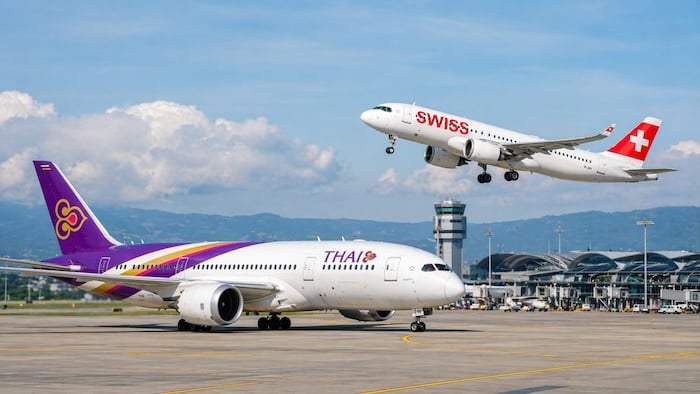
As global aviation faces rising costs, geopolitical instability, and unpredictable demand, airlines are adopting sharply different strategies. While some carriers are expanding long-haul routes to capture growth opportunities, others are cutting capacity and restructuring networks to protect profitability. The result is a fragmented but highly adaptive industry landscape.
Air France Pushes Strategic Expansion
Air France is pressing ahead with selective growth, particularly on long-haul routes where demand remains resilient.
In its summer 2026 schedule, the airline is adding three weekly flights between Paris Charles de Gaulle and Dakar from June 30 to August 31.
Asia is another focus. Tokyo Haneda gains an additional weekly frequency between September 5 and October 24, while Shanghai will see three extra weekly flights between September 11 and October 14.
For winter 2026/2027, Air France is significantly expanding service to India. Mumbai and Delhi will each see up to ten weekly flights, supported by additional departures designed to increase flexibility and connectivity through Paris.
KLM Enhances Capacity and Passenger Experience
Partner airline KLM is also expanding, though with a focus on both frequency and onboard product.
In summer 2026, KLM will increase flights between Amsterdam and Bangkok, adding additional services on Tuesdays, Thursdays, and Sundays. During the winter season, the airline will upgrade aircraft on Caribbean routes, introducing Boeing 777-200 and 787-10 jets. These upgrades bring enhanced comfort, including lie-flat seats in business class and expanded premium economy cabins.
Lufthansa Cuts Capacity Amid Rising Costs
In contrast, Lufthansa Group is scaling back operations significantly. The group has announced the cancellation of up to 20,000 short-haul flights across Europe by October, driven largely by surging jet fuel prices linked to ongoing instability in the Middle East.
The cuts are concentrated on underperforming routes, particularly from Frankfurt and Munich, with around 120 daily flights already removed from schedules since April. Regional connections, including services to Poland and Norway, are among the most affected.
To maintain network connectivity, Lufthansa is reinforcing its hub strategy, consolidating traffic through major gateways such as Zurich, Vienna, Brussels, Rome, Frankfurt, and Munich. Additional measures include the closure of its regional subsidiary CityLine and the cancellation of selected long-haul leisure routes.
The approach reflects a clear shift: fewer flights, fuller aircraft, and tighter operational control to offset cost pressures.
Thai Airways Focuses on Optimization Over Cuts

Meanwhile, Thai Airways is pursuing a different path—growth through efficiency rather than reduction.
The airline is targeting an average load factor of around 82% by 2025, focusing on optimizing schedules and aligning aircraft types with route demand. Newer, fuel-efficient aircraft such as the Boeing 787-9 and Airbus A321neo are helping reduce costs while supporting sustainability goals.
Rather than cutting routes, Thai Airways is refining its network. High-demand corridors are prioritized, and routes such as Samui–Kuala Lumpur have been reintroduced to capture regional traffic flows. Aircraft utilization is also increasing, with planes deployed more intensively on profitable routes.
Cargo operations are being optimized as well, contributing as a secondary revenue stream. Early results show improving financial performance and rising load factors, with some routes achieving 80–90% occupancy.
A Divided Industry Strategy
The divergence between airlines highlights a broader global trend:
- Emirates continues rebuilding long-haul capacity through its global hub, trusting a cease-fire will prevail .
- Delta Air Lines is expanding transatlantic services with seasonal flexibility
- Singapore Airlines focuses on premium long-haul growth
- Qatar Airways is increasing frequencies on key intercontinental routes in the hope that the situation in Iran will improve.
At the same time, European carriers like Lufthansa are consolidating, reflecting mature markets and intense cost pressures. Lufthansa canceled 20,000 flights in short-haul flights that can be replaced by rail connections
The New Reality of Air Travel
The contrast between expansion and contraction underscores a key reality: there is no single strategy for success in today’s aviation market.
In Europe, rising fuel costs are forcing consolidation, reduced frequencies, and a stronger reliance on hub networks. In Asia, where demand growth remains stronger, airlines are optimizing operations to sustain expansion without overextending capacity.
For travelers, this means a mixed experience—fewer direct flights and tighter schedules in some regions, but improved connectivity and more efficient services in others.
What is clear is that jet fuel remains the dominant cost factor shaping airline decisions. Whether through expansion, reduction, or optimization, carriers are being forced to rethink how they deploy aircraft and design networks.
In this environment, success is no longer defined by how much airlines grow—but by how intelligently they adapt.







Leave a Comment