
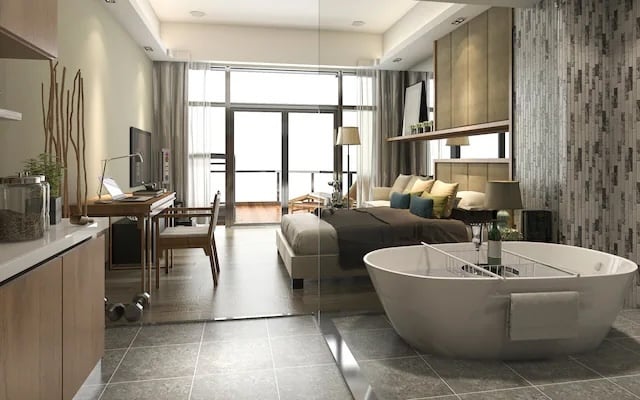
A few years ago, I checked into the brand-new Hyatt Centric South Beach Miami, a property the company proudly promoted as part of Hyatt Centric , its then-new lifestyle-focused brand aimed at modern, design-forward travelers.
The room immediately made a statement — but not necessarily a welcome one.
Instead of a traditional, fully sealing bathroom door, the room featured a sliding barn-style door. It looked stylish, but functionally it fell short. The door did not close completely, leaving visible gaps along the edges that limited privacy. In addition, frosted glass elements allowed light — and silhouettes — to spill into the main room. While visually trendy, the setup made even routine bathroom use feel awkward, particularly for anyone sharing the room.
At the time, I assumed this was an isolated design experiment — an overenthusiastic attempt to merge residential aesthetics with hotel rooms. But after doing research, it became clear this was not an exception. It was the beginning of a broader hospitality trend.
Across the global hotel industry, more properties — including upscale and luxury brands — have quietly eliminated traditional bathroom doors altogether or replaced them with partial barriers, glass panels, curtains, or sliding doors that do not fully close. What is marketed as modern , open , or space-efficient design is increasingly being experienced by guests as a loss of one of the most basic expectations in a hotel room: privacy.
As traveler complaints mount and entire websites now exist to track hotels without proper bathroom doors, the question facing the industry is no longer whether guests notice — but whether hotels have underestimated how much privacy actually matters.
Why more hotels are removing bathroom doors — and why travelers are pushing back
In hotel rooms around the world, a once-non-negotiable feature is quietly disappearing: the bathroom door. From New York to Tokyo, from boutique lifestyle hotels to global chains, travelers are increasingly discovering open-plan bathrooms, frosted glass partitions, sliding barn doors with gaps — or, in some cases, no barrier at all between the toilet and the bed.
What hoteliers call modern design and space efficiency , many guests describe with one word: awkward.
The Rise of the Doorless Bathroom
The trend toward removing traditional bathroom doors has gained momentum over the past decade, particularly in newly built or renovated hotels. According to hospitality designers interviewed by InsideHook and other travel media, the reasons are straightforward:
Why hotels are doing it
- Cost savings:Doors, frames, hinges, locks, and soundproofing add expense. Eliminating them lowers construction and maintenance costs.
- Space optimization:Swing doors take up room. Open layouts make small hotel rooms feel larger, especially in dense urban markets.
- Design aesthetics:Open bathrooms allow natural light, create a “spa-like” feel, and align with minimalist and industrial design trends.
- Operational efficiency:Fewer moving parts mean fewer repairs and replacements.
For hotel developers, the concept checks many boxes. For guests, however, the experience often does not.
What Guests Are Saying
Guest feedback across review platforms, Reddit forums, and social media paints a very different picture. Complaints commonly include:
- Lack of privacywhen traveling with partners, friends, family, or colleagues
- Sound and smell issues, especially with toilets separated only by glass or curtains
- Surprise at check-in, when booking photos fail to clearly show the bathroom layout
- Embarrassment, leading some guests to use lobby restrooms instead of their own room
One frequent traveler told eTurboNews, “I don’t need luxury — I need a door that closes.”
The backlash has grown strong enough to inspire a grassroots response. The website BringBackDoors.comnow catalogs hotels worldwide based on bathroom privacy levels, using guest submissions to warn future travelers.
Hotels Around the World Reported to Have No Traditional Bathroom Door

Below are examples of hotels that have been reported by gueststo feature rooms with no solid bathroom door or extremely limited privacy. Layouts may vary by room type.
🌍 Europe
- 25hours Hotel Florence Piazza San Paolino– Open bathroom concept in multiple room categories
- AC Hotel Atocha– Partial walls or open bathroom layouts
- AC Hotel Strasbourg– Doorless or glass-separated bathrooms
- Brown’s Central Hotel– Mixed layouts; some rooms lack solid doors
🇺🇸 North America
- 1 Hotel Brooklyn Bridge– Open bathroom design in select rooms
- 1 Hotel Central Park– Minimal bathroom separation
- 1 Hotel Nashville– Reported doorless bathroom layouts
- AC Hotel Denver Downtown– Open or glass bathroom concepts
🌏 Other Regions
- AC Hotel Tokyo Ginza– Glass or open bathroom designs
- Aloft Playa del Carmen– Minimal privacy bathroom layouts
- Alaia Belize, Autograph Collection– Open-plan bathroom concepts
A Growing Trust Issue in Hospitality
For many travelers, the issue isn’t modern design — it’s transparency.
Guests argue that hotels should clearly disclose bathroom layouts during booking, especially when privacy is significantly reduced. As one industry observer noted, “You wouldn’t hide the fact that a room has no window — why hide the fact that it has no bathroom door?”
As hotels compete for loyalty in an increasingly experience-driven market, ignoring guest discomfort may prove costly. Bathroom privacy, it turns out, is not a detail travelers are willing to sacrifice quietly.
What Travelers Can Do
Until the industry responds, seasoned travelers recommend:
- Carefully reviewing guest photos, not just official images
- Reading recent reviews for keywords like glass , open , or no door
- Calling the hotel directly to confirm bathroom privacy
- Consulting community databases such as BringBackDoors.com
The Bottom Line
The removal of bathroom doors may save space and money for hotels, but it risks alienating guests who expect privacy as a basic standard — not an optional upgrade. As backlash grows louder, the hospitality industry may soon face a simple question from travelers worldwide:
Is modern design worth losing the door?




Leave a Comment