
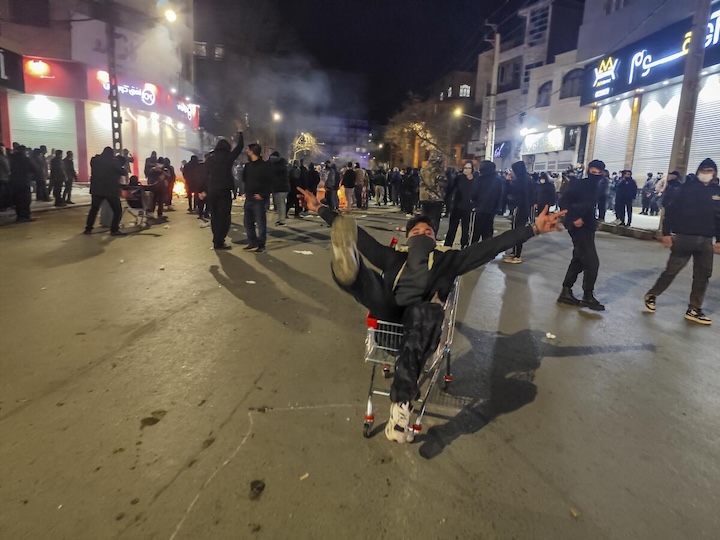
eTurboNews remains connected to on-the-ground reporting from Iran, where witnesses say the situation is rapidly deteriorating. Residents and activists describe snipers firing at anyone visible outdoors, families being forced to pay to retrieve the bodies of loved ones, and civilians being compelled into armed roles against their own neighbors.
Unofficial numbers now say more than 20,000 people have been killed so far.
At the center of many allegations is the Basij, a force the government portrays as volunteer-based but which activists say is increasingly sustained through coercion.
A Country in Revolt, a Nation Cut Off
As night fell across Iran, protests reportedly reignited in multiple cities, defying official claims that order had been restored. With internet access largely severed, journalists barred, and independent observers unable to enter, the scale of unrest has been reconstructed from smuggled videos, witness testimony, and encrypted communications with activists inside the country.
What emerges is a portrait of a nation in open defiance—and of a state accused by rights groups and witnesses of responding with extraordinary violence against unarmed civilians.
Chants That Signal a Break with the System
Field reports describe crowds chanting slogans rarely heard so openly in Iran’s modern history. Videos reviewed by this newsroom—recorded in darkness to avoid detection—capture chants calling for the removal of Supreme Leader Ali Khamenei, alongside monarchist slogans invoking the return of the Shah.
Analysts say these chants reflect more than anger at specific policies.
“This is not reformist language,” said one regional political analyst. “It signals rejection of the system itself—and a collapse of fear.”
Authorities have dismissed the protests as isolated incidents, pointing instead to pro-government rallies. Activists counter that many images broadcast by state media rely on edited or archival footage—claims that could not be independently verified due to the communications blackout.
Gunfire in the West, Reports of Snipers
The city of Dezful is completely under the control of popular militias.
Armed mercenaries wearing masks, speaking Arabic and not understanding Persian, are present. The city is under military rule and terror.
Snipers are stationed on tall buildings and over the past two days have been shooting directly at the heads of anyone passing in the streets, killing them.
They show no mercy — neither to children, nor to the elderly, nor to the young.
Anyone who leaves their home is either shot with a sniper bullet to the head or killed on the street by hired mercenaries.
There is a strong possibility that the same situation exists in other cities of Khuzestan province as well. They are being slaughtered in complete darkness and total media silence.
Be the voice of the people of Dezful and the silent cities.
More witnesses report targeted shootings, often fatal headshots. Videos circulated among activist networks appear to show bodies lying in streets as gunfire echoes nearby. While this newsroom has not independently verified the footage, multiple sources provided consistent descriptions.
“No one leaves their home,” one resident said via an encrypted message shortly before communications were cut. “Children, elderly—there is no distinction.”
An unknown father said:
Those who claim to be concerned about internal security and foreign occupation — where are you now? You yourselves are the occupying executioners of Iran. Shame on you.
Who Is Doing the Shooting? Competing Narratives
Iranian authorities claim that civilians—and even some security personnel—have been killed by “foreign mercenaries,” a charge repeated in briefings to diplomats. Activists and analysts dispute this narrative, pointing to videos that appear to show uniformed forces firing live ammunition and to spent cartridges they allege match state-issued weapons. Such evidence has not been independently examined.
Forced Basij Mobilization and the Weaponization of Civilians
New testimony from activists suggests that the role of the Basij goes far beyond voluntary participation.
Mahtab, an Iranian activist speaking from outside the country, says that in many cases, Basij identification cards are issued under direct coercion.
According to her account, individuals are pressured into participation to:
- Protect their own lives
- Keep their jobs
- Avoid arrest or harassment of family members
- Or even secure permission to retrieve the bodies of killed relatives
“This means the state is deliberately forcing civilians to take up arms against other civilians,” Mahtab said. “This is a classic tactic used by authoritarian regimes.”
A Regime Under Strain—and a Society Turned Against Itself
Mahtab and other analysts describe two objectives behind this forced mobilization.
First, they point to a serious shortage of repression forces. Signs of fatigue, refusals to obey orders, defections, and internal collapse have been reported within security ranks. As a result, the authorities increasingly rely on coerced civilians, forced Basij recruits, non-local units, and—according to activists—foreign fighters brought in to suppress unrest.
Second, they describe a deliberate strategy of psychological warfare.
When protesters are killed by individuals labeled as “ordinary citizens” or “Basij members,” responsibility is blurred. Public anger is redirected away from the state itself, while fear, mistrust, and division spread within communities.
“This turns society inward against itself,” Mahtab said. “It destroys solidarity and replaces it with suspicion.”
Iran’s top Sunni cleric condemns
Iran’s top Sunni cleric, Mowlavi Abdolhamid, on Tuesday condemned the violent killing of protesters in cities across the country, warning that those who gave such orders would be held accountable.
“The massacre of thousands of protesters in Tehran and other cities of our country over a few days was a horrific and unprecedented catastrophe. This bitter event has plunged the Iranian nation into grief and rage, and has deeply wounded the conscience of free people around the world,” he posted on X.
“Undoubtedly, those who ordered and carried out this crime will be held accountable in this world, and in the hereafter they will also deserve divine punishment,” Abdolhamid added.
U.S. Rhetoric: “Help Is on Its Way”
In a significant escalation of international engagement, U.S. President Donald Trump publicly urged Iranians to continue protesting and said that “help is on its way,”signaling support for the demonstrators and strongly criticizing Tehran’s violence against civilians.
Posting on social media, Trump wrote: “ Iranian Patriots, KEEP PROTESTING — TAKE OVER YOUR INSTITUTIONS!!!… HELP IS ON ITS WAY,”
At the same time, the U.S. told its citizens to leave Iran immediately.
Ur urging protesters to document abuses and warning that the U.S. would hold perpetrators accountable. Trump cancelled all meetings with Iranian officialsand warned that Washington was considering a range of options, including potential punitive actions if the crackdown continued
The firm U.S. language reflects growing frustration in Washington and appears aimed at bolstering international pressure on the Iranian regime.
Russia’s Warning and the Risk of Escalation
In contrast, **Russian President Vladimir Putinand other Kremlin officials have issued stark warnings to Washington. Moscow condemned what it called “subversive external interference” in Iran’s internal affairs and warned that any attempt to use the unrest as a pretext for military action would have “disastrous consequences”for regional and global security.
The Russian Foreign Ministry described U.S. threats of military intervention as “categorically unacceptable,”reflecting Moscow’s fierce opposition to foreign involvement and its strategic partnership with Tehran.
Russia’s warning underscores the broader geopolitical stakes surrounding the crisis and raises fears that international tensions could intensify alongside internal unrest.
Reframing Responsibility
Activists stress a moral distinction often erased in official narratives:
- The forced Basij member does not act by free choice.
- The unarmed protester is not an enemy.
- The true perpetrator is the system itself.
In Mahtab’s words:
“This is a system that converts citizens including children soldiers,into victims or into instruments of violence.”
Human-rights advocates warn that such tactics—if confirmed—could constitute grave violations of international law.
A Death Toll Impossible to Verify
Unofficial estimates circulating among activist networks place the number of those killed in recent weeks at around 12,000, though no independent body has confirmed the figure.
What can be confirmed is the steady flow of images showing women, children, and young men among the dead and injured. In one widely shared clip, an armed man appears to mock fallen civilians. The authenticity of the video has not been independently verified, but multiple versions have circulated from different sources.
This reporter was shot dead while filming this:
A Nation Silenced
Internet access across Iran remains severely restricted. Messaging apps, social platforms, and most international websites are inaccessible to ordinary users. Activists say the blackout is designed to prevent coordination and suppress evidence.
Against this backdrop, authorities announced the resumption of Iran–Qatar flights, presenting it as a sign of stability. Critics argue the announcement is performative: without internet access or functioning payment systems, most Iranians cannot book flights or even verify schedules.
Why the World Is Being Urged to Act
For protesters, the blackout is as dangerous as the bullets.
“Silence is the weapon,” one activist said before losing contact. “If no one sees us, no one helps us.”
Journalists, diplomats, and human-rights organizations are now being urged to demand restored internet access, independent investigations, and accountability for violence against civilians.
Whether the world responds—or looks away—may determine how this chapter in Iran’s history is written.
Editor’s Note
eTurboNews (eTN) traditionally covers travel, tourism, and human rights. This story originated from discussions within the World Tourism NetworkIran discussion group and continued with the help of a brave Iranian travel journalist on the ground, who communicated via satellite to collect first-hand footage and eyewitness information, shared directly with eTurboNews.
While this reporting has moved far beyond conventional tourism coverage, eTN believes there is a clear and unavoidable connection. Tourism does not exist in isolation from human rights, safety, freedom of movement, or the lived realities of people in destination countries. Ignoring credible reports from Iranian patriots risking their lives to document events for the international community would be irresponsible.
For this reason, eTurboNews has chosen to publish this investigation and is waiving all copyrights, explicitly encouraging other media outlets, human-rights organizations, and policymakers to republish or reference this information as neededin the public interest.




Leave a Comment