

Gyeongju Summit Marks Historic Leadership Shift for Asia-Pacific Tourism Association
Veteran Korean tourism executive Henry Oh has been elected Chairman of the Pacific Asia Travel Association (PATA) for the 2026–2028 term following an intense and politically charged contest that exposed deep divisions within one of the Asia-Pacific region’s most influential tourism organizations.
Oh, President of Global Tours Korea, secured victory over fellow candidate Mayur “Mac” Patel, Regional Commercial and Industry Affairs Leader at OAG Group, in a closely contested election held during the PATA Board meeting in Gyeongju on May 11, 2026. While officials declined to release the exact vote count, the final margin was disclosed as approximately 60–40 percent.
The outcome represents a landmark moment for South Korea’s tourism industry, as Oh becomes the first Korean national to chair PATA since the organization’s founding in 1951.
The election, however, was far from straightforward.
A Contest Shaped by Strategic Alliances
What initially appeared to be a two-man race between Oh and Nepalese tourism leader Suman Pandey evolved dramatically in the weeks leading up to the vote.
Pandey, Group Chairman of Explore Himalaya Travel & Adventure and a respected Executive Board member, had originally entered the contest as a serious challenger. But the sudden entry of Patel into the race altered the political dynamics inside the association.
Several influential board members reportedly viewed Patel’s candidacy as a strategic attempt to split support between Oh and Pandey, potentially enabling Patel to emerge victorious with a plurality.
Concerned about the implications of a divided vote, senior PATA figures persuaded Pandey to withdraw from the race in what many insiders described as a calculated move designed to consolidate support behind Oh.
Pandey later confirmed the rationale behind his withdrawal.
“I did that for the benefit of PATA. We all knew what they were trying to do,” Pandey said.
The maneuver effectively transformed the contest into a direct showdown between Oh and Patel.
National Pride and Regional Politics
The stakes surrounding the election extended well beyond the internal governance of PATA.
For South Korea, hosting the 2026 PATA Annual Summit in Gyeongju and Pohang represented a major opportunity to showcase the country’s growing influence in global tourism. A defeat for Oh on home soil would have been viewed by many within the Korean travel sector as a symbolic setback.
The contest also highlighted regional alignments and lobbying efforts within the organization.
Patel reportedly received strong backing from elements of the Thai tourism community, including former PATA Thailand Chapter Chair Ben Montgomery, who now serves as PATA Vice Chairman. According to multiple board sources, lobbying efforts intensified in the days leading up to the election as both camps sought to secure undecided votes.
Both candidates circulated letters to board members outlining their visions for the organization.
Henry Oh: A Legacy Rooted in PATA History
Oh’s campaign emphasized continuity, heritage, and a desire to restore PATA’s prestige.
In his message to board members, Oh highlighted his deep personal and professional ties to the organization.
Global Tours Korea, the company he leads, has maintained PATA membership since 1962. The relationship began under the leadership of his father, Henry Oh Sr., who became a highly respected figure within the association and was awarded PATA Life Membership in 1986.
Oh described growing up around PATA events and credited the association with helping shape his global outlook and industry connections.
“For many ways, PATA has been part of my life,” he wrote, underscoring both his personal attachment to the organization and his understanding of its historical importance.
He also pointed to his role in helping secure South Korea’s hosting rights for the 2026 PATA Annual Summit while serving on the Executive Board.
Campaigning on a platform of unity and renewal, Oh promised to strengthen collaboration among members across different cultures and regions while rebuilding PATA’s standing within the global tourism industry.
“Given the opportunity to serve, my mantra is to unite PATA members as a strong community across diverse cultures and regions and strengthen the voice of our industry,” he wrote.
This is an adaptation by eTN of a story published by Travel Impact
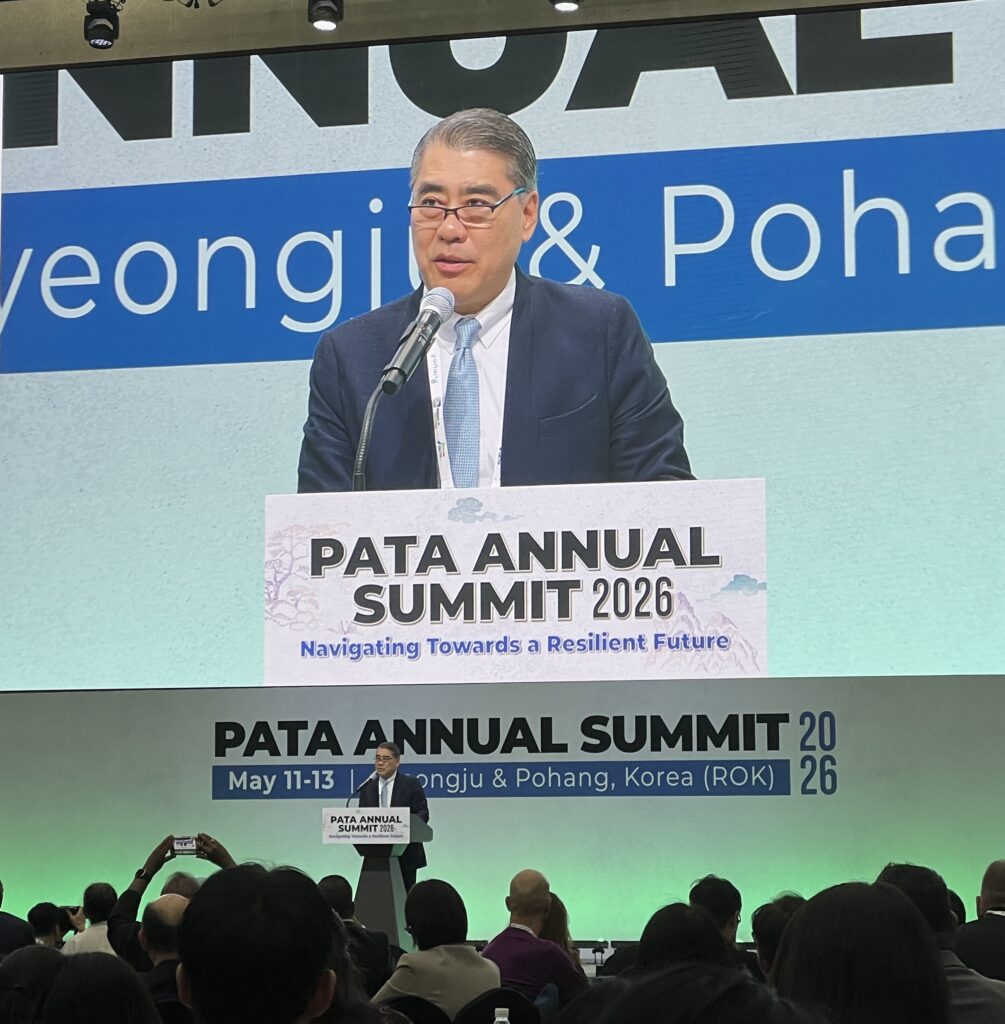
A Mandate to Revive PATA
Speaking at a press conference following his election victory, Oh acknowledged openly that PATA’s influence and reputation had diminished compared with its earlier decades.
“There is no doubt that PATA’s standards and prestige have declined since the days of my father,” he said.
He pledged to reconnect with the association’s global chapter network and personally visit members throughout the Asia-Pacific region in an effort to rebuild trust and engagement.
“I don’t know how, but I will do my best,” he told reporters.
Oh also stressed that his ownership of a private company gives him the financial independence and scheduling flexibility necessary to devote significant time to the association.
His election speech focused heavily on revitalization, inclusion, and rebuilding organizational morale.
Korea’s Tourism Ambitions on the Global Stage
Beyond internal PATA reforms, Oh used the occasion to outline broader ambitions for South Korea’s tourism sector.
He noted that while South Korea generates approximately 30 million outbound travelers annually, the country still faces challenges in balancing inbound tourism growth.
“Korean tourism must go global,” he said.
Oh argued that South Korea’s expanding international popularity—driven largely by the global success of K-pop, Korean television dramas, food culture, and entertainment exports—creates an unprecedented opportunity to attract more international visitors.
“We were mainly domestic. Now we have become very popular due to K-pop. We now have to create more opportunities for people to come to Korea,” he said.
Industry analysts believe Oh’s chairmanship could strengthen cooperation between PATA and Korean tourism institutions while raising South Korea’s visibility across regional tourism markets.
Strong Support from the Korea Tourism Organization
Oh’s candidacy received a significant boost from the Korea Tourism Organization (KTO), whose President Sunghyeuck Park sent a personal letter to PATA board members endorsing him.
In the letter, Park praised Oh’s long-standing involvement in tourism leadership and stressed that the endorsement was based not on nationality but on merit and experience.
“Mr. Oh is a highly respected industry leader,” Park wrote, noting his active roles in organizations including the Korea Travel Agents Association and SKAL Korea.
The KTO also highlighted Global Tours Korea’s decades-long relationship with PATA and described Oh as a leader capable of strengthening regional tourism resilience and sustainability.
“We are confident that his experience, commitment, and deep understanding of the tourism landscape will enable him to effectively lead PATA,” the letter stated.
The institutional support underscored how strategically important the election was considered within Korea’s tourism establishment.
Patel Campaign Focused on Reform
Although unsuccessful, Patel’s campaign resonated with some board members who agreed with his assessment that PATA faces significant structural and financial challenges.
Patel’s campaign materials, which included an extensive letter and professionally produced video presentation, centered on reform and organizational modernization.
He argued that PATA’s revenue growth had failed to keep pace with the organization’s ambitions and warned that stagnant membership numbers threatened its long-term effectiveness.
Patel also criticized what he described as unclear governance structures between the PATA Secretariat, Executive Board, and broader Board.
“The roles within PATA have become less clear over time,” he wrote.
According to Patel, the lack of clarity had weakened operational efficiency, reduced confidence within the Secretariat, and made it harder for the broader Board to contribute meaningfully to strategic direction.
His proposed reforms included strengthening financial performance, enhancing PATA’s aviation and tourism intelligence capabilities, expanding membership value, and improving institutional governance.
“I will lead an Executive Board that supports the Secretariat rather than second-guesses it,” Patel promised.
He also pledged greater transparency and accessibility if elected.
Questions About PATA’s Direction
The election campaign also triggered wider reflection on PATA’s recent trajectory under outgoing Chairman Peter Semone.
Some board members privately questioned why many of the issues identified by Patel had not been addressed earlier, particularly given Patel’s own service on the Executive Board during Semone’s tenure.
The debate highlighted growing concerns among members about PATA’s relevance in an increasingly competitive global tourism landscape.
Once regarded as one of the most powerful tourism organizations in the Asia-Pacific region, PATA has in recent years faced challenges including membership stagnation, reduced influence, and questions surrounding its strategic direction.
Observers say Oh now faces the difficult task of unifying a divided organization while restoring confidence among members and industry stakeholders.
A Critical Period for Asia-Pacific Tourism
Oh assumes leadership at a pivotal time for the region’s travel industry.



Leave a Comment