

If playback is interrupted, you can restart it.
From Christopher Nolan’s The Odyssey to Richard E. Grant’s Very Modern Odyssey , Malta and its sister islands are once again proving that the Mediterranean’s greatest stories still have a natural home on their shores.
VALLETTA, Malta —Homer could hardly have imagined IMAX cameras, Hollywood location scouts or television travelogues when The Odyssey began its journey through Western culture nearly 3,000 years ago. But in 2026, the Mediterranean is once again following Odysseus — and Malta is finding itself close to the center of the action.
The release of Christopher Nolan’s The Odyssey has renewed worldwide interest in the landscapes associated with Homer’s classic epic. Nolan’s production turned the Mediterranean itself into a major character, shooting extensively in Greece and on Italian islands, as well as in Morocco, Scotland and Iceland. The island of Favignana, west of Sicily, became Ithaca on screen, while the Aeolian Islands supplied some of the film’s maritime landscapes.
Malta, meanwhile, brings something different to the Odyssey story: not simply cinematic scenery, but a centuries-old claim to a place in the myth itself.
Gozo, Malta’s smaller and greener sister island, has traditionally been associated with Ogygia, the island home of the nymph Calypso, where Homer tells us Odysseus remained for seven years before continuing his voyage home. Malta’s official tourism material still describes Gozo as the supposed Isle of Calypso, and Calypso’s Cave overlooking Ramla Bay keeps the legend firmly embedded in the island’s tourism identity.
Now actor Richard E. Grant is following the Homeric trail from a decidedly modern perspective.
Richard E. Grant Starts His Odyssey in Malta
In the four-part travel series Richard E Grant’s Very Modern Odyssey , Grant explores the history, gastronomy, culture and landscapes associated with Odysseus’ voyage while trying to separate mythology from historical reality.
Channel 4 commissioned the series, with co-production financing from CBC in Canada and international sales to broadcasters including SBS in Australia, HRT in Croatia, Prima Group in the Czech Republic, BBC UKTV in New Zealand and Cosmote in Greece. It premiered in Canada on August 1 and in the UK on August 2.
The Malta Tourism Authority (MTA) worked closely with Grant and the production as the series explored the Maltese Islands.
It is familiar territory for an organization promoting a country that has helped provide locations for productions including Gladiator , Troy , Game of Thrones , Assassin’s Creed , World War Z , Jurassic World Dominion , Napoleon and Gladiator II . VisitMalta itself promotes the islands as a destination where travelers can revisit famous film locations.
For Grant, however, Malta is more than another spectacular backdrop.
Homer portrays Odysseus as a complicated hero, driven as much by intelligence and ambition as by conventional morality. Grant’s journey uses that character and the places traditionally associated with his voyage to investigate where myth ends and reality begins.
And there may be no better place to begin than Gozo.
Was Gozo Homer’s Ogygia?
Grant starts at the place traditionally identified as the island where Odysseus found himself after shipwreck: Ogygia.
For generations, Gozo has claimed that connection.
The association may be impossible to prove archaeologically, but that uncertainty is part of its appeal. Here, mythology, archaeology and modern Mediterranean life exist within an unusually compact landscape.
MTA Chairman Dr. Charles Mangion said:
“Having the Maltese Islands feature so prominently in the opening episode of Very Modern Odyssey strengthens our international visibility among audiences who value culture, history and authentic experiences. This is the type of exposure that supports our ambition to attract quality tourism throughout the year.”
In the first episode, Grant takes viewers through Malta and Gozo, exploring the archipelago’s deep-rooted history.
The program moves beyond Homer to Malta’s extraordinary archaeological and religious heritage, hidden sites, food and dramatic landscapes. Grant visits ancient monuments and explores the layers of civilizations that have turned a small group of Mediterranean islands into one of Europe’s densest concentrations of history.
MTA CEO Carlo Micallef said:
“This collaboration gives the Maltese Islands an important platform to reach discerning international travellers through an engaging and authentic story. By showcasing our history, culture, gastronomy and unique character, the program demonstrates that Malta offers the depth of experience increasingly sought by quality-conscious visitors.”
The first episode of Very Modern Odyssey becomes an archaeological journey in its own right, showcasing religious artifacts, lesser-known attractions and island stories while highlighting Malta’s ancient heritage and dramatic scenery.
MTA Director of International Marketing Arthur Grima added:
“Richard E. Grant brings genuine curiosity and enthusiasm to his journey, allowing audiences to discover the Maltese Islands through a highly engaging lens.”
Malta Was Playing Ancient Greece Long Before The Odyssey
The connection between Malta and epic filmmaking did not begin in 2026.
Few places in the Mediterranean have proved as adaptable in front of a camera. Malta’s limestone fortifications can become ancient Rome, Jerusalem or a fictional capital. Its harbors can represent historic Mediterranean ports. Its cliffs and intensely blue water require remarkably little help to suggest an ancient world.
That versatility helped make Malta a location for Ridley Scott’s Gladiator and later Gladiator II . Fort Ricasoli and other Maltese facilities have repeatedly been transformed into monumental ancient worlds. Malta Invest says the Malta Film Studios, operating since 1964, has serviced more than 200 productions.
Then there is Troy .
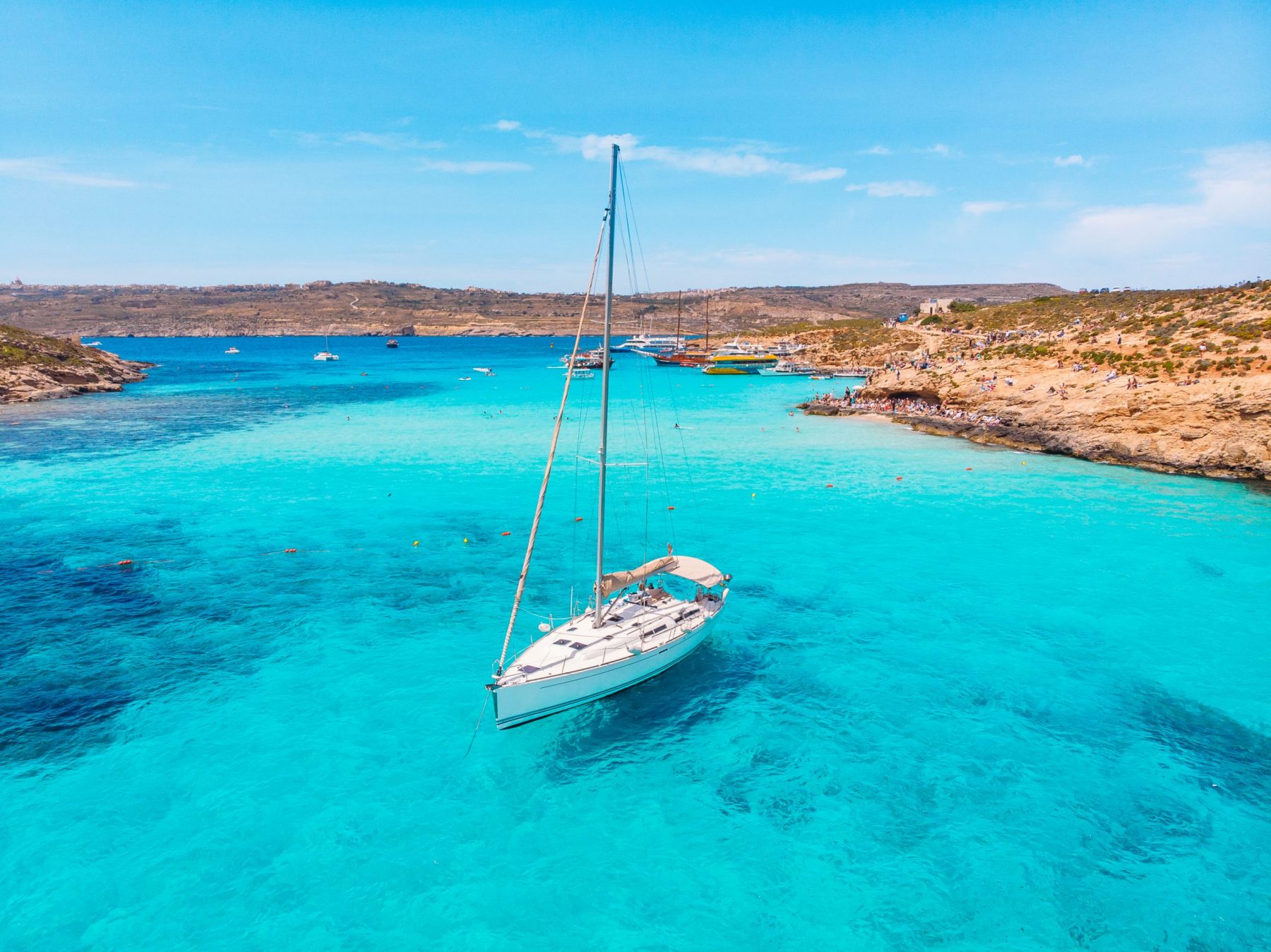
The 2004 Brad Pitt epic based on the Trojan War made extensive use of Malta, including Fort Ricasoli, Mellieħa and tiny Comino. The production constructed its city of Troy at Fort Ricasoli, while Comino’s extraordinary blue waters became part of the ancient Mediterranean world.
That gives Malta an unusual distinction in the renewed Odyssey boom: the islands have already portrayed the world from which Odysseus’ legendary voyage begins.
Comino has also appeared in productions such as The Count of Monte Cristo , while Malta and Gozo have provided locations for Game of Thrones , By the Sea , Munich , Captain Phillips , World War Z , Napoleon and Assassin’s Creed .
A Mediterranean Competition for Odysseus
Malta does not have the Odyssey to itself — and that makes the story more interesting for travelers.
Across the Mediterranean, islands have competed for centuries to connect their landscapes with Homer’s geography. In 2026, those legends are being reinforced by a new form of cultural authority: cinema.
Favignana, Sicily:Nolan transformed this rugged Egadi island into Ithaca. The Castle of Santa Caterina became the exterior of Odysseus and Penelope’s palace, while Favignana’s pale stone, quarries, coves and surrounding sea gave the mythical homeland a physical identity.
The Aeolian Islands, Sicily:Lipari, Vulcano and Basiluzzo provided maritime locations connected with Aeolia, the kingdom of Aeolus, ruler of the winds. Filming took place around the islands during Nolan’s Mediterranean shoot.
Djerba, Tunisia:Traditionally associated with the land of the Lotus-Eaters, Djerba appears later in Grant’s television journey. There he explores markets, Amazigh pottery, Jewish craftsmanship and traditional fishing while searching for the legendary lotus that caused Odysseus’ sailors to forget their desire to return home.
Ithaca and Kefalonia, Greece:Modern Ithaca naturally retains the strongest name recognition as Odysseus’ homeland, although scholars and enthusiasts have long debated whether Homeric geography corresponds exactly with the islands carrying those names today. Neighboring Kefalonia has also been proposed as a possible location for Homer’s kingdom.
Gozo, Malta:Gozo’s claim is not to Ithaca but to Ogygia and Calypso — one of the most memorable stops on Odysseus’ journey. Unlike a film set constructed for a production, that association has become part of Gozo’s own cultural and tourism mythology.
Together, these destinations effectively create a modern Odyssey trail stretching across the Mediterranean.
Malta’s Advantage: An Entire Film World in a Tiny Archipelago
What distinguishes Malta is scale.
Within a relatively small archipelago, a visitor can move from prehistoric temples to medieval Mdina, Baroque Valletta, massive coastal fortifications, fishing villages, limestone cliffs and the intensely blue waters surrounding Gozo and Comino.
For filmmakers, that geographical compression is valuable. For travelers, it means a film-location itinerary can double as a history, food, architecture and beach vacation.
The formula has become increasingly important to Malta. Recent reporting describes a film industry hosting dozens of projects annually, supported by production infrastructure and incentives, although the industry’s rapid expansion has also generated debate locally about subsidies, pressure on public spaces and whether enough of the boom benefits Maltese filmmakers themselves.
That debate is part of the larger story. Malta is no longer merely a pretty location rented by Hollywood. Film has become intertwined with the country’s international image, economy and tourism strategy.
From Homer to Hollywood to Tourism
Christopher Nolan’s The Odyssey has already demonstrated the tourism power of mythology on screen. Locations associated with the production, particularly Favignana and other Mediterranean shooting sites, have attracted renewed international travel attention since the film’s release.
Malta has every reason to want a share of that attention.
Here the traveler does not have to decide between Homer, Hollywood and history.
A visitor can search for Calypso on Gozo, remember Achilles and Troy beside Comino’s blue water, walk through locations transformed into ancient Rome for Gladiator , recognize Mdina from Game of Thrones , and then sit down to a very modern Maltese meal.
That may ultimately be Malta’s greatest advantage in the new Mediterranean competition for screen tourism.
Other islands can claim a chapter of The Odyssey . Malta can offer something closer to an entire cinematic library.
And as Richard E. Grant discovers in Very Modern Odyssey , separating myth from reality may not really be the point. In Malta, the two have been sharing the same landscape for a very long time.




Leave a Comment