

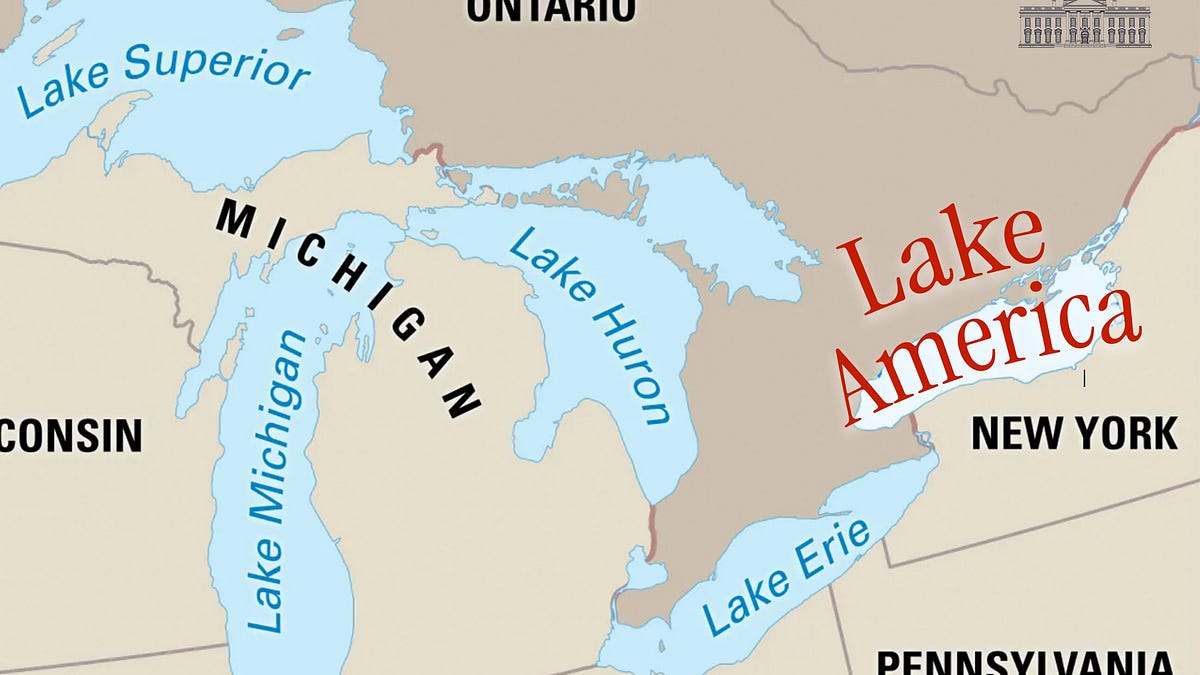
One day after President Trump renamed Lake Ontario “Lake America,” his Special Presidential Envoy for Tourism celebrated by ridiculing Canada. At a time when millions of Canadian visits have disappeared, and American destinations are trying to win them back, it raises a serious question: Whose interests is America’s tourism envoy serving?
If playback is interrupted, you can restart it.
On August 27, President Donald Trump signed an executive order directing the U.S. federal government to rename Lake Ontario “Lake America.”
The United States can determine the name used by its own federal government, maps and agencies. It cannot rename the Canadian portion of a lake shared by two sovereign countries, and Canada has made clear that, on its side of the border, Lake Ontario remains Lake Ontario.
That dispute will undoubtedly generate plenty of political theater on both sides of the border. But what happened the following day raises a different and potentially more consequential question.
On August 28, the man President Trump appointed Special Presidential Envoy for American Tourism, Exceptionalism, and Valuespublished an article celebrating the change.
Nick Adams titled it:
“Fun Facts About Lake America! Our Greatest Lake!”
Had Adams simply celebrated the new American name, waved the flag, and encouraged Americans and foreigners alike to visit, this might have been nothing more than another chapter in an unusual naming controversy.He didn’t. Instead, America’s presidential tourism envoy used the occasion to attack Canada, ridicule its government and mock its prime minister.
Adams accused Canada of “arrogance, aggression, and supreme ingratitude.” He declared: “It’s not a good position to be in for a country that needs us far more than we need them.”
And he concluded his tourism pitch by suggesting visitors might hear Canadian Prime Minister Mark Carney “crying from the other side of the lake.”
Coming from a partisan commentator, this would simply be political provocation. Coming from the man appointed to promote American tourism, it deserves considerably more scrutiny.
Because Nick Adams is not merely selling Donald Trump’s political agenda. He is supposed to be selling America. And right now, America has a Canadian tourism problem.

Millions of Canadians Have Already Voted With Their Passports
This is what makes Adams’s intervention so extraordinary. Canadian travel to the United States has fallen dramatically.
Statistics Canada reported that Canadian-resident return trips from the United States fell 25.4 percent in 2025 compared with 2024.
Approximately 7.1 million Canadian visits disappeared, while Canadian travel spending in the United States declined by approximately $3.3 billion.
Those numbers are not abstract statistics in a trade dispute. They represent hotel rooms that weren’t booked. Restaurant meals that weren’t purchased. Rental cars sitting on lots.
- Attraction tickets that weren’t sold.
- Golf rounds that weren’t played.
- And money that wasn’t spent in American communities.
The impact is especially significant because Canadians have historically been among America’s most dependable international visitors.
- They don’t simply fly into the United States for a few days.
- Many stay for weeks or months.
- Many own property.
- They buy groceries, dine in restaurants, play golf, shop, attend entertainment and sporting events, hire local services and pay American property taxes.
- Entire communities have spent decades building relationships with Canadian snowbirds.
- And increasingly, some of those Canadian visitors are saying:
- We don’t feel welcome anymore.
Florida and Palm Springs Know What Is at Stake
Consider Florida. Canadian snowbirds have been part of the state’s winter economy for generations. Yet Canadian visitation to Florida fell again in 2025, continuing a decline that represents real money to hotels, restaurants, attractions, and communities accustomed to Canadian winter residents.
Then there is Palm Springs and the Coachella Valley. For decades, Canadians haven’t simply visited Palm Springs. They have become part of its seasonal community.
They own homes and condominiums. They return to the same restaurants. They have American friends and neighbors. They support local businesses for months at a time.
These aren’t people predisposed to dislike the United States. Quite the opposite. They are among America’s most loyal repeat customers. One Canadian Palm Springs homeowner, reacting to Adams’s “Lake America” article, had an immediate response:
“Oh my God. This is beyond sickening.”That reaction should matter to America’s tourism envoy. Not because every Canadian necessarily shares it. But because tourism is ultimately about something remarkably simple:
How does a destination make you feel?People rarely spend thousands of dollars vacationing somewhere they believe they are resented. They go somewhere else.
When eTurboNews contacted Palm Springs and Visit Florida there was no response to Nick Adam’s comments.
American States Are Trying to Repair the Relationship
Perhaps the most striking aspect of Adams’s article is how dramatically it conflicts with what American tourism officials themselves are doing. California has explicitly reached out to Canadians.
Governor Gavin Newsom and Visit California launched “California Loves Canada,”a campaign designed to reassure Canadian travelers that they remain valued and welcome.
The message could hardly be clearer: Whatever is happening politically between Washington and Ottawa, Californians still want Canadians to visit.
New York has taken a similar approach. With Canadian visitation declining, the state has actively courted Canadian travelers and emphasized that they remain welcome. Tourism businesses across the country are doing the same thing.
- Hotels want Canadians back.
- Restaurants want Canadians back.
- Golf courses want Canadians back.
- Retailers want Canadians back.
- Destinations that have depended on Canadian snowbirds for decades want Canadians back.
Which makes the contrast extraordinary.
California:Canada, we love you. Come back.
New York:Canada, you’re welcome here.
American tourism businesses:We miss you.
America’s presidential tourism envoy:You’re arrogant and ungrateful; your prime minister is worthy of ridicule, and remember that you need us more than we need you.
Which one is America’s tourism policy?
The White House’s Own Order Recognizes the Economic Value of the Lake
There is another irony in all of this. The White House executive order renaming Lake Ontario “Lake America” itself recognizes the lake’s economic importance, including its role in shipping and recreation. Recreation means tourism. Tourism means visitors.
And some of the most obvious potential international visitors to communities surrounding this newly christened “Lake America” live directly across it. They are Canadians. So why would the president’s own tourism representative celebrate a tourism asset by insulting the people living on the opposite shore?
One might agree completely with President Trump’s decision to rename the lake and still ask that question. Because this is not ultimately an argument over whether the lake should be called Lake Ontario or Lake America. It is an argument about whether America’s tourism strategy makes economic sense.
Leave Trump Versus Carney Out of It
That distinction is important. President Trump has every right to pursue the trade policies his administration believes advance American interests. Canadian Prime Minister Carney has every right to defend what his government believes are Canadian interests.
- Governments negotiate.
- Governments threaten tariffs.
- Governments disagree.
- Presidents and prime ministers exchange sharp words.
- That is international politics.
But a retired Canadian couple deciding whether to spend February in Florida isn’t negotiating a trade agreement.
- A family from Toronto considering a weekend in New York didn’t impose Canadian tariffs.
- A Canadian homeowner deciding whether to spend another winter in Palm Springs isn’t sitting across the negotiating table from Donald Trump.
They are customers.And customers have choices. Mexico has beaches. Europe has culture. The Caribbean has sunshine. Asia offers extraordinary destinations. Canada itself offers an enormous domestic tourism market. The United States is not entitled to anybody’s vacation. It has to earn it.
You Don’t Have to Like Canada’s Government to Welcome Canadians
This is where politics should end, and basic economics should begin. There is nothing contradictory about being fiercely pro-American and enthusiastically welcoming Canadian visitors. In fact, attracting millions of Canadians to spend billions of dollars in American communities would seem to be an exceptionally pro-American objective.
- Their spending supports American businesses.
- Their hotel stays support American workers.
- Their restaurant bills support American jobs.
- Their property ownership supports American communities.
- Their taxes support American local governments.
- Their repeat visits strengthen economic and personal relationships between two countries whose citizens have lived, traded and traveled alongside one another for generations.
- You don’t have to agree with Mark Carney to understand that.
- You don’t have to approve of Canada’s trade policy.
- You don’t even have to particularly like Canada.
- You simply have to understand tourism.
And tourism begins with one of the oldest principles of hospitality: Make your guests feel welcome.
So What Exactly Is Nick Adams’s Job?
That brings us back to the central question. Nick Adams holds an extraordinary title:
Special Presidential Envoy for American Tourism, Exceptionalism, and Values.
If the president appoints someone to a position explicitly responsible for American tourism, Americans have every right to expect that person to advance American tourism.
- That means attracting visitors.
- Increasing visitor spending.
- Supporting hotels, restaurants and attractions.
- Helping tourism-dependent communities prosper.
- And making potential international guests believe America is somewhere they would like to visit.
So when the holder of that office publicly antagonizes citizens of one of America’s most important international tourism markets while American destinations are spending money trying to persuade those same people to return, asking whether he is effectively performing that job is entirely legitimate.
Is Nick Adams trying to bring Canadian tourists back?
Or is his priority pleasing President Trump and demonstrating his loyalty to the president’s political message? Perhaps Adams believes the two objectives are compatible. The tourism numbers suggest otherwise.
The Question Is Bigger Than Nick Adams
There is also a larger issue.
Adams isn’t a private citizen with an entertaining social-media account. He carries a presidential title. His words therefore carry an implication — fair or not — that they represent something larger than Nick Adams. And that leaves Canadian travelers with a reasonable question:
Does this rhetoric represent the personal style of Nick Adams, or does it represent the attitude of the White House that appointed him?
Because there is an enormous difference.
If President Trump wants Canadians to continue spending billions of dollars in the United States, visiting Florida, buying homes in Palm Springs, shopping in New York and vacationing throughout America, then his administration has every economic reason to make that clear.
If the administration doesn’t particularly care whether Canadians return, Americans whose livelihoods depend upon those visitors deserve to know that too.
Tourism isn’t measured in political applause. It is measured in arrivals, hotel nights, restaurant bills, airline seats, rental cars, attraction admissions, retail purchases, and dollars.
By those measures, losing millions of Canadian visits is not a victory for America.
Did the White House Just Make It Official?
Perhaps that is the uncomfortable question raised by the events of the past two days. On Thursday, President Trump renamed Lake Ontario “Lake America” for U.S. federal purposes.
On Friday, his Special Presidential Envoy for American Tourism celebrated by telling Canada that it is arrogant and ungrateful, mocking its prime minister and reminding Canadians that, in his estimation, they need America considerably more than America needs them.
Meanwhile, American states and tourism businesses are pleading with those same Canadians to come back.
So forget the politics for a moment. Forget Trump versus Carney. Forget even the argument over what to call the lake.
Ask the question as a hotel owner in Florida. Ask it as a restaurant owner in Palm Springs. Ask it as a tourism operator in New York. Ask it as one of the millions of Canadians deciding where to spend your next vacation — and your money.





Leave a Comment