

If playback is interrupted, you can restart it.
NEW YORK— At a time when wars, geopolitical fragmentation and economic confrontation are reshaping borders, aviation routes and the way people see one another, a relatively small organization of tourism leaders is preparing to mark an extraordinary milestone.
For four decades, the International Institute for Peace through Tourism (IIPT) has worked on an idea that can sound deceptively simple: travel can be more than an industry. It can be an instrument of peace.
On September 10, IIPT will launch a yearlong celebration of its 40th anniversary with a Global Leadership Virtual Summit, beginning a new chapter in a movement founded in 1986 by Dr. Louis D’Amore.
The timing is difficult to ignore.
The World Economic Forum’s Global Risks Report 2026 describes a world in which geoeconomic confrontation has become the leading immediate global risk, followed by state-based armed conflict. Half of the experts surveyed expect the next two years to be turbulent or stormy.
Tourism is directly exposed to that instability. Conflict changes flight paths, closes borders, alters perceptions of destinations and disrupts communities whose livelihoods depend upon visitors. The continuing Middle East crisis has already demonstrated both sides of the equation: significant localized disruption alongside a remarkable determination among travelers and tourism businesses to adapt.
The World Economic Forum has similarly warned that tourism’s impressive post-pandemic recovery now faces mounting geopolitical, environmental and technological pressures.
Against this background, IIPT is asking a question Louis D’Amore began asking four decades ago:
What if one of the world’s great movements of people could also become one of its great movements for peace?
The Work That Rarely Made the Headlines
IIPT’s story is not primarily one of treaties negotiated in foreign ministries or peace agreements signed before television cameras. Much of it happened quietly.

It happened through conferences and conversations. Through tourism leaders who remained in contact when governments did not. Through the planting of trees and dedication of Peace Parks. Through meetings between people whose countries or communities were separated by politics, religion, history or conflict.
And sometimes it happened in places where an American talking publicly about peace was itself remarkable.
In 2008, D’Amore traveled to Tehran and addressed Iranian leaders at the Islamic Hall of the People on the subject of Peace through Tourism. IIPT records describe him speaking about Iran’s ancient civilization, culture and history while recalling former Iranian President Mohammad Khatami’s initiative for a United Nations International Year of Dialogue Among Civilizations.
The message was characteristic of D’Amore’s philosophy: people must not become prisoners of the political relationship between their governments.
Tourism offered another channel.
Travel could allow ordinary citizens to encounter one another before geopolitical narratives defined what they were supposed to think about one another.
That philosophy carried IIPT into the Middle East peace conversation as well.
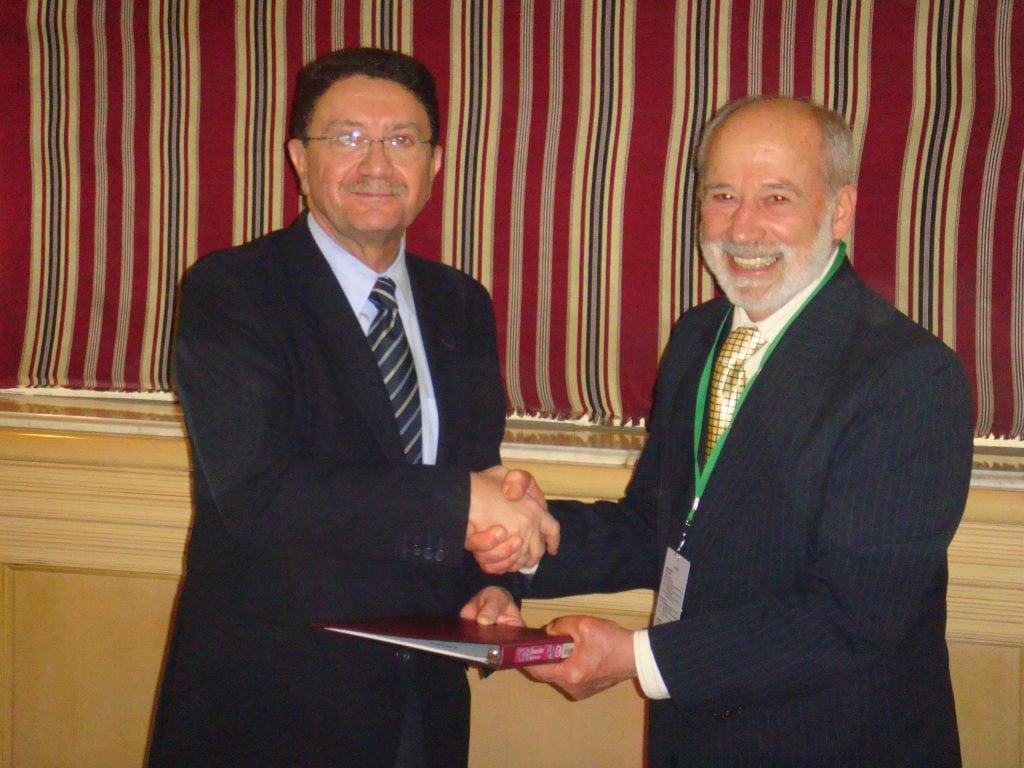
At its 2000 Global Summit in Amman, Jordan, organized at a moment of renewed Israeli-Palestinian violence, the program centered on subjects including “healing the wounds of conflict through tourism.”Nobel Peace laureate and former Israeli Prime Minister Shimon Peres was among the prominent figures associated with the summit, although contemporary reporting said violence ultimately prevented him from attending.
The distinction matters. IIPT’s history should not be exaggerated into diplomatic achievements it did not claim. Its contribution has instead been the persistent creation of spaces where tourism leaders, political figures, communities and peace advocates could continue talking about what might remain possible when conventional politics failed.
A Movement Born in an Earlier Age of Anxiety
D’Amore founded IIPT in 1986, the inaugural United Nations International Year of Peace.
The Cold War still divided the planet. Terrorism was increasingly affecting international travel. Environmental deterioration and disparities between richer and poorer nations were becoming harder to ignore. D’Amore’s research into the future of tourism led him toward a different question.
Rather than simply forecasting how large tourism would become, he began asking what such a powerful global industry could become.
The answer became IIPT.
Its founding vision was travel and tourism as the world’s first “Global Peace Industry,”built around another idea that remains at the center of the organization today:
Every traveler is potentially an Ambassador for Peace.
IIPT’s own historical record says its concept of peace was always broader than the absence of war. It encompassed peace among people, peace with nature, respect for cultural heritage, responsibility toward future generations and the use of tourism to reduce poverty and help heal the wounds of conflict.
Two years after its founding, IIPT convened its first Global Conference, “Tourism — A Vital Force for Peace,”in Vancouver in 1988. It attracted approximately 800 participants from 68 countries.
Stephen Lewis, Canada’s former Permanent Representative to the United Nations, was among the prominent participants as the gathering helped introduce what D’Amore called the “Higher Purpose of Tourism.”
That concept would eventually encompass sustainable development, environmental protection, cultural preservation, poverty reduction, international understanding and reconciliation.
In 1994, IIPT brought its conference to Montréal under the theme “Building a Sustainable World Through Tourism,”helping push sustainability and poverty reduction further into the international tourism conversation.
Over the decades that followed, IIPT convened summits, conferences and initiatives in destinations including Amman, Geneva, South Africa and Thailand.
Its orbit included heads of state, royalty, United Nations leaders, Nobel laureates and some of tourism’s most influential executives. IIPT records list figures associated with its programs ranging from Nelson Mandela and King Abdullah II of Jordan to UN Secretary-General Kofi Annan, Shimon Peres, Marriott’s J.W. Marriott Jr. and American Express leader Harvey Golub.
Yet perhaps the more remarkable story is that the organization itself remained relatively small.
The Small Team Behind a Global Idea
IIPT never became a massive international bureaucracy.
Instead, much of its survival has depended on a network of tourism professionals, volunteers, chapter leaders, board members and longtime believers who continued carrying D’Amore’s vision from one generation of leadership to another.

Today, Ajay Prakash serves as IIPT President, Timothy Marshall chairs its Board of Directors and Andreas Larentzakis serves as Executive Director, supported by chapter presidents, directors, ambassadors and volunteers around the world.
Larentzakis illustrates the character of that network particularly well. He joined IIPT as a volunteer in 1999, assisted with the Amman Global Summit in 2000 and Geneva summit in 2003, and after retiring from business in late 2024 became the Institute’s Executive Director.
Marshall, meanwhile, has chaired IIPT’s board since 1999 and has described the organization as a “family” held together by a shared commitment to D’Amore’s principles. In 2023 he helped oversee the transition from D’Amore’s presidency to Prakash, with D’Amore becoming Founder and President Emeritus after nearly four decades of leadership.
It is this small group — supplemented by leaders in countries and communities across several continents — that has largely kept the Peace through Tourism movement alive behind the scenes.
- Not through military power.
- Not through government authority.
- But through relationships.
Peace Parks: Putting an Idea Into the Ground
Perhaps no IIPT initiative illustrates that philosophy more visibly than its Global Peace Parks.
The program began in 1992 during Canada’s 125th anniversary celebrations, when hundreds of parks were dedicated to peace. Today, the network numbers more than 450 Peace Parks worldwide.
They include places carrying enormous historical, spiritual or cultural meaning — from Victoria Falls to Bethany Beyond the Jordan and other sites across six continents.
The concept is deliberately uncomplicated.
- A park is a place where people can meet.
- A tree survives political cycles.
- A plaque can remind future visitors that another generation chose reconciliation over resentment.
In April 2025, an IIPT Olive Peace Park was dedicated in Kepez-Çanakkale, Türkiye, overlooking the Dardanelles and Gallipoli Peninsula — terrain once synonymous with the carnage of the First World War.
The dedication coincided with Türkiye’s National Sovereignty and Children’s Day and recognized children around the world affected by war. Participants included children from Türkiye, North Macedonia and Bulgaria.
There was symbolism in the location. Countries whose soldiers once fought and died there now send descendants back as visitors. A battlefield became a destination of remembrance. Former enemies became hosts and guests.
That is Peace through Tourism in physical form.
In July 2025, the historic Caux Palace above Montreux, Switzerland, was also formally welcomed into IIPT’s network. Caux Initiatives of Change described the Peace Park as a place for dialogue, trust-building, cultural heritage, responsible tourism and sustainability.
Serbia has also continued expanding the network, including Peace Park dedications in Čačak and Sokobanja during 2025.
These are modest acts measured against wars involving armies, missiles and billions of dollars. But that may be precisely their point. Peace is not constructed only when presidents sign documents.
Sometimes it has to be cultivated long before politicians are ready to sign anything.
Tourism’s Resilience Is Also Its Responsibility
Travel has repeatedly demonstrated its ability to recover from terrorism, financial crises, pandemics, natural disasters and war. That resilience is commercially important.
But IIPT’s argument goes further: resilience without responsibility is not enough.
Tourism can reinforce division just as easily as it can overcome it. It can deepen inequality, overwhelm communities and turn cultures into commodities. Travel alone does not automatically create peace.
For tourism to become a peace-building force, it has to be designed around encounters that encourage dignity, economic participation, cultural respect and genuine human contact.
That makes IIPT’s message unusually relevant in 2026.
The global system is becoming more fragmented. The World Economic Forum says multilateralism is under growing pressure and warns that confrontation is increasingly replacing cooperation. Tourism moves in the opposite direction.
Its basic architecture requires borders to be crossed, strangers to be welcomed, cultures to be encountered and some degree of trust to exist.
Every aircraft carrying citizens of multiple nations, every hotel lobby filled with different languages and every guide explaining one culture to visitors from another represents a tiny counterweight to isolation.
That does not make tourism a substitute for diplomacy. It makes tourism a form of people-to-people diplomacy.
September 10: Forty Years Later
That history will form the backdrop when IIPT opens its anniversary year on September 10, 2026, with a 90-minute Global Leadership Virtual Summit from 9:00 to 10:30 a.m. New York time.
The theme will be:
“40 Years of Peace Through Tourism — A Global Call to Reimagine the Future of Travel.”
According to IIPT’s updated anniversary program, a high-level panel titled “Beyond Borders: Travel, the Future and the Pursuit of Peace”is expected to include:
- H.E. Ekitela Lokaale, Ambassador and Permanent Representative of Kenya to the United Nations in New York;
- Ela Gandhi, peace activist and granddaughter of Mahatma Gandhi;
- Michael Collins, Executive Director, Americas, Institute for Economics & Peace;
- Geoffrey Lipman, Co-Founder of the SUNx Program and President of SUNx Malta;
- Ignacio Packer, Executive Director of the Caux Initiatives of Change Foundation; and
- Juergen Steinmetz, President and CEO of Travel News Group.
The speaker list remains in formation.
The virtual summit will begin a yearlong sequence of anniversary activities, followed by a global conference planned for Serbia in December 2026and further international programs during 2027.
The anniversary is scheduled to culminate with an in-person Global Leadership Summit at United Nations Headquarters in New York in August 2027, with the final date still to be announced.
The Question Louis D’Amore Leaves to Tourism
Forty years after IIPT’s creation, nobody can reasonably argue that tourism has ended war.
That was never a realistic standard. The more important question is whether millions of encounters created through travel can reduce the psychological distance that makes conflict easier.
- Can visiting another country make its people harder to demonize?
- Can tourism provide livelihoods that give communities a greater stake in stability?
- Can heritage tourism teach societies to remember conflict without perpetuating hatred?
- Can destinations recovering from war use tourism to rebuild not only infrastructure but relationships?
- Can travelers return home as informal ambassadors for people they previously knew only through headlines?
Those questions have followed IIPT from Vancouver to Amman, from Tehran to Geneva, from the battlefields of Gallipoli to the gardens of Caux. And in 2026, they have acquired new urgency.
The world is again confronting wars, nuclear anxieties, economic fragmentation, distrust between major powers and deepening political polarization. Tourism itself cannot solve those crises.
But four decades after Louis D’Amore proposed tourism as a global peace industry, IIPT’s persistence makes another point.
Peace does not survive solely because governments maintain it. It survives because people keep meeting.
- Because somebody keeps the conversation going.
- Because somebody plants the tree.
- Because somebody crosses the border.
And because, even when the television cameras have gone elsewhere, a small group of people continues working behind the scenes on the proposition that every traveler can still be an Ambassador for Peace.




Leave a Comment