

PORTONOVI, MONTENEGRO —Seven years after welcoming its first visitors on the shores of Boka Bay, Portonovi has become one of the most ambitious examples of Montenegro’s transformation from a relatively inexpensive Balkan beach destination into a playground for international luxury hospitality, yacht owners, wellness travelers and second-home buyers.
It is also a development that raises some of the bigger questions now facing Montenegro tourism.
How much luxury is enough? Can spectacular new resorts retain a genuine connection with the communities and culture surrounding them? Can Montenegro deliver service and infrastructure matching prices that increasingly compete with Italy, France, Greece and Croatia? And how does a country outside the European Union reconcile its legacy of Russian investment and visitors, major investment from Azerbaijan and other non-EU markets, and its increasingly advanced ambition to join the EU?
Against that wider background, Portonovi’s seventh anniversary is more interesting than a list of awards.
It offers a snapshot of where Montenegro tourism may be heading.
From Yugoslav Military Base to €835 Million Luxury Development
Portonovi occupies approximately 26 hectares of the former Kumbor military base near Herceg Novi.
The redevelopment has been led by Azmont Investments. Azmont identifies its parent as Azerbaijan Global Investments, a consortium of Azerbaijani investment interests. Montenegro’s investment authorities say that, according to information supplied by the investor, more than €835 millionhas been invested in the project since its implementation began.
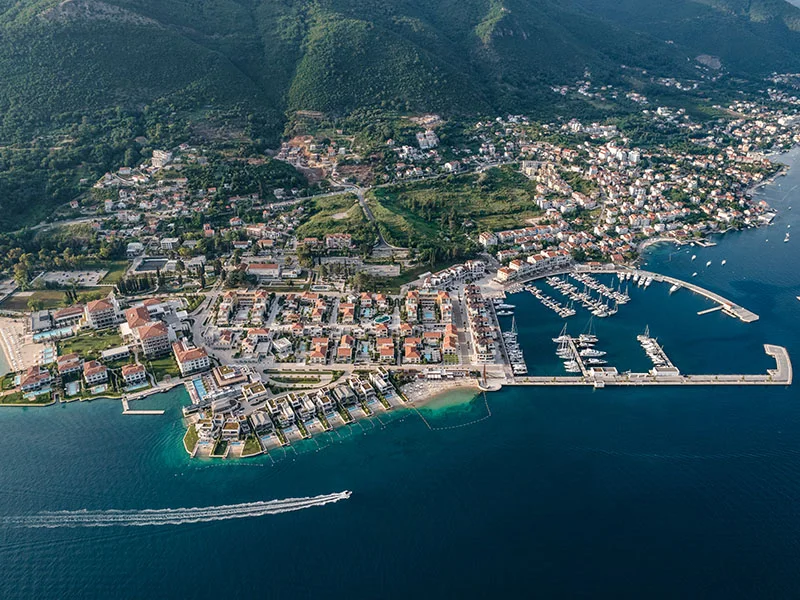
Portonovi began receiving visitors in 2019, while One&Only Portonovi—the luxury hotel that became perhaps the destination’s most internationally recognizable component—opened in 2021 as the first One&Only resort in Europe. (
Today the development combines residential and vacation apartments, villas, restaurants, boutiques, public waterfront areas, a marina, One&Only Portonovi and its Chenot Espace wellness operation.
That blend of residential real estate and tourism is increasingly familiar around Boka Bay.
The Times has described Portonovi, Porto Montenegro and Luštica Bay as a trio of major marina-residential developments helping reposition the bay internationally, while Vogue singled out One&Only Portonovi when describing Montenegro as an emerging wellness destination.
But Portonovi is also its own world.
Its polished waterfront architecture and controlled luxury environment can feel very different from neighboring Montenegrin towns—and reactions to that difference range from admiration to accusations of sterility.
Seven developments during Portonovi’s seventh year illustrate both its achievements and the questions accompanying them.
1. Portonovi Marina Reaches the Top Tier
One of the clearest achievements came when Portonovi Marina received 5 Gold Anchor Platinumstatus from The Yacht Harbor Association.
It is the highest level of Gold Anchor accreditation, recognizing marina infrastructure, service, operations, and overall customer experience. Portonovi already held International Clean Marina and Superyacht Ready accreditation. (
For a small Adriatic country competing against established Mediterranean yachting centers, this is significant.
Luxury yachts do not simply purchase berths. Their passengers and crews generate demand for provisioning, restaurants, maintenance, ground transportation, excursions and hotel services.
Portonovi’s challenge is to turn the marina’s international recognition into economic value that extends beyond the resort gates.
That question matters because nearby Kotor already demonstrates the downside of uncontrolled tourism success.
Reuters reported that increasing tourism and cruise arrivals have brought congestion, housing pressure and environmental concerns to the UNESCO-listed town, with residents and officials debating how to better manage visitor numbers. Portonovi’s relatively controlled nautical model offers one alternative: fewer visitors, but substantially higher spending per traveler.
Whether that produces broader benefits for the surrounding region will remain an important measure of success.
2. Four Seasons I Chooses Portonovi
Portonovi’s yachting credentials received another boost on June 12, 2026, when Four Seasons I, the inaugural vessel from Four Seasons Yachts, called at Portonovi during its maiden Mediterranean season.
The vessel carries just 95 suites and represents Four Seasons’ entry into the ultra-luxury yacht sector.
For Portonovi, being selected as an Adriatic stop is powerful international branding. It effectively places this small Montenegrin marina within the itinerary network of one of the world’s best-known luxury hospitality brands.
It also illustrates how Portonovi’s geographic position can work in its favor.
Croatia and Dubrovnik are close, while Kotor, Perast and the landscapes of Boka Bay are accessible by boat. Several travelers reviewing One&Only Portonovi specifically praised boat trips around the bay as among the highlights of their stay. But geography can also become a weakness.
Travelers arriving through Dubrovnik during busy periods can encounter considerable delays at the Croatia-Montenegro border. In recent luxury-travel discussions, visitors specifically complained about border queues when reaching Portonovi from Croatia, with some suggesting walking across the border between separate transfer vehicles as an improvised workaround.
For a destination selling frictionless luxury, regional transportation infrastructure remains something the resort itself cannot fully control.
3. Building Traditions Instead of Just Selling Real Estate
A resort of luxury residences and yachts risks becoming a collection of expensive buildings rather than a community.cPortonovi has tried to counter that through recurring events.
In 2026 the destination staged the seventh Portonovi Regatta Boka Islands, while Portonovi Summer Rise and Portonovi Wine Night reached their sixth editions.
The 3×3 FIBA Lite Quest returned for a fourth edition, the Portonovi New Year’s Run for a third, and the annual Tree Lighting Ceremony reached its fifth year.cThat longevity is arguably more meaningful than launching new events every season.
It suggests an attempt to build traditions involving homeowners, guests, local organizations and residents from the surrounding area.
For Montenegro, year-round programming is strategically important.
The country remains heavily exposed to seasonal coastal tourism, and one of the tests for luxury developments is whether they can generate employment and business outside July and August.
Portonovi advertises permanent, seasonal and internship employment opportunities across hospitality, housekeeping, landscaping, marina operations and other functions.
But the broader economic question is whether luxury developments produce enough local career development and supplier opportunities—or primarily function as internationally financed enclaves. That debate is unlikely to disappear as Boka Bay becomes increasingly valuable real estate.
4. Culture Becomes Part of the Luxury Formula
Portonovi’s latest expansion is not another building. It is culture.
A partnership with Herceg Fest brought the closing concert of the 20th Dani Muzike festival to Portonovi, while cooperation with the Operosa Montenegro Opera Festival introduced programming including an open-air performance of La Bohèmeand Opera per i Piccoli, designed for children and families.
This matters because one of the recurring criticisms of newly constructed luxury destinations is precisely their lack of accumulated culture.
Unlike Kotor, Perast or Herceg Novi, Portonovi cannot manufacture centuries of history. It opened in 2019.
Its challenge is therefore to build a contemporary identity without pretending to be an ancient Adriatic village. Some travelers think it succeeds. Others clearly do not.
One 2026 luxury-travel contributor described Portonovi as beautiful and serene, while another called the property “beautiful but sterile.” A separate discussion characterized One&Only Portonovi as “soulless” despite acknowledging the quality of the physical property.
A Tripadvisor reviewer similarly praised the gardens, beach and rooms but said the marina lacked atmosphere and felt more reminiscent of a newly created Gulf-style luxury development than an organic Mediterranean settlement. These are subjective opinions, not objective defects.
But they point to an important challenge: luxury architecture can be built relatively quickly. A sense of place takes longer.
Cultural partnerships may be one way Portonovi is attempting to close that gap.
5. A Residential Destination — and Increasing Privacy
Residential real estate remains fundamental to the Portonovi business model.
The destination markets Village Residences, Marina Apartments, villas and One&Only-branded homes to international purchasers looking for either lifestyle ownership or investment potential. Portonovi explicitly markets some properties as investment opportunities connected to Montenegro’s tourism economy.
The Village has now moved toward greater privacy, operating as a gated residential community accessible to homeowners, their guests and guests staying in rental residences.
At the same time, the waterfront promenade, restaurants, boutiques and other public areas remain accessible. That balancing act is important.
Too much exclusivity risks separating Portonovi from the surrounding community. Too little privacy undermines one of the things wealthy homeowners are paying for.
New payment arrangements also broaden the purchasing proposition. According to Portonovi, Marina Apartments can be acquired with a 20 percent down payment followed by interest-free repayments of up to five years, while Village Residences offer repayment periods of up to four years.
What About Russian Buyers?
Russia should be discussed carefully. Russian citizens have historically played a significant role in Montenegro’s tourism, real-estate and investment economy. That legacy remains visible throughout the coast.
But Montenegro’s relationship with Russia has changed sharply.
The country joined NATO in 2017 and imposed sanctions against Russia after its 2022 invasion of Ukraine. Montenegro is now the leading candidate for EU accession and hopes to join the European Union by 2028, although rule-of-law, corruption and judicial reforms remain obstacles. ( Reuters )
Russian capital has also become less dominant than it once was.
What cannot responsibly be claimed from publicly available evidence is a precise Russian share of Portonovi’s current homeowners or guests. Portonovi does not appear to publish a customer breakdown by nationality.
So while Russian-speaking owners and visitors form part of the wider Montenegro coastal story, presenting Portonovi specifically as a predominantly Russian destination would require evidence that is currently not public.
Its Azerbaijani investment origins, by contrast, are documented.
6. One&Only Portonovi Wins Awards — While Guests Debate Value and Service
One&Only Portonovi remains Portonovi’s strongest international hospitality brand. Its achievements are substantial.
The property received Two MICHELIN Keysin the Global MICHELIN Keys selection, while Chenot Espace at One&Only Portonovi was named World’s Best Hotel Spa 2025by the World Spa Awards. The World Spa Awards independently lists Chenot Espace as the 2025 global winner in the hotel-spa category. ( World Spa Awards )
International media praise has also been strong.
Vogue highlighted its wellness offering and Montenegro’s combination of mountains, coast and adventure, while The Times in 2026 included One&Only Portonovi among the properties driving Montenegro’s growing appeal to upscale British travelers. ( Vogue )
Traveler reviews provide a more nuanced picture.
Tripadvisor currently shows a strong overall rating, with recent reviewers praising spacious rooms, bay views, cleanliness, spa facilities, breakfast and highly personalized service. ( Tripadvisor )
Booking.com reviews similarly contain enthusiastic praise for cleanliness, facilities and individual restaurant and hotel employees. But even highly rated reviews sometimes mention isolated service failures. ( Booking )
Among luxury travelers on Reddit, the strongest recurring compliment is Chenot Espace.
One recent reviewer described it as among the best spas they had experienced and praised the expertise of therapists, fitness coaches and wellness personnel. Families also singled out the large pool, calm beach, children’s facilities and availability of boat excursions. ( Reddit )
The recurring criticism is consistency.
Several guests describe service as “hit or miss,” particularly compared with the almost anticipatory service delivered at leading resorts in Asia or other ultra-luxury destinations. Some mention long periods without pool attendants or inconsistent restaurant service.
Price is another repeated complaint.
A Tripadvisor guest praised One&Only as a beautiful luxury hotel but cited restaurant and pool pricing as excessive, including an example of €8 for a scoop of ice cream. Another reviewer questioned whether the overall experience justified what they considered exceptionally high rates.
Portonovi Beach Club receives similar criticism from some visitors. One 2025 Tripadvisor reviewer praised the water and beach service but said food was overpriced and cited peak-season sunbed packages ranging from €85 to €200 depending on row.
None of this means the property fails as a luxury resort. Indeed, many guests give it exceptional ratings and say they intend to return.
It means Portonovi has entered the most demanding part of the luxury market: when prices are extraordinary, expectations become extraordinary too.
7. A New Chapter Under Absheron Hotel Group
In August 2025, Portonovi announced its full integration into Absheron Hotel Group, part of the wider PASHA corporate structure.
Absheron operates hotels and resorts in Azerbaijan and other international markets, while PASHA Holding has interests extending across banking, insurance, real estate, hospitality, tourism and technology.
The move brings Portonovi closer to a larger hospitality-management ecosystem and reinforces the destination’s Azerbaijani corporate connections.
For Portonovi, the potential advantage is scale: management systems, training, commercial expertise, purchasing strength and greater integration with an international network. The risk is equally familiar in hospitality.
As operations become more corporate, destinations can become more standardized.
Portonovi’s next management challenge is therefore not simply to improve efficiency. It is to improve consistency without losing individuality.
That concern matters because “sterile,” “soulless” and “could be anywhere” appear repeatedly among the minority of critical luxury-travel reviews.
Operational excellence alone will not answer that criticism. A stronger connection to Montenegro might.
Is Portonovi Underpromoted by Montenegro Tourism?
There is a perception that Portonovi receives less visibility than Montenegro’s universally promoted icons—Kotor, Budva, Sveti Stefan and increasingly Porto Montenegro.
But saying Montenegro’s tourism authorities do not promote Portonovi would be inaccurate.

The National Tourism Organization of Montenegro specifically highlighted One&Only during its international promotion at World Travel Market London, noting substantial British media attention surrounding the European debut of the brand in Montenegro.
The more interesting question is therefore why Portonovi still sometimes feels like a destination operating in parallel with mainstream Montenegro tourism.
Part of the answer may be positioning.
- Kotor sells history.
- Budva sells beaches and nightlife.
- Durmitor sells nature.
- Porto Montenegro has spent years developing a recognizable marina-town identity.
- Portonovi sells something different: privacy, wellness, residences, yachts and resort-controlled luxury.
That makes it valuable to Montenegro—but also somewhat self-contained.
The Bigger Challenge: Montenegro Is Becoming Expensive Before All of Its Infrastructure Becomes Luxurious
Portonovi does not exist in isolation from the country around it. Montenegro is experiencing the complicated consequences of tourism success.
Reuters documented overcrowding, traffic congestion, environmental pressure and rising housing costs around Kotor. Recent social-media travel discussions likewise show a sharply polarized picture.
Some visitors describe Montenegro as spectacular and say they want to return. Others complain about traffic, taxi pricing, inconsistent service, poor transportation organization and prices they no longer consider inexpensive. These posts are anecdotal and should not be treated as representative surveys, but their frequency indicates where visitor frustration is developing.
This creates an unusual tourism challenge.
Montenegro increasingly charges Western Mediterranean prices in parts of its coast while still operating with Balkan-scale roads, border crossings, airports and public transportation infrastructure. That gap can become particularly visible for guests paying ultra-luxury rates.
One&Only can control a suite, a spa treatment, a restaurant table or a yacht excursion. It cannot control a summer traffic jam or a Croatian-Montenegrin border queue.
Seven Years Later: Success, But Not a Finished Story
Portonovi’s achievements are real.
A Platinum marina accreditation, Four Seasons I calling at its port, Two MICHELIN Keys for One&Only, a world spa award for Chenot Espace, recurring community events, expanding cultural partnerships and integration into Absheron Hotel Group all demonstrate momentum.




Leave a Comment