
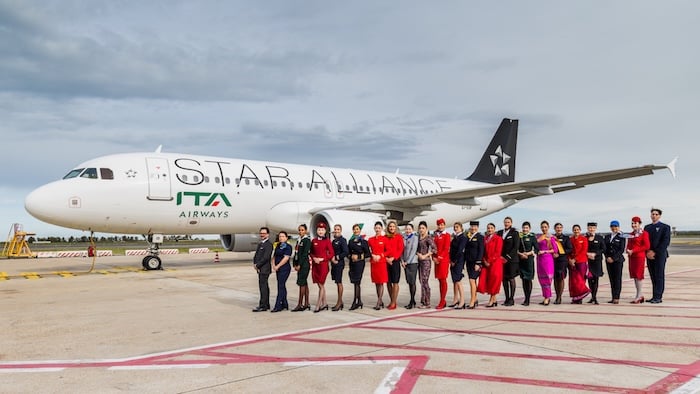
Rome, Italy – The global aviation landscape marked a significant milestone as ITA Airways was officially inducted as the 26th member of Star Alliance, completing its integration into the world’s largest airline network. The ceremonial event, held at the Piazza di Spagna Lounge at Rome Fiumicino Airport, brought together senior executives, including ITA Airways CEO Joerg Eberhart, Star Alliance CEO Theo Panagiotoulias, and Lufthansa Group Chief Commercial Officer Dieter Vranckx.
Effective April 1, ITA Airways becomes fully embedded within the Star Alliance ecosystem, connecting its primary hubs in Rome and Milan Linate Airport to a global network of more than 1,150 destinations across 190 countries. The integration enables seamless travel benefits for passengers, including through check-in, reciprocal frequent flyer recognition, and access to Star Alliance’s extensive lounge network.
Theo Panagiotoulias described the induction as a “strategic expansion” that strengthens the Alliance’s presence in Southern Europe while enhancing customer connectivity and travel experience. ITA Airways CEO Joerg Eberhart called the move a “historic milestone,” emphasizing the airline’s ambition to combine global standards with its distinctive Italian identity.
The induction follows months of intensive collaboration led by Lufthansa Group, which has taken a central role in mentoring ITA Airways’ integration. With ITA now positioned as a key network carrier within the Lufthansa Group, the move significantly reinforces the group’s competitive position across Europe and intercontinental markets.
ITA Airways contributes more than 350 daily flights and serves over 16 million passengers annually, strengthening connectivity within Italy and between Southern Europe and major global destinations. As part of the Alliance, Star Alliance Gold members will also gain access to ITA-operated lounges in Rome, Milan, and Catania.
A Strategic Contrast Within Lufthansa Group
While ITA Airways’ inclusion aligns with Lufthansa Group’s full-service network strategy, it also highlights a notable contrast within the group’s portfolio. Eurowings, another Lufthansa subsidiary, remains outside the Star Alliance despite being fully integrated into the group’s commercial network.
This distinction reflects differing business models. ITA Airways operates as a full-service carrier designed for global connectivity and premium passenger services—criteria essential for Star Alliance membership. In contrast, Eurowings functions as a low-cost and leisure-focused airline, prioritizing point-to-point travel and cost efficiency over alliance-driven integration. However, Eurowings has the monopoly on many former Lufthansa routes and serves as a clear feeder into the Star Alliance system.
As a result, passengers traveling on Eurowings flights may not receive the same alliance benefits, such as lounge access or full frequent flyer reciprocity, even when booked within the broader Lufthansa network. The approach allows Lufthansa Group to maintain a dual strategy: leveraging alliance synergies through its network carriers while competing aggressively in the low-cost segment via Eurowings.
Expanding the Star Alliance Network
With the addition of ITA Airways, Star Alliance now comprises 26 member airlines, collectively offering more than 17,500 daily flights worldwide. The move fills a longstanding gap in the Alliance’s coverage of Italy following the exit of Alitalia, and positions Rome Fiumicino as a strengthened southern European hub within the alliance structure.
For travelers, the integration promises smoother connections, expanded route options, and a more consistent global travel experience. For Lufthansa Group and Star Alliance, it represents a strategic consolidation of market presence in one of Europe’s most important aviation markets.
As global alliances continue to evolve, the contrasting roles of ITA Airways and Eurowings underscore a broader industry trend: airline groups increasingly balancing premium global networks with flexible, cost-efficient subsidiaries—each serving distinct but complementary market segments.










Leave a Comment