
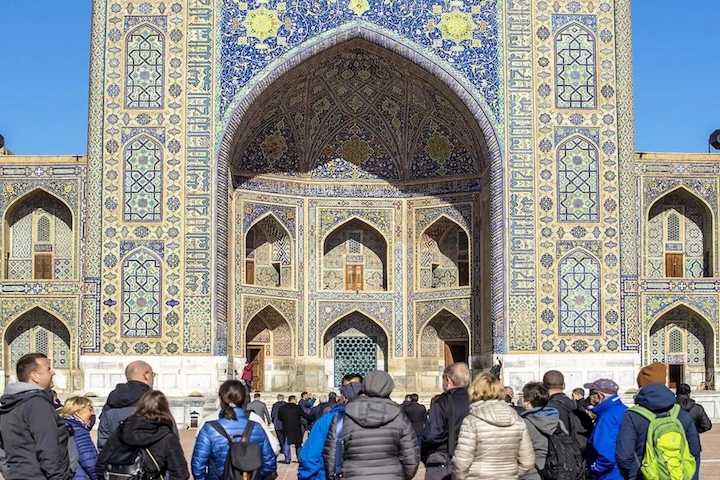
Uzbekistan’s inbound tourism jumped to 11.7 million foreign visitors in 2025, one of the sharpest year-on-year increases the country has recorded, according to preliminary figures from the National Statistics Committee (Stat.uz). The total is up 3.7 million visitors, or 46.8%, compared with 2024.
What stands out isn’t only the scale of the increase — it’s who is driving it. The top source markets are overwhelmingly regional: Kyrgyzstan (3.3m), Tajikistan (2.7m), Kazakhstan (2.7m), and Russia (~984k). That pattern signals that Central Asia’s travel boom is being propelled first by cross-border, short-haul movement(family visits, shopping, events, and “Silk Road circuit” tourism), and only then by long-haul leisure growth.
What changed in Uzbekistan
Several forces have converged:
- Policy and promotion tailwinds:International reporting tied to UN Tourism data has ranked Uzbekistan among the world’s fastest-growing destinations in 2025, noting arrivals up roughly 73% versus 2019over January–September 2025 — a sign growth is more than a post-pandemic bounce.
- Air access and infrastructure:The region’s tourism pitch is increasingly built around easier entry and better connectivity. Samarkand — a key anchor of the classic Silk Road itinerary — opened a major new airport terminal in March 2022, expanding capacity and supporting new routes.
- Bigger export earnings:Uzbekistan’s tourism services exports were reported at $4.8 billion in 2025, reinforcing that the surge is translating into hard-currency revenue, not just higher headcounts.
How Uzbekistan compares with its neighbors
Uzbekistan isn’t rising in isolation — but it’s rising differently.
Kazakhstan (scale leader):Kazakhstan is reporting very large visitor totalsas well. One December briefing cited 12.1 million foreign nationals visiting for tourism purposes between January and September 2025, including 8.6 millionstaying more than one day. Kazakhstan also reported 7.5 million foreign visitors in H1 2025, with 5 million staying longer than 24 hours, and has emphasized investment and accommodation capacity expansion.
Bottom line:Kazakhstan is competing on volume + investment, supported by big domestic mobility and large-scale infrastructure.
Kyrgyzstan (nature/adventure magnet):Kyrgyzstan’s tourism narrative is increasingly tied to mountains, lake tourism, and adventure travel. One regional report put 2025 visits at around 10 million.
Bottom line:Kyrgyzstan is benefitting from regional demand and outdoor tourism, often as an add-on to multi-country itineraries.
Tajikistan (smaller base, solid growth):Tajikistan is growing but from a lower base. Asia-Plus reported 1,388,800 foreign nationals enteredTajikistan from January–September 2025, up from 2024; the same report noted that Uzbekistan was the single largest sourceover that period.
Bottom line:Tajikistan’s tourism is rising steadily, but totals remain well below those of Uzbekistan/Kazakhstan.
Turkmenistan (opening, but still constrained):Turkmenistan has historically been the region’s hardest destination to enter. That may be shifting at the margins: in April 2025, Turkmenistan adopted a law enabling electronic visasand removing some traditional entry frictions.
Bottom line:If implementation is meaningful, Turkmenistan could start capturing more regional spillover — but it’s still the most policy-dependentmarket in Central Asia.
The regional story: “Silk Road circuits” and connectivity politics
Uzbekistan’s 2025 numbers underline a structural reality: Central Asia’s tourism boom is being built regionally first. Neighbor-heavy source markets are consistent with an emerging multi-stop travel pattern— for example, a Samarkand–Bukhara core plus add-ons into Kazakhstan’s cities/nature or Kyrgyzstan’s lakes and mountains.
At the same time, big-power diplomacy is reinforcing the mechanics of tourism growth. Reuters has reported Central Asian commitments with China to improve road/rail links and direct flights, alongside discussion of simplified visa procedures— the kind of connectivity upgrades that typically unlock more “hub-and-spoke” itineraries across borders.




Leave a Comment