How agentic AI
is rewriting the rules for logistics providers

Paula Natoli
Director, Supply Chain & Logistics Industry Solutions, Google Cloud
Logistics is shifting from price-based competition to AI-driven intelligent orchestration that scales human expertise into a strategic advantage.
Over the past several months, a consistent theme has emerged from my conversations with executives across the logistics industry: the era of competing solely on price is evolving. While speed and cost remain foundational, the traditional playbook of simply moving goods cheaper than the competition is no longer enough to win. The market is shifting toward a model where shippers consolidate their provider relationships, prioritizing partners who can deliver strategic intelligence alongside transportation.
The numbers back this up: 74% of shippers say they're likely to switch 3PL providers based on a provider's AI capabilities . LSPs must transform from utilities that move goods into strategic partners that orchestrate outcomes. The race to the bottom is over. For our industry, a new race to deliver certainty has begun.
The shift nobody is talking about
Every logistics provider sees the same obvious opportunities: automate document processing, digitize rate confirmations, speed up proof-of-delivery workflows. These matter. But they're table stakes. Every provider will have these capabilities. They won't differentiate anyone. They'll just keep you in the game.
The real opportunity is digitizing expertise, not just paperwork.
Think about what actually makes a great logistics provider valuable. Maybe it's a dispatcher who knows that a certain distribution center always has dock delays on Tuesdays, so she proactively reroutes Friday shipments. An account manager who sees a spike in e-commerce orders from one region and repositions inventory before the client even asks. An operations lead who recognizes a carrier's performance pattern and switches providers before a service failure happens. None of that knowledge lives in a PDF. It's trapped in the "document dungeon" of rate sheets, email chains, and scanned proofs of delivery, buried alongside the operational expertise that should be powering your business.
This level of expertise doesn't scale. When a major new account is won, the immediate response is a costly hire-to-ramp-up operational scale. While revenue grows, margins remain stagnant because the business is scaling linearly. To truly break away, intelligence must scale exponentially, not just through headcount.
The Intelligent Orchestrator: Digitizing what makes you different
The logistics industry has spent years building better systems of record: tools that track where a shipment is right now. Agentic AI represents something different. It's a shift toward systems of agency that intelligently help organizations scale, plan for different scenarios, and solve problems before they become serious.
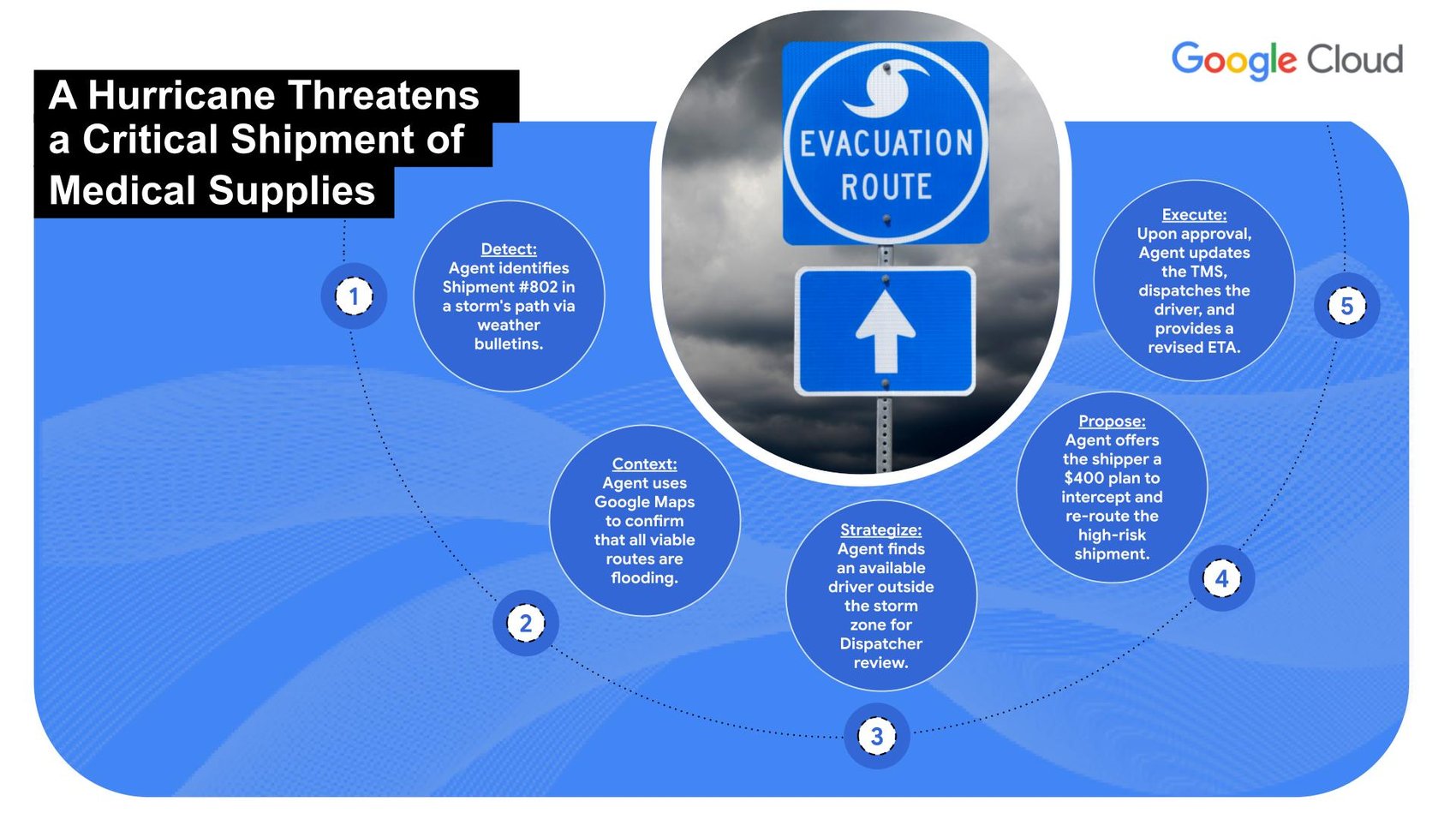
Imagine an autonomous orchestrator: an AI agent that codifies your organization’s collective expertise. It maps your network's unique patterns and anticipates seasonal demand shifts with precision. By recognizing early warning signs of delays, it proactively reroutes freight and rebalances inventory —resolving issues and communicating with shippers before a disruption becomes a crisis.
The technology exists today. AI agents can monitor shipments across an entire network, detect anomalies, query real-time conditions, and take action autonomously for routine decisions. Humans and AI agents work in concert: the agents handle routine monitoring and exception detection, freeing humans to focus on the complex judgment calls and relationship management that keep accounts growing.
Intelligent orchestration in action
Why context is everything
Most AI implementations share one limitation: they optimize in a vacuum. A traditional transportation management system calculates the most efficient route based on distance and historical patterns. It can't see that a festival closed the city center. It doesn't know that search trends show a demand spike in an adjacent market. It can't anticipate that weather patterns will shift traffic in six hours.
Intelligence without context is faster processing. Intelligence with real-world context is a strategic advantage.
Google Cloud offers something fundamentally different here. AI agents built on the Google Cloud platform see beyond a provider's network into the world around it. When an agent detects a potential shipment delay, it can query Google Maps Platform for real-time traffic patterns, check search trends for demand signals in alternative markets, and factor in weather, events, and regional dynamics that most logistics systems can't access today.
A competitor might automate document processing. But can they tell a shipper, "We rerouted your shipment because search data shows demand spiking in Ohio, and Maps data confirmed gridlock in your original destination"? That's intelligent orchestration.
The path forward
The real opportunity for our industry goes beyond back-office automation. It's digitizing what makes each company unique: their workforce’s expertise, the network intelligence, the ability to see around corners. That's what shippers will pay for. That's what AI can scale.
The technology is ready, and providers are already realizing ROI. By using Gemini and Gemini Enterprise at the core of their operations, logistics providers are moving beyond simple data tracking to true intelligent reasoning. These models allow teams to parse massive, multi-modal datasets, from complex global trade contracts to real-time port telemetry, to uncover routing efficiencies and cost-saving opportunities that were previously hidden in operational silos.
This central intelligence is operationalized through specialized tools. Vertex AI Agent Builder and Document AI turn those insights into action, slashing document processing times and automating partner communications without replacing legacy systems. WeatherNext provides the predictive foresight necessary to transform risk into a competitive advantage, allowing leaders to reroute high-value cargo days before a storm hits. Shippers are already consolidating their business with partners who deliver these tangible AI-driven outcomes.
The age of the agentic logistics provider is here. The providers who move from managing freight to orchestrating these outcomes will define the next era of global logistics.