
This content was last updated in October 2025 and represents the status quo as of the time that it was written. Google's security policies and systems may change going forward, as we continually improve protection for our customers.
Cloud HSM is part of the Cloud Key Management Service (Cloud KMS) architecture, and provides the backend for provisioning and managing hardware-protected keys. To help you meet corporate and compliance regulations, Cloud HSM lets you generate your encryption keys and perform cryptographic operations in FIPS 140-2 Level 3 certified hardware security modules (HSM).
Cloud HSM provides two protection levels for hardware-backed keys:
- Multi-tenant Cloud HSM: Multi-tenant keys are housed on clusters of HSMs that serve multiple Google Cloud customers.
- Single-tenant Cloud HSM: Single-tenant keys are housed in dedicated partitions on clusters of HSMs, where each partition serves only one customer. You create and manage your own Single-tenant Cloud HSM instances, which are cryptographically isolated from other Google Cloud customers. Single-tenant Cloud HSM instances incur additional costs compared to Multi-tenant Cloud HSM keys. For more information, see Single-tenant Cloud HSM .
Throughout this guide, references to Cloud HSM refer to both Multi-tenant Cloud HSM and Single-tenant Cloud HSM.
This paper describes Cloud HSM architecture, including how the hardware is managed and keys are attested and created. For more information about Cloud KMS, see Cloud Key Management Service encryption .
Overview
Cryptographic operations include the following:
- Encrypting data at rest
- Protecting the private keys for Certificate Authority Service
- Protecting data encryption keys so that they can be stored together with the encrypted data
- Generating and using asymmetric keys for cryptographic operations such as digital signatures and authentication
Cloud HSM uses Marvell LiquidSecurity HSMs (models CNL3560-NFBE-2.0-G and CNL3560-NFBE-3.0-G) with the firmware versions 3.4 build 09 and 10. For more information about our certification, see Certificate #4399 . For information about the HSM devices and hardware-protected keys, see key attestation .
Multi-tenant Cloud HSM is fully managed so that you can protect your workloads without the operational overhead of managing an HSM cluster. Single-tenant Cloud HSM is jointly managed between your instance administrators and Google. The Cloud HSM service provides the following advantages:
- Global availability
- A consistent and unified API
- Automatic scaling based on your use
- Centralized management and regulatory compliance
Multi-tenant Cloud HSM is available in many Google Cloud regions around the globe, including multi-regions that span larger geographies. Single-tenant Cloud HSM is available in a subset of these regions. You must use the Cloud KMS service endpoint to create and use hardware-protected keys in Cloud HSM to protect your data, including data that you store in other Google Cloud services, such as BigQuery, Cloud Storage, and Persistent Disk.
With Cloud HSM, you can use hardware-protected keys without having to manage HSM hardware yourself. Google owns and manages the HSM hardware, including deployment, configuration, monitoring, patching, and maintenance. When you use Cloud HSM, your data is strictly isolated from other tenants and services in Google Cloud. The Cloud HSM data plane API, which is part of the Cloud Key Management Service API, lets you manage hardware-protected keys programmatically.
Cloud HSM supports hardware-protected customer-managed encryption keys (CMEKs) , wherever CMEKs are supported by Google Cloud services. For example, you can encrypt data in Cloud Storage buckets or Cloud SQL tables using a Cloud HSM key that you manage. Multi-tenant Cloud HSM also supports Cloud KMS Autokey for streamlined creation and management of CMEKs.
Cloud HSM management
Within Cloud HSM, clusters of HSMs are maintained by Google site reliability engineers (SREs) and technicians who work in each Google Cloud data center location. Google handles physical security, logical security, infrastructure, capacity planning, geo-expansion, and data center disaster-recovery planning.
Abstraction of HSM hardware
Typically, applications communicate directly with HSMs using both PKCS#11 and a cluster management API. This communication requires that you maintain specialized code for workloads that use or manage hardware-protected keys.
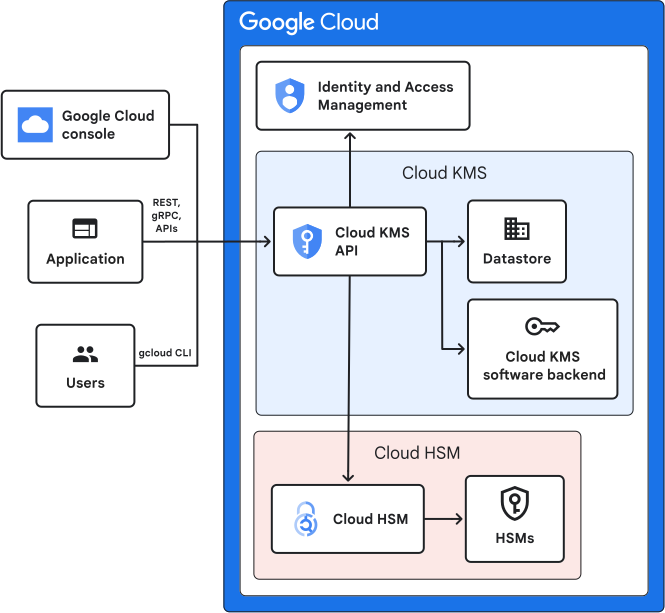
Cloud HSM abstracts communication away from the HSM by proxying requests for hardware-protected keys through the Cloud Key Management Service API. The abstraction reduces the need for HSM-specific code. Cloud HSM inherits tight integration with Cloud KMS.
Tight integration with Cloud KMS provides substantial security
benefits. The Cloud Key Management Service API significantly reduces the breadth of the HSM interface
available, reducing risk in the case of a customer security breach. For example,
an attacker would be unable to wipe entire HSMs. By default, attempts to destroy
individual keys are mitigated through a default 30-day safety
period
. You can set the constraints/cloudkms.minimumDestroyScheduledDuration
organization policy to
enforce a minimum length for the scheduled for destruction
duration for new
keys and the constraints/cloudkms.disableBeforeDestroy
organization policy to
destroy key versions only when they are disabled. For more information, see Control key version destruction
.
You can control access to HSM resources using Identity and Access Management (IAM) . IAM configuration is less likely to suffer from misconfigurations and bugs than a custom HSM solution. In addition to IAM controls, managing a Single-tenant Cloud HSM instance also requires two-factor authentication (2FA) from a quorum of at least two designated approvers . When you create an instance, you decide how many approvals are required for every change to a Single-tenant Cloud HSM instance. Approvals require challenges that are signed with private key material that you create outside of Google Cloud.
The following diagram shows the Cloud HSM architecture.
Strict geographic separation, by design
In Multi-tenant Cloud HSM, you can choose to make keys globally available or to enforce strict geographic restrictions on keys that require restrictions. Single-tenant Cloud HSM is only available in individual regions.
Often, HSMs are divided into partitions, so that a single physical device can operate as multiple logical devices. You might use partitions to reduce deployment costs in cases where you need to separate HSM administration and keys. The following diagram shows Multi-tenant Cloud HSM partitions in three regions.
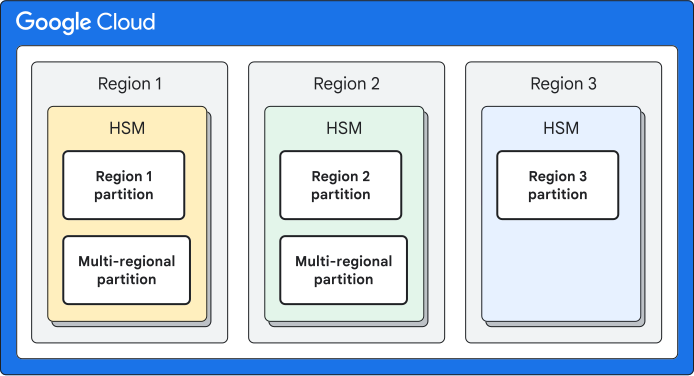
To isolate the keys for each region and multi-region, each Cloud HSM region is associated with a separate HSM regional wrapping key (see diagram in Creating keys ). To support high availability, the wrapping key is cloned onto partitions in each HSM that is physically located in the region. HSM regional keys don't leave the HSM in that location. Cloning lets HSMs in the same region serve the same set of customer keys, and ensures that HSMs outside the region cannot serve those keys.
Cloud HSM also creates multi-regions using wrapping keys. All customer keys for a multi-region are wrapped using a wrapping key present on a partition in all locations that constitute the multi-region. The service uses the same hardware for multi-regions, but provides the same strong isolation between regions and multi-regions that exists between different regions.
The regionalization scheme requires that wrapping keys are only replicated to appropriate partitions. Each configuration change must be approved by multiple members of the Cloud HSM team before it becomes active. Data center technicians can't access an HSM configuration, runtime, or storage.
When you create keys in a Single-tenant Cloud HSM instance, the wrapping keys on your dedicated partitions ensure that your keys can't be served outside of your partitions or the region.
Centralized management
In a conventional data center that hosts HSMs, management of the HSMs and their resources is entirely separate from management of other hardware-protected keys. Cloud HSM is tightly integrated into Google Cloud, allowing you to seamlessly manage your Cloud HSM resources. For example, you can manage the following:
- You manage your hardware-protected keys alongside your other keys in Cloud KMS and externally managed keys in Cloud External Key Manager (Cloud EKM) .
- You manage access to hardware-protected keys within IAM.
- Costs for cryptographic operations using hardware-protected keys are reported in Cloud Billing.
- You can use hardware-protected keys transparently in all Google Cloud services that support encrypting resources using CMEK. CMEK integrations require the CMEK key and the data it encrypts to be located in compatible geographic locations. Because of the strict geographic restriction of the Cloud HSM keys, all encryption and decryption of the CMEK data are also geographically restricted.
- Administrative operations on hardware-protected keys are always logged at the API layer in Cloud Audit Logs. You can choose to enable data-access logging as well. For more information, see Cloud KMS audit logging information .
- Google works directly with the HSM manufacturer to keep the hardware and software on each HSM updated, and to find and fix issues in real time. In the event of a zero-day exploit on the HSM, Google can selectively disable affected code paths on affected HSM clusters until the exploit is fixed.
- You can track your keys, including your hardware-protected keys and the resources that they encrypt using key usage tracking dashboards .
Developer and user experience
Because Google is responsible for HSM management, Cloud HSM offers significant benefits to developers and end users. When you use Multi-tenant Cloud HSM, you don't have to do anything to maintain your HSM clusters. When you use Single-tenant Cloud HSM, you are responsible for ongoing cluster maintenance operations using the gcloud CLI.
There are four main user personas for using Cloud HSM:
- End users: Cloud HSM is usually transparent to end users of your products and resources. For example, if your Google Cloud resources are protected with a CMEK, the data is automatically encrypted and decrypted as needed for your users by service agents.
- Developers: Your developers use your Cloud HSM keys. If you use Autokey, your developers can request new keys on-demand. If you don't use Autokey, your Cloud KMS administrators create and manage keys for your developers to use.
- Cloud KMS administrators: Your Cloud KMS administrators are responsible for creating and rotating your Cloud HSM keys. They can also manage your Autokey settings or organization policies, if these responsibilities are not handled by dedicated organization administrators.
- Single-tenant Cloud HSM administrators: If you use Single-tenant Cloud HSM, you must have a team of administrators that you trust to approve creation and maintenance operations on your Single-tenant Cloud HSM instances. Separate IAM roles control who is authorized to propose, approve, and execute changes to your instance. Changes can't be applied without prior approval, which requires quorum authentication using 2FA keys.
HSMs at Google scale
When you rely on hardware that exists on-premises or in data centers, the hardware can create a performance bottleneck or become a single point of failure. Cloud HSM is designed to be extremely resilient to unpredictable workloads and hardware failures. The Cloud HSM backend uses a pool of HSMs in each region to ensure high availability and scalability. This pool of HSMs lets Cloud HSM also provide high throughput. For more information, see Monitor and adjust Cloud KMS quotas .
All customer keys are stored wrapped with a regional wrapping key in the Cloud KMS database and can only be unwrapped by an HSM in the region as part of a cryptographic operation. This wrapping has the following benefits:
- A key's durability is not tied to a specific HSM or subset of HSMs in a region.
- Each Cloud HSM customer experiences the full scale and availability of the Cloud HSM clusters that serve their keys.
- Cloud HSM can handle a much larger set of keys that can be stored on an HSM.
- Adding or replacing an HSM is rapid and secure.
Unified API design
Cloud HSM and Cloud KMS share a common management and data plane API. The internal details of communicating with an HSM are abstracted from the caller.
Consequently, no code changes are required to update an existing application that uses software keys in Cloud KMS to support hardware-protected keys. Instead, you update the resource name of the key to use.
PKCS#11 support
You can use Cloud Key Management Service API to connect your existing applications to Cloud HSM to manage cryptographic keys. The PKCS#11 library lets you use hardware-protected keys to sign your binaries and serve TLS web sessions.
Security and regulatory compliance
Cloud HSM has obtained compliance with numerous regulations, including FedRAMP High , C5:2020 , and OSPAR . In addition, Cloud HSM helps you enforce regulatory compliance for your workloads in the cloud.
Cryptographic key attestation
Each time that you generate or import a Cloud HSM key, the HSM generates an attestation statement that is signed with a signing key that is associated with the partition. The statement contains information about your key's attributes. The signing key is backed by certificate chains that are rooted in both Google and the HSM manufacturer. You can download the attestation statement and certificates to verify the statement's authenticity and validate properties of the key and the HSM that generated or imported it.
The certificate chain lets you check the following:
- The HSM hardware and firmware are genuine.
- The HSM partition and HSM are managed by Google.
- The HSM is in the FIPS mode of operation.
The content of the attestation statement lets you check the following:
- The key is not extractable.
- The key was generated for your CryptoKeyVersion.
- The public key in an asymmetric key pair corresponds to a hardware-protected private key.
- The key material of an imported symmetric key matches the value you wrapped.
Secure key import directly into HSMs
You can securely import existing keys into Cloud HSM to maintain a backup of your key material outside of Google Cloud, or to simplify migrating certain workloads to Google Cloud. The key-import process does not allow Google any direct access to the unwrapped key material. Cloud HSM provides you with an attestation statement for the HSM-generated wrapping key to validate that no access occurred.
Because key import potentially creates security and compliance risks by allowing users to bring keys from unknown sources, separate IAM roles allow fine-grained control over who can import keys into a project. Imported keys can be distinguished by the attestation statement that the HSM generates on import.
For more information, see Importing a key into Cloud Key Management Service .
Strict security procedures safeguard HSM hardware
As mandated by FIPS 140-2 level 3, HSM devices have built-in mechanisms to help protect against, and provide evidence of, physical tampering.
In addition to the assurances provided by the HSM hardware itself, the infrastructure for Cloud HSM is managed according to Google infrastructure security design overview .
The following documented and auditable procedures protect the integrity of each HSM during provisioning, deployment, and in production:
- All HSM configurations must be verified by multiple Cloud HSM SREs before the HSM can be deployed into a data center.
- After an HSM is put into service, configuration change can only be initiated and verified by multiple Cloud HSM SREs.
- An HSM can only receive firmware that is signed by the HSM manufacturer.
- HSM hardware is not directly exposed to any network.
- Servers that host HSM hardware are prevented from running unauthorized processes.
The duties for system operators are defined in standard operating procedures. System operators are prevented from accessing, using, or extracting customer key material while performing their duties.
Service and tenant isolation
The Cloud HSM architecture ensures that HSMs are protected from malicious or inadvertent interference from other services or tenants.
An HSM that is part of this architecture accepts requests only from Cloud HSM, and the Cloud HSM service accepts requests only from the Cloud KMS service. The Cloud KMS service enforces that callers have appropriate IAM permissions on the keys that they attempt to use. Unauthorized requests don't reach HSMs.
Multi-tenant Cloud HSM keys are also subject to quotas for cryptographic operations. These quotas protect your ability to run your workloads by helping to prevent inadvertent or malicious attempts to overload the service. The default quotas are based on observed usage patterns. The quotas are significantly below the service capacity and can be increased upon request.
Request flows
This section demonstrates how the Cloud HSM architecture applies in practice by showing the steps for different types of requests. These flows emphasize the Cloud HSM portions. For more information about steps common to all keys, see the Cloud Key Management Service deep dive .
Creating keys
When you create a hardware-protected key, the Cloud Key Management Service API doesn't create the key material, but requests that the HSM create it.
An HSM can only create keys in locations that it supports. For Multi-tenant Cloud HSM, each partition on an HSM contains a wrapping key that corresponds to a Cloud KMS location. For a Single-tenant Cloud HSM instance, your dedicated partition uses a wrapping key that's dedicated to your instance. The wrapping key is shared among all partitions that support the Cloud KMS location or the Single-tenant Cloud HSM instance.
The following diagram shows how hardware-protected keys are wrapped in Cloud KMS.
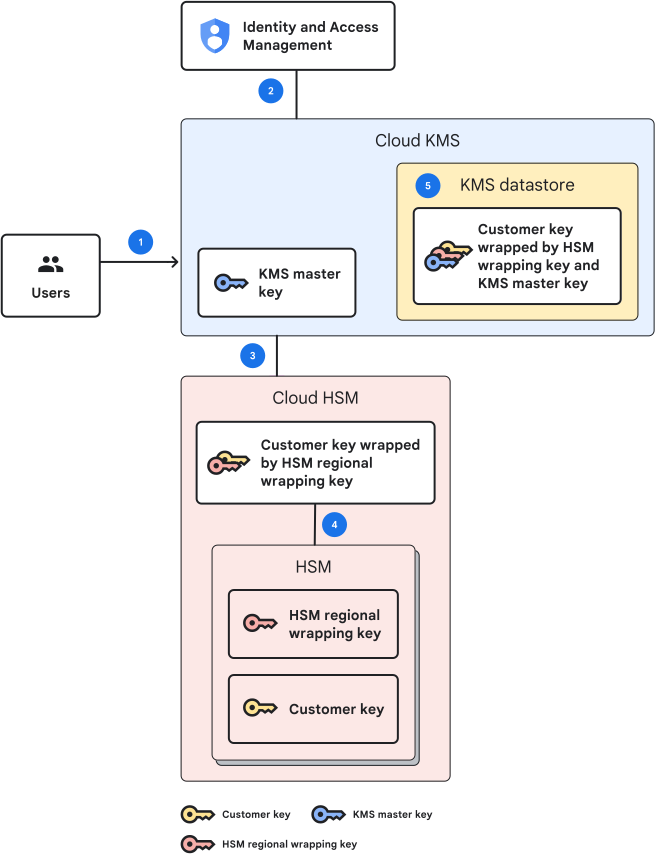
The key-creation process looks like the following:
- The Google Front End Service (GFE) routes the key creation request to a Cloud KMS server in the location that corresponds to the request.
- The Cloud Key Management Service API verifies the caller's identity, the caller's permission to create keys in the project, and that the caller has sufficient write request quota. If the caller is requesting a Single-tenant Cloud HSM key, the API also verifies that the selected Single-tenant Cloud HSM instance is available.
- The Cloud Key Management Service API forwards the request to Cloud HSM.
- Cloud HSM directly interfaces with the HSM. The HSM:
- Creates the key and wraps it with the location-specific or instance-specific wrapping key.
- Creates the attestation statement for the key and signs it with the partition signing key.
- After Cloud HSM returns the wrapped key and attestation to Cloud KMS, the Cloud Key Management Service API wraps the HSM-wrapped key according to the Cloud KMS key hierarchy , then writes it to the project.
This design ensures that the key can't be unwrapped or used outside of an HSM, can't be extracted from the HSM, and exists in its unwrapped state only within specified locations.
Cryptographic operations
When you perform a cryptographic operation in Cloud KMS, you don't need to know whether you are using a hardware-protected or software-protected key. When the Cloud Key Management Service API detects that an operation involves a hardware-protected key, it forwards the request to an HSM in the same location. The following are the steps for a cryptographic operation:
- The GFE routes the request to a Cloud KMS server in the appropriate location. The Cloud Key Management Service API verifies the caller's identity, the caller's permission to access the key and perform the operation, and the project's quota for cryptographic operations.
- The Cloud Key Management Service API retrieves the wrapped key from the datastore and decrypts one level of encryption using the Cloud KMS master key. The key is still wrapped with the HSM wrapping key for the KMS location.
- The Cloud Key Management Service API detects that the protection
level
is
HSMorHSM_SINGLE_TENANTand sends the partially unwrapped key, along with the inputs to the cryptographic operation, to Cloud HSM. - Cloud HSM directly interfaces with the HSM. The HSM completes the
following operations:
- Checks that the wrapped key and its attributes have not been modified.
- Unwraps the key and loads it into the HSM storage.
- Performs the cryptographic operation and returns the result.
- The Cloud Key Management Service API passes the result back to the caller.
Cryptographic operations using hardware-protected keys are performed entirely within an HSM in the configured location, and only the result is visible to the caller.
This diagram shows the difference between creating hardware-protected keys and software-protected keys in Cloud KMS.
CMEK integrations
All hardware-protected keys are CMEKs
. Configuring a CMEK-enabled service
to use
Cloud HSM keys is as simple as choosing a key with an HSM
or HSM_SINGLE_TENANT
protection level when following the service-specific
instructions.
When a caller reads or writes data to a CMEK-enabled service, the caller doesn't need direct permission to use the key, and the caller doesn't need to know whether the key is stored in an HSM.
The same CMEK operation flow is used with hardware-protected keys and software-protected keys, with the following exceptions when using hardware-protected keys:
- The request from the CMEK-enabled service is initiated within Google's network, and doesn't need to traverse the GFE.
- The Cloud Key Management Service API verifies that the service account for the CMEK-enabled service has proper permissions to use the key. The Cloud Key Management Service API doesn't validate permissions on the end user of the CMEK-enabled service.
Cloud HSM is required if you want to use Autokey to provision Cloud KMS keys. Autokey lets the Cloud KMS service agent provision hardware-protected keys automatically on request. For more information, see Automatic provisioning for CMEK .
Use your own HSMs
The HSMs that Cloud HSM uses are managed by Google. However, under certain circumstances, your organization might want to use your own HSMs to store the hardware-protected keys for your workloads. For example, using your own HSMs might help you with migrating your workloads to Google Cloud.
In certain locations only, Google offers an infrastructure HSM-as-a-service that provides cryptographic key operations for secure cryptographic transactions in Google Cloud. The products are known as Bare Metal Rack HSM and Bare Metal HSM . With Bare Metal Rack HSM or Bare Metal HSM, you purchase and configure your own HSMs and then ship them to Google data centers, so that they can be hosted by Google. You maintain full logical access to your HSMs and must work directly with your HSM vendor to manage and troubleshoot your devices. Google provides physical and network security, rack space, power, and network integration for a fee. For more information, see Bare Metal Rack HSM and Bare Metal HSM .
What's next
To learn more, explore the following resources:
