



■(19-2)英語訳論文『エドヴァルド・ムンクの去勢不安』(2)
Castration anxiety and phallic symbolism
Munch remained single throughout his life. However, he is known to have had relationships with four or five women who were important to the creation of his works. These relationships did not last long, and all ended unhappily. Munch, who suffered deep emotional pain (the women involved must have also suffered some kind of pain), persistently pursued those memories and made them permanent in his works. According to Munch's friend Rolf Stenelson, Munch did not seem to have any gratitude for the women he had relationships with, nor did he look back on them with joy. For Munch, women were always demonic beings who sucked the living blood of men like vampires, hunted for lovers, and destroyed them.
J.P. Hodin, who visited Munch while he was alive and wrote a critical biography of him, introduces the following view of Jungian psychologist G.W. Digby.
"Why can't Munch love? Why can't he surrender himself to the ideal of a woman and her love without feeling guilty, without feeling physical passion, without feeling a sense of loss?... This may be due to the childish consciousness that lies deep within Munch, who felt deceived by his mother, who rejected and abandoned him, crushed his longing for love, and turned him into a rotting corpse. [7]"
I think there are two patterns in Munch's relationships with women. One is when he is attracted to a married woman, and in a relationship that includes her husband, he is torn between the joy of love and jealousy. The second is when he is in a relationship with an unmarried woman, and when the woman adores him and wants to marry him, Munch runs away.
However, both are the same in that Munch avoids marriage.
It may be said to be an unconscious reenactment of the Oedipus conflict (the love triangle within the family that Lacan talks about).
Munch's first lover, whom he recalled in his diary as "Français Heyselberg," was Emily Ellen Thaulov, the wife of his cousin Carl Thaulov. The two met in the summer of 1884, when Munch was 22 years old, in Åsgårdstrand. This place, facing the fjords of Oslo, would later become important as a place for Munch to create his artworks.
Ten years after their meeting, his relationship with Mrs. Thaulov began to appear in his works. These include "Voices," "Looking at Each Other," "Enchanted 1 and 2," "Moonlight," "Separation," and "Ashes." All of these works have a wide variety of variants, including oil paintings, copperplate engravings, lithographs, and woodblock prints. The seaside of Åsgårdstrand on a summer night was the setting for this secret love affair.
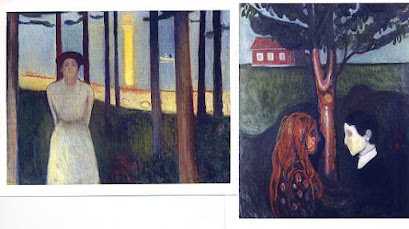
Munch said that he was a man who came from a monastic home, and that he had never experienced love until he met Madame Thaulov. She was said to have been a beautiful woman with a singing voice. In the work "Voice" (Figure 1), a young woman in white clothes is standing in a pine forest by the sea, facing the viewer, with her hands behind her back and her chest exposed. A boat can be seen in the distance in the sea between the trees. Two figures are in it. The moon is casting a pillar of light resembling a male organ onto the water.
The composition of a figure facing forward with two figures following behind it is a common pattern in Munch's figures. Someone is watching, someone is chasing, someone is targeting. Munch always harbors such feelings of anxiety deep in his heart. The figure behind sometimes changes shape and becomes the shadow of the figure facing forward. It looms huge and black as an unidentifiable presence of anxiety and as the shadow of death. Madame Taurov in "Moonlight" is dressed in mourning clothes. With her hands behind her back, she stands like a ghost in the moonlight. A huge shadow stands behind her. It is a shadow that is far too unnatural for the moon to be the light source. And for whom is she mourning? Perhaps it is a representation of Munch's own unconscious, yearning for the death of her husband.
Incidentally, strange pillars of moonlight appear in the works depicting the sea in relation to Madame Thaulov, like clichés in children's drawings (e.g. tulips, houses, suns, etc.). This is a symbol of Munch's sexual desire combined with "purity." "Purity" is expressed by the woman's white clothing and her hands behind her back. This is Munch's image of Madame Thaulov, and also a projection of Munch's own mentality, which had never experienced love.
How is this image destroyed, and hatred for women erupts?
Let's look at "Ashes," which depicts the end of his relationship with his wife. The man, holding his head in despair, is crouching with his back to the woman. The woman stands with her arms outstretched, holding her head in both hands, with a look of astonishment and surprise on her face. Her white dress is disheveled, her chest is exposed, and her red underwear is visible. You can guess what happened. "Red is the natural color of sexual desire. It is the only color that affects animals. It is closest to the symbol of the phallic body."[8]" said O. Spengler. Arne Eggum of the Oslo Museum of Art reports that in a recently discovered draft by Munch, he openly describes a love scene with Mrs. Thaulov.
The moonlight in the shape of a male genitalia shines in as a sign of the sadness of being abandoned. It is not a symbol of burning young desire. It is a compensation for the anxiety of the failure of love, which is a prelude to the illicit love affair from the very beginning. To avoid anxiety, the phallic symbol appears as a defense mechanism of the ego. It can be said that this is Munch's castration anxiety.
In the work entitled "Enchanted 2", a man and a woman look at each other, and the woman's long hair is wrapped around the man. Between them is a moon pillar. In the work "Looking at Each Other" (Fig. 2), which uses the same motif, a tree is painted instead of the moon pillar. The moon pillar and the tree play the same role. However, they are not exactly the same. There are traces of a branch having been chopped off at the crotch of this tree. The cut edge has been painted with red paint, and looks as if it is bleeding. The man has a sad, expressionless, pale face, gazing into the woman's eyes. It is as if the man has become impotent in front of the woman's imposing and vital presence.
(Figure 1) (Figure 2)
Munch's wandering period, which began in 1892, began with his relationship with Dagny Juhl, whom he met in Berlin. This relationship was a love triangle involving Strindberg and the Polish writer Stanislaw Przybyszewski (known as Stahu), who would later become her husband. "The Red Ivy" was born from this relationship. This work has a very complex content. The position of Stahu, the protagonist of the painting, seems to be Munch's own position. However, I do not have the space to explain the meaning of this work here. For now, it is enough to pay attention to the fact that a tree is ostentatiously painted behind Stahu, who is stiff with anxiety and fear, and one of the three branches has been cleanly cut off.
Sigmund Freud says that anxiety causes repression, not repression causes anxiety. He also says that anxiety appears as a reaction to the loss of a loved one, and that castration anxiety and death anxiety are the same thing. This is because castration anxiety also involves separation from a valued object (male reproductive ability).
Changes in the form of “ The Kiss”
Munch called his works "my children." In fact, his works were his ego itself. When his mother died, he prayed as the son of a devout Christian family, but in the end, religion did not save him. Munch established his ego not through religion, but through painting. Illness, madness, and death took too much from Munch. He thought that one day he would be destroyed, abandoned, or lost. For him, the loss of something that belonged to him, whatever it was, meant the collapse of the self. He confirmed that he had not lost it by painting. During his 81-year life, he painted the same motif repeatedly. And no other artist made as many replicas (copies made by the original artist) as Munch. Whenever he had to give up a work, he always made a replica. Every work he sold had variants and replicas. Six replicas of the early work The Sick Child have been confirmed. Now, Munch's repressed sexuality began to threaten his spirit.
Women were intruding into the artistic creation life that Munch held dear, and destroying it, he thought. If he got too close to women, he risked being absorbed into it. For Munch, that would be like killing himself.
But on the other hand, I think Munch had a shrewd spirit as an artist. In later years, Munch said:
"I want to preserve this vulnerability. It's a part of me. I don't want to shy away from illness. My art owes a lot to my illness."[9]"
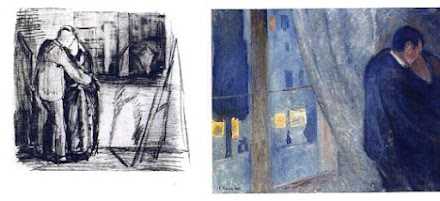
Munch was clearly aware that his art was born from his own painful experiences. He was introverted and taciturn, but he was willing to expose himself for the sake of his art. To an almost masochistic extent. As for his relationships with women, was it just a coincidence that Munch was drawn to women who were married? The Bohemian group certainly advocated free love under the banner of women's liberation. But what about Madame Thaulov, his cousin's wife? What about Oda Krogh, his teacher's wife? And what about the love square between the friends? When Dagny Juhl married Stahu in 1893, Munch was tormented by jealousy and became delusional that Stahu was persecuting him. This was Munch's love pattern. If we examine the variants of “The Kiss” in chronological order, the relationship between Munch's mental state and his artistic achievements becomes clear. The first sketch for this work was The Farewell (Figure 3), dated 1889. Lovers are kissing at a window in the studio at night. That it is night can be seen by the fact that the shadows of the people and the easel are directed towards the window, lit from within. It is dark outside the window, and a building is vaguely visible. The lovers are slightly away from the window, as if hiding. This accentuates the sexual scent, and gives the impression of a tryst.
In the 1892 oil painting (Figure 4), this is unmistakable. The illicit lovers embrace tightly and kiss each other behind the window curtains. The window, which takes up two-thirds of the painting, reveals a building and figures opposite. These are truly 'the eyes of the world.'
(Fig. 3) (Fig. 4)
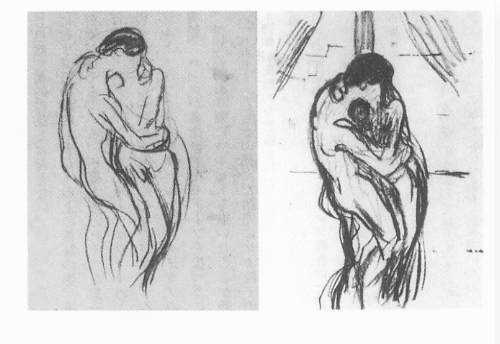
However, in the two sketches from 1895 (Fig. 5), the lovers are completely naked. The pencil lines intertwine in layers, trying to capture the pose of burning lust.
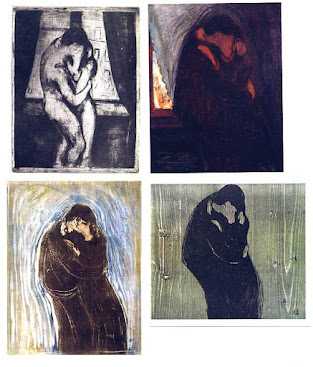
These sketches were printed in copperplate in the same year (Fig. 6). Of the vast number of kissing images from around the world, past and present, this one may be said to be the most realistic. It is vivid and beautiful. The contours of the bodies of the two people embracing each other intertwine, penetrate each other, disappear, then reappear, and finally intertwine thickly to clarify the form. Nevertheless, the faces that are pressing their lips together are only distinguished by a faint line, and are almost melted into each other. The lovers, who have given themselves over to their desire, are in the center of the window, as if they don't care about the public's eyes, or rather, as if they are showing off.
But Munch's pursuit continues.
In the 1897 oil painting (Fig. 7), the lovers are clothed again, but the descriptive quality of the 1892 work is lost and the painting is somewhat simplified. The windows are mostly closed with curtains, but street lights and human figures can be seen through small openings, hinting at the secrecy of this love affair. Munch's attention, however, is more inclined to pursue the silhouette of the man and woman united together. Their faces are completely fused.
In the woodblock print "Kissing" (Fig. 8), produced between 1897 and the following year, all explanatory extraneous matter has been removed. The man and woman have melted into a single, phallic silhouette. The surrounding atmosphere undulates and pulsates.
But eventually Munch removes even those wavy ripples. The woodcut (Figure 9) created around 1902 pursues the simple form of the subject, a characteristic of woodcut prints, to the extreme, simplifying it to the point where it seems no further could be achieved. Thirteen years after the first sketch, the form stands out as an extremely clear phallus.
G. W. Digby, mentioned above, points out that the characteristics of an introverted artist are "a tendency toward simplification, a stripping away of the image to its essentials, and an emphasis on contour," and says, "which is equivalent to psychology."
What kind of year was 1902 for Munch, when he created the final version of "The Kiss"?
(Figure 5)
(Figure 6) (Figure 7)
(Figure 8) (Figure 9)
In 1901, Dagnyi (who had married Stahu in 1893), the central figure in the love square, was shot in the head with a pistol by a man who was her husband's friend and her lover. The man also committed suicide on the spot. He had become mentally unstable.
Munch was jealous of the marriage of the Stahus and suffered from delusions of persecution from the husband, so this incident was not something that could be ignored. At the time, Munch was in a romantic relationship with Thura Larsen, the daughter of a wealthy wine merchant in Oslo. In fact, he thought that the relationship had been settled two years earlier. The two met in 1897. They had traveled together to various European cities, but when she asked Munch to marry her, Munch ran away. This was another of Munch's romantic patterns. When an unmarried woman wanted to marry him, he felt fear, avoided her, and hated her. His complicated relationship with Tulla came to a dramatic end in the summer of 1902.
One stormy night, Munch's friends came to visit him. They told him that Tulla was on her deathbed and wanted to see him just once more. Munch was moved, and accompanied his friends to her house.
When Munch entered the room, Tulla, who had been sleeping, suddenly woke up and demanded that he marry her. She pulled out a pistol -- Munch remembered that the pistol had been inserted inside a book called "Sex and Character" by Otto Weininger. In the midst of the ongoing events, he was watching the events as if from heaven -- and said that if Munch did not marry her, she would commit suicide, and pointed the gun at her chest. As Munch struggled with her to snatch the pistol from her, it went off. The bullet pierced the ring finger of Munch's left hand.
The loss of self that Munch feared most became a reality in the form of a physical loss.
Later, in a letter to a friend, Munch wrote:
"Her vulgar nature has ruined my life...miraculous hands, the hands that are the miracle of God destroyed...can you imagine what that is like...the pain of love can be forgotten, but the physical mutilation is irreparable. [10]" (Italics by Yamada)
This incident was probably a major trigger, and Munch's delusions of persecution became even more intense. He became suspicious of his friend, and even assaulted him. This was in 1902.
"The miracle of God" - that is, the superego (the force of fate). Munch's hands were the medium between his ego (painting) and the superego. To lose one's hands is to be abandoned by the superego, and one no longer has any protection against any danger. It is "irreversible." He had to make up for it somehow.
Thus, "The Kiss" has revealed its phallic form. One could say so.
Artistically, the powerful simplicity of the subject matter has earned it a monumental status in the history of printmaking.
In conclusion
Munch suffered from schizophrenia in 1908 and was treated in a psychiatric hospital. He was released a year later, and it is said that he had no particular symptoms after that.
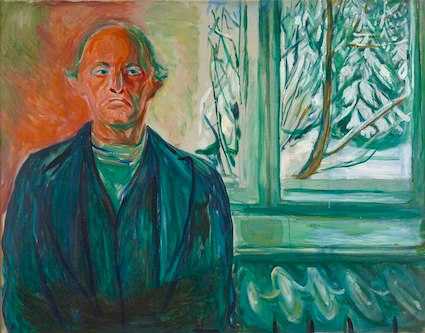
"Self-Portrait at a Window" (Figure 10), painted when Munch was around 77 years old, that is, around 1940, is the most impressive self-portrait of Munch's later years.
Munch is standing in the left half of the painting. Perhaps it is the heat radiating from the heater, but his face is bright red and his lips are tightly pressed together. He gives off the impression of being stubborn and self-assured.
A glass window takes up the right half of the painting. The outside is covered in snow. It is the death of the season. But Munch seems to be stubbornly confronting death. In the snow, there is a single tree, standing tall and arching. The tree's unmistakable presence supports the composition of the painting, creating a terrifying sense of tension. The tree's shameless cut is no longer to be found. Its phallus stands erect, manly, in the face of approaching death.
(Figure10)
References
[1] Teiichi Hijikata, "Edvard Munch - Man and Art," Catalogue of the Edward Munch Exhibition, Kanagawa Prefectural Museum of Art, 1970.
[2] Tadao Miyamoto, "Regarding Munch's 'The Scream'," Considerations on Human Abnormality, Chikuma Shobo, 1970.
[3] N. Stang, "Edvard Munch: A Biography," translated by Masahiko Inatomi, Chikuma Shobo, 1974.
[4] J.P. Hodin, "Edvard Munch," translated by Noriko Minato, PARCO Publishing, 1986.
[5] Miyahiko Miki, "The Age of Munch," Tokai University Press, 1992.
[6] Same as [3].
[7] Same as [4].
[8] O. Spengler, The Decline of the West, Vol. 1, translated by Muramatsu Masatoshi, Satsuki Shobo, 1977.
[9][10] The same book as [3].
References
[1] Miyamoto Tadao, Modern Abnormality and Normality, Heibonsha, 1972.
[2] Miyamoto Tadao, "The Sun and Schizophrenia," in Psychopathology of Schizophrenia 3, edited by Kimura Satoshi, Tokai University Press, 1974.
[3] Miyamoto Tadao, "Hallucinations and Creativity," in Fundamentals and Clinical Practice of Hallucinations, edited by Takahashi, Miyamoto, and Miyasaka, Igaku Shoin, 1970.
[4] Freud, "Inhibition, Symptoms, and Anxiety," in The Collected Works of Freud, Vol. 6, translated by Imura, Okonogi, et al., Jinbun Shoin,1970.
[5] Rudolf Lemke, "Madness in Paintings," translated by Fukuya Takehito, Yuhikaku, 1981.
[6] Catalogue of the "Munch Exhibition," Idemitsu Museum of Arts, 1993.
©Tadami Yamada. All Rights Reserved.
ジャンル別一覧


人気のクチコミテーマ
-
-

- 読書備忘録
- 恋とか愛とかやさしさなら 一穂 …
- (2026-05-01 09:34:44)
-
-
-

- ミステリはお好き?
- 【読書】地雷グリコ/12月22日~30日…
- (2026-05-03 20:30:04)
-
-
-

- ★ おすすめのビジネス書は何ですか!…
- やりたいことは全部やりなさい/森永…
- (2026-04-29 13:12:15)
-
© Rakuten Group, Inc.
