



PR
令和維新
2004年4月から企業を離れ、コンサルタントや情報起業を試行しなが ら、失われた20年を取り戻し、日本再生をめざす私の歩みをみて一人でも多くの後継者が出てくれることを祈りつつ友達から紹 介されたこのホームページの更新を続け、これまでの活動の記録と今やビッグデータ、AI,、IOT,ブロックチェーン、仮想通貨の時代になってしまいましたが、私の現状認識と関連技術を紹介していきたい。
先端技術情報20260731
「貨幣と経済について正しく理解しよう」貨幣と経済に関する無理解
FRBのバランスシート拡大:なぜ2026年が次の暗号資産強気相場の引き金となり得るのか(Fed’s Balance Sheet Expansion: Why 2026 Could Trigger the Next Crypto Bull Run)
デジタル革命:今ビットコインに投資することが、あなたの最も戦略的な一手になり得る理由(The Digital Revolution: Why Investing in Bitcoin Now May Be Your Most Strategic Move Yet)
(1)2026年に世界を激変させるテクノロジートレンド17(17 Technology Trends That Will Transform Our World in 2026)
先端技術情報20260730
基盤から立て直そう
暗号資産への巨大な警鐘:ウォール街の9億ドル買いシグナルが本当に意味するもの(Crypto’s Massive Wake-Up Call: What Wall Street’s $900M Buy Signal Really Means)
(2)デジタル革命:今ビットコインに投資することが、あなたの最も戦略的な一手になり得る理由(The Digital Revolution: Why Investing in Bitcoin Now May Be Your Most Strategic Move Yet)
先端技術情報20260729
「貨幣と経済について正しく理解しよう」貨幣と経済に関する無理解
FRBのバランスシート拡大:なぜ2026年が次の暗号資産強気相場の引き金となり得るのか(Fed’s Balance Sheet Expansion: Why 2026 Could Trigger the Next Crypto Bull Run)
デジタル革命:今ビットコインに投資することが、あなたの最も戦略的な一手になり得る理由(The Digital Revolution: Why Investing in Bitcoin Now May Be Your Most Strategic Move Yet)
(1)2026年に世界を激変させるテクノロジートレンド17(17 Technology Trends That Will Transform Our World in 2026)
先端技術情報20260730
基盤から立て直そう
暗号資産への巨大な警鐘:ウォール街の9億ドル買いシグナルが本当に意味するもの(Crypto’s Massive Wake-Up Call: What Wall Street’s $900M Buy Signal Really Means)
(2)デジタル革命:今ビットコインに投資することが、あなたの最も戦略的な一手になり得る理由(The Digital Revolution: Why Investing in Bitcoin Now May Be Your Most Strategic Move Yet)
先端技術情報20260729
Comments
FreshP
@ Re:(2)最高のETHボット:狙撃手、コピートレード、ウォレット追跡(テレグラム&ウエブ) Best ETH Bots: Sniper, Copy Trading, Wallet Trackers - Telegram & Web(04/02)
正直、私はずっとGunbotを好んでいました…
Rajshekhar
@ Re:(1)2024年2月に50~100倍の可能性がある上位8つの仮想通貨プロジェクトは何か?(What are the top 8 crypto projects with50–100x potential in February 2024?)(02/27)
It is based on the decentralized concep…
やすじ2004
@ Re:2024年に仮想通貨ネオバンキングに切り替える8つの説得力のある理由とは?(op 8 Compelling Reasons to Make the Switch to Crypto Neo Banking in 2024?)(01/17)
寒い日が続くので、週末はしっかり食べて…
aki@ Re:ビットコインアナリストのプランBは10ヶ月間の「顔が溶けるFOMO」を予測Bitcoin analyst PlanB predicts 10 months of ‘face melting FOMO’(03/12)
この様な書込大変失礼致します。日本も当…
Adobe@ Re:(2)CIDM Sponsor Profile – Adobe Technical Communications CIDM スポンサー紹介- アドービ テクニカル・コミュニケーションズ(01/04)
XML Documentation for Adobe <small> <a…
🌸 新作「二人の宇宙…
New!
神風スズキさん
木曽福島機関区のC12… New!
GKenさん
New!
GKenさん
2026年7月31日の…
New!
藻緯羅さん
源氏物語〔35帖 柏木…
New!
USM1さん
ハープコンサート in… 47弦の詩人さん
木曽福島機関区のC12…
New!
GKenさん2026年7月31日の…
New!
藻緯羅さん源氏物語〔35帖 柏木…
New!
USM1さんハープコンサート in… 47弦の詩人さん
Category
カテゴリ未分類
(112)連絡
(24)交流会
(27)セミナー
(29)参考情報
(138)オフ会
(36)on-line報告会
(13)翻訳ビジネス
(8)情報開発
(270)ビッグデータ
(88)ブロックチェーン
(249)人工知能
(536)IOT
(307)仮想通貨
(868)コンテンツ
(127)政治経済
(1948)先端技術
(964)DITA
(52)テレワーク
(28)UX
(0)文書管理
(8)テクニカルライテイング
(23)学習
(9)訓練
(1)XMLソリューション
(3)メタバース
(101)Web3
(68)投資
(192)IoT
(34)投資信託
(1)ビットコイン
(789)イーサリアム
(163)NFT
(41)オンライン
(0)受動収入
(14)ソーシャルメデイア
(0)DAO
(2)DeFi
(79)暗号通貨
(168)トークノミクス
(22)アルトコイン
(229)空中投下
(16)スマート契約
(4)ステーブルコイン
(42)金
(5)生成AI
(5)SCM
(4)ウオレット
(9)不労所得
(58)セキュリテイ
(4)ミームコイン
(50)CBDC
(5)PoS
(3)PoW
(1)ETF
(15)仮想通貨ETF
(1)予言
(7)裁定取引
(1)GameFi
(5)マイニング
(9)RWA
(25)DePIN
(22)SWFT
(1)WLFI
(1)アービトラージ
(7)XRP
(67)大統領選
(4)BCH
(1)取引ボット
(17)トレーデイング
(52)不動産
(1)詐欺
(4)貿易戦争
(1)医療
(1)金融
(2)TEZOS
(1)CARDANO
(2)カルダーノ
(3)ステーキング
(5)チェーンリンク
(1)開発
(0)HEDERA
(3)スマートマネー
(0)流動性
(0)AIエージェント
(19)401k
(1)国際送金
(1)solano
(1)AI
(1)暗号資産
(75)機関投資家
(5)量子コンピューター
(4)AIエージェント
(1)ドキュメンテーション
(2)AIトレーデイング
(1)Keyword Search
▼キーワード検索
Freepage List


Shopping List
お買いものレビューがまだ書かれていません。
2026.06.23

テーマ: 英語のお勉強日記(8442)
カテゴリ: 暗号資産
People prefer digital banks over crypto wallets: Can a 9% return on holdings change reality?
人々は暗号資産ウォレットよりデジタル銀行を好む:保有資産に9%のリターンがあれば、この現実は変わるのか

IC News
ICニュース
Nov 22, 2025
2025年11月22日
Digital wallets won the payments war. By mid-2025, around 65% of US adults used them, accounting for 39% of e-commerce and 16% of in-store transactions.
デジタルウォレットは支払い戦争に勝利した。2025 年半ばまでに、米国の成人の約 65% がデジタルウォレットを使用し、 EC 取引の 39%、店頭取引の 16% を占めるようになった。
Apple Pay and PayPal are now boring infrastructure, the default way millions move money without thinking about it.
Apple Pay と PayPal は今や退屈なインフラとなり、 何百万人もの人々が何も考えずにお金を動かすデフォルト手段になっている。
Web3 ウォレットはそうではない。Mercury と Protocol Theory が 9 月に米国の成人 3,428 人を対象に行った調査では、 暗号資産ウォレットを「直感的」と感じる人はわずか 13%、 「自分のお金の管理に自然に馴染む」と答えた人は 12% に過ぎなかった。
For comparison, 75% and 64% say the same about traditional digital wallets. The gap is not marginal, but is structural. Most Americans have never seen a Web3 wallet in real life, and this week saw two direct attempts to close that gap.
比較として、従来のデジタルウォレットではそれぞれ 75%、64% が同じように答えている。この差はわずかなものではなく、構造的なものだ。たいていのアメリカ人は現実世界で Web3 ウォレットを見たことがなく、 今週、そのギャップを埋めようとする 2 つの直接的な試みがあった。
Aave launched a savings app offering up to 9% APY with balance protection, with a $1 million limit. Meanwhile, Mastercard expanded its Crypto Credential system to self-custody wallets on Polygon, replacing hex addresses with verified usernames.
Aave は、最大 9% の APY と残高保護を提供する貯蓄アプリを開始し、上限は 100 万ドルとなっている。一方、Mastercard は Crypto Credential システムを ポリゴン上の自己保管ウォレットに拡張し、 16 進アドレスを認証済みユーザー名に置き換えた。
Both borrow heavily from mainstream finance UX, high-yield savings accounts, KYC-verified aliases, and both bet that making DeFi feel less foreign will pull in the wallet-curious majority still sitting on the sidelines.
どちらも、従来金融の UX、高利回りの貯蓄口座、KYC 済みの別名といった要素を大きく取り入れ、 「DeFi を異質に感じさせないこと」が、まだ傍観しているウォレットに興味はある層を引き込むことに賭けている。
The question is whether better UX alone can move a 13% intuitiveness score, or whether the problem runs deeper than interface polish and headline yields.
問題は、UX を改善するだけで「直感的」と答える 13% という数字を動かせるのか、 それとも課題は UI の磨きや高利回りといった表面的なものを超えて、もっと深いところにあるのか──という点だ。
The perception problem
認知の問題
The Mercuryo data shows wallets stratified by income and familiarity. More than half of Americans earning over $100,000 now own crypto, compared with roughly one in four earning under $40,000.
Mercuryo のデータは、ウォレット利用が収入と慣れによって階層化されていることを示している。年収 10 万ドル以上のアメリカ人の半数以上が現在暗号資産を保有しているのに対し、 4 万ドル未満の層では約 4 人に 1 人にとどまる。
高所得者は、自己保管ウォレットを使う可能性が低所得者のほぼ 3 倍に達する。低所得層のユーザーは、送金回廊やビットコインATMなどの「取引回廊」に集中しており、そこでは手数料が 15〜20% に達することもある。
The researchers frame this as crypto quietly entrenching inequality rather than solving it.
調査研究者たちは、これを「格差を解消するどころか、静かに固定化している」と捉えている。
That skew matters because it reveals Web3 wallets as specialized tools for the affluent and technically confident, not mass-market infrastructure.
この偏りが重要なのは、Web3 ウォレットが大衆向けインフラではなく、裕福で技術に自信のある層向けの専門ツールであることを示しているからだ。
一方、デジタルウォレットはその逆を行うことで主流化した。複雑さを抽象化し、新しい思考モデルを必要とせず、既存の銀行口座やカードに直接つながった。
PayPal does not ask users to manage seed phrases or understand gas. Apple Pay does not expose public-key cryptography. Web3 wallets do, and the Mercuryo study suggests most people find that cognitively foreign and intimidating.
PayPal はユーザーにシードフレーズの管理やガスの理解を求めない。Apple Pay は公開鍵暗号を見せない。だが Web3 ウォレットはそれを要求し、Mercuryo の調査では多くの人がそれを「認知的に異質で、恐怖を感じる」と答えている。
The adoption ceiling is not about awareness. Crypto ownership has risen steadily. The ceiling is about every day fit. Only 16% of respondents have ever witnessed a Web3 wallet transaction in person, and many describe addresses and seed phrases as clunky and anxiety-inducing.
採用の上限は「認知度」の問題ではない。暗号資産の保有率は着実に上がっている。問題は「日常生活への適合性」だ。回答者のうち、Web3 ウォレットの取引を実際に見たことがあるのはわずか 16%。多くの人がアドレスやシードフレーズを「不格好で、不安を誘うもの」と表現した。
It is not possible to normalize something that still feels like a subculture ritual.
サブカルチャーの儀式のように感じられるものを、一般化することはできない。
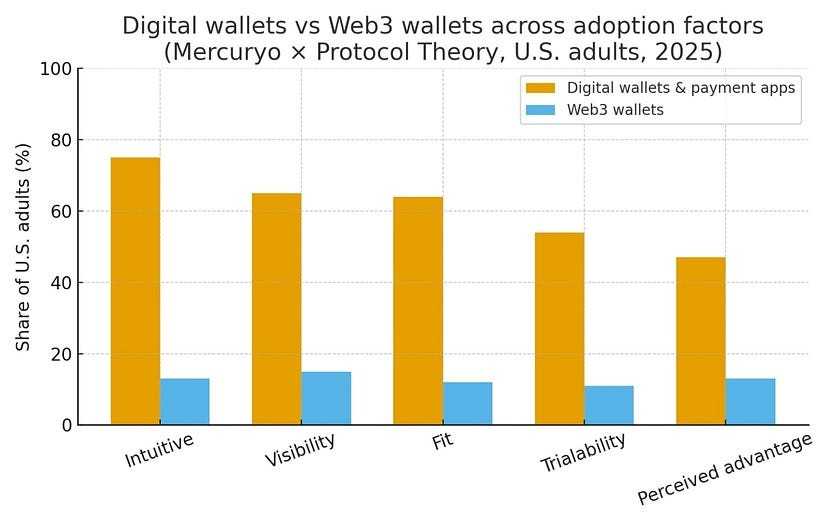
Digital wallets outpace Web3 wallets across all adoption metrics, with 75% finding traditional wallets intuitive versus just 13% for crypto wallets.Tentar novamente
あらゆる採用指標でデジタルウォレットは Web3 ウォレットを上回っており、従来型ウォレットを「直感的」と感じる人が 75% なのに対し、暗号資産レットはわずか 13% にとどまる。再試行。
Aave wraps DeFi in a savings-account shell
Aave は DeFi を「貯蓄口座の殻」に包み込む。
Aave’s new app tries to fix this by hiding the protocol entirely. The iOS app positions itself as a retail savings product paying up to 9% APY through a mix of base yield and task-based bonuses for identity verification, auto-savings, and referrals.
Aave の新アプリは、プロトコルそのものを完全に隠すことで、この問題を解決しようとしている。この iOSアプリは、本人確認・自動積立・紹介などのタスクに基づくボーナスと基本利回りを組み合わせ、最大9%のAPY を支払う小口向け貯蓄商品として位置づけられている。
The marketing explicitly compares this to traditional savings: US accounts average roughly 0.4% APY, while high-yield accounts cluster in the 3%-4% range.
マーケティングではこれを従来の貯蓄口座と明確に比較しており、米国の平均 APY は約 0.4%、高利回り口座でも 3〜4% 程度に集中している。
Independent banking data />that top high-yield savings rates sit around 4% to 5%, while the broader average is closer to 0.2%.
独立した銀行データでも、最高水準の高利回り口座は 4〜5% 程度で、全体平均は 0.2% に近いことが確認されている。
Aave also promises up to $1 million in balance protection, marketed as coverage far above the FDIC’s $250,000 cap.
Aave は最大 100 万ドルの残高保護も約束しており、これは FDIC の 25 万ドル上限を大きく上回る補償として宣伝されている。
Follow-up reporting clarifies this is commercial insurance specific to the custodial app, not FDIC deposit insurance or Aave’s on-chain safety module, and the provider remains undisclosed.
続報によれば、これは FDIC 保険でも Aave のオンチェーン安全モジュールでもなく、保管型アプリ固有の商業保険であり、提供者は非公開のままだ。
Technically, users do not control keys. Deposits sit in ERC-4337 smart accounts managed by an Aave guardian multisig, with passkeys and session keys abstracting away seed phrases entirely.
技術的には、ユーザーは鍵を管理しない。預け入れは Aave のガーディアン・マルチシグが管理する ERC-4337 スマートアカウントに置かれ、パスキーとセッションキーによってシードフレーズは完全に抽象化されている。
That architecture lets Aave strip out the “scary” parts, gas, contract interaction, private-key custody, and deliver instant withdrawals, support for over 12,000 banks and cards, and a UI that looks identical to a fintech savings app.
このアーキテクチャにより、Aave はガス、コントラクト操作、秘密鍵管理といった「怖い部分」を取り除き、即時出金、1万2千以上の銀行・カード対応、フィンテックの貯蓄アプリと同一に見える UI を提供できる。
Users see projected earnings, recurring deposits, and a balance. They do not see Ethereum, lending pools, or transaction logs.
ユーザーが見るのは予測収益、定期入金、残高だけであり、イーサリアムやレンディングプール、トランザクションログは見えない。
========================
インターネット・コンピュータランキング
==============================
ネットサービスランキング
==============================
![[商品価格に関しましては、リンクが作成された時点と現時点で情報が変更されている場合がございます。]](https://hbb.afl.rakuten.co.jp/hgb/55273e45.b00732d0.55273e4d.aafa5f24/?me_id=1411705&item_id=10000004&pc=https%3A%2F%2Fthumbnail.image.rakuten.co.jp%2F%400_mall%2Fzenbofficial%2Fcabinet%2Fthumb%2F15offcp%2Fmar08_260615.jpg%3F_ex%3D240x240&s=240x240&t=picttext "[商品価格に関しましては、リンクが作成された時点と現時点で情報が変更されている場合がございます。]")
【15%OFFクーポン】【糖質オフの豆100%麺】ZENB ゼンブ ヌードル 丸麺 8食~ 送料無料 パスタ そば ラーメン | 糖質オフ グルテンフリー 糖質制限 糖質コントロール 小麦粉不使用 たんぱく質 食物繊維 低GI 置き換え ダイエット時の栄養補給に
価格:2,620円~(税込、送料無料) (2026/6/23時点)

![[商品価格に関しましては、リンクが作成された時点と現時点で情報が変更されている場合がございます。]](https://hbb.afl.rakuten.co.jp/hgb/552743c6.f8e9b45b.552743c7.83e3936e/?me_id=1405737&item_id=10000348&pc=https%3A%2F%2Fthumbnail.image.rakuten.co.jp%2F%400_mall%2Fdogenka-miyazaki%2Fcabinet%2Fimgrc0083985721.jpg%3F_ex%3D240x240&s=240x240&t=picttext "[商品価格に関しましては、リンクが作成された時点と現時点で情報が変更されている場合がございます。]")
\5/28販売開始/【超高確率みくじ 第3弾】2本セット【150口限定】山崎18年 白州18年 響17年 宮城峡10年 竹鶴 イチローズ 津貫 など 福袋 酒くじ おみくじ ウイスキー くじ 最新
価格:12,999円(税込、送料無料) (2026/6/23時点)
お気に入りの記事を「いいね!」で応援しよう

[暗号資産] カテゴリの最新記事
-
あなたの暗号資産戦略は2025年にはもはや… 2026.07.28
-
暗号資産の地合いが底に達したとき:その… 2026.07.24
-
ブロックチェーン上のゴールド:なぜ2026… 2026.07.16


【毎日開催】
15記事にいいね!で1ポイント


© Rakuten Group, Inc.
