

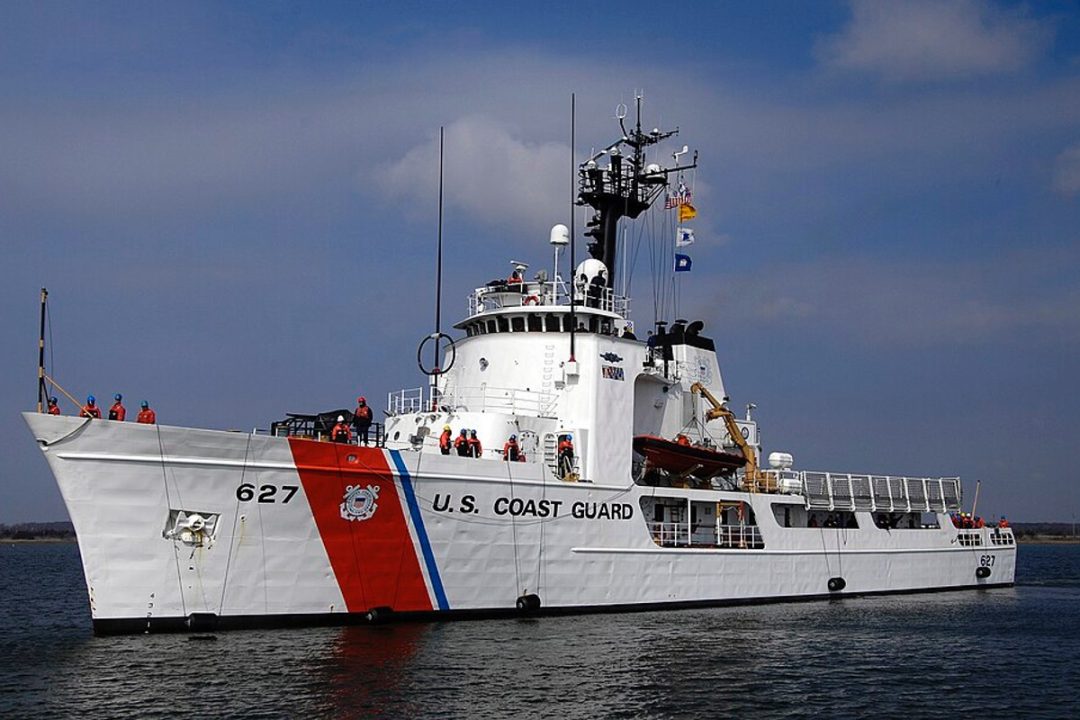
Coast Guard Recruitment Rises, but Agency Still Faces Woes
The U.S. Coast Guard recently celebrated its strongest recruiting numbers in nearly four decades — but the agency, which defends U.S. maritime borders, continues to struggle in key areas.
In an October 7 press release , the Coast Guard announced that it had “surpassed its recruiting goals for the third consecutive year, bringing in its largest enlisted class in nearly four decades,” or since 1987.
The press release continued:
In Fiscal Year 2026 (FY26), the Coast Guard enlisted 5,445 active-duty members, exceeding the 5,204 enlisted members who joined in FY 2025 and 4,422 in FY 2024. The Service also commissioned 346 active-duty officers, the second highest number in recorded Coast Guard history.
It also noted that the Coast Guard had recently opened new recruiting offices in Miami; Long Island, New York; Austin, Texas; and the Netherlands.
Importance of the Coast Guard
The Coast Guard, founded in its current form in 1915 when the U.S. Revenue Cutter Service and U.S. Life-Saving Service merged, is currently part of the U.S. Department of Homeland Security (DHS), but can be transferred to the U.S. Department of Defense in wartime. The agency “provid[es] port security and mass-mobilization capabilities to support the U.S. Navy, [and deals] with such serious problems as marine safety and the flow of illegal immigration, illegal criminal narcotics, and illegal fishing in addition to assisting partner and allied states around the world in building their own naval and coast guard capabilities,” according to a recent Heritage Foundation report .
The Coast Guard’s recruitment surge comes shortly after it received $25 billion from the One Big Beautiful Bill Act in 2025, including for new cutters, aircraft, and helicopters, as well as technology and infrastructure improvements. The service’s then-acting commandant, Admiral Kevin Lunday, called it a “historic investment.”
More Is Needed
These developments, however, are only scratching the surface toward revitalizing the service. According to The Heritage Foundation’s 2026 Index of U.S. Military Strength , “The contemporary Coast Guard has been plagued by chronic underfunding, major recruitment shortfalls, old or declining equipment, extensive maintenance problems, and the lack of enough key ships to carry out the missions it has been tasked with performing.”
For example, the report notes that despite the recent recruiting successes, “the Government Accountability Office reported [in 2025] that ‘the Coast Guard is short about 2,600 active-duty staff and operating below the workforce level it thinks necessary to meet mission needs.’”
Additionally, “the DHS Inspector General observed [in 2025] that ‘Coast Guard cutters were unavailable for 2,068 cumulative days over a 3-year period’ and ‘calculated that the Coast Guard could have interdicted an additional 57 to 89.1 metric tons of cocaine had these cutters been performing the counterdrug mission.’” For comparison, the service successfully interdicted 421.9 metric tons of cocaine during that period (below its “removal goal of 690 metric tons”).
The latter estimate is important, since the Coast Guard has played a key role , particularly under President Donald Trump’s administration, in interdicting drugs and stopping illegal migration.
Although The Heritage Foundation’s neocon, pro-interventionist leanings are evident in its 2026 index, the report remains useful for evaluating the Coast Guard’s current capabilities.
Overseas Entanglements
The Coast Guard’s woes must be viewed in the context of the United States’ deep entanglements overseas. For example, the Iran War has reportedly cost the U.S. Armed Forces more than $171 billion , and according to one report, U.S. overseas military bases cost the Armed Forces about $55 billion annually.
In other words, as the United States spends enormous amounts of money on overseas entanglements, it struggles to support an agency directly responsible for securing U.S. maritime borders. This demonstrates the government’s long-standing misplaced, unconstitutional priorities.
Instead of policing the world while neglecting its own borders, the United States must uphold George Washington’s advice of having “as little political connection as possible” with foreign countries.
This article is part of The New American’s weekly online newsletter Insider Report , which is emailed to TNA subscribers each week. Click here to subscribe to The New American to receive the Insider Report and access exclusive content.