When you buy through links on our articles, Future and its syndication partners may earn a commission.

May 2026 is set to bring a host of celestial targets for astrophotographers, from a beautiful full Flower Moon rising to the Eta Aquariid meteor shower. In their wake comes the last best dark-sky window of spring for mid-northern latitudes in the Northern Hemisphere, as June’s solstice threatens prolonged twilight.
However, in the dying embers of May comes an unexpected visitor — a second full moon, a so-called Blue Moon, making this month the perfect time to practice a full moonshot. Here’s everything you need to know about astrophotography in May:
Read: 10 must-shoot events for astrophotographers in 2026
Friday, 1 May: Full ‘Flower Moon’ rises

May begins and ends with a full moon. First comes the full Flower Moon, at its most photogenic at moonrise where you are . Although a full moon lacks shadows on its surface — making it less interesting for close-up lunar imaging — it excels as a landscape subject. When low on the horizon, Earth’s atmosphere scatters shorter wavelengths of light, turning the moon a deep orange. Think composition, using apps like PhotoPills and TPE (The Photographer's Ephemeris) to align the moon with foreground subjects such as buildings, coastlines or hills. A telephoto lens (200–600mm) will exaggerate the moon’s size relative to the foreground.
Read: How to photograph the full moon
May 5-6: Eta Aquarid meteor shower

It runs from April 19 through May 28, but May 5-6 is when to try for the annual Eta Aquarid meteor shower. The shower’s peak night, it should see about 10 to 20 “shooting stars” per hour, which makes this one less for standing and staring at and more for capturing on camera.
The best way to shoot a meteor shower is always to automate the process. With a wide-angle lens and a tripod, frame the southeast night sky and take test frames, making sure the stars are sharp by zooming in on your viewfinder. Then use a low f-number (such as f/2.8), an ISO of between 800 and 3200, and an exposure of about 20-30 seconds. Use an intervalometer (a separate device or a built-in feature on your camera) and take the same image again and again for multiple hours.
Will you catch a meteor? You’ll only know when you go through your images afterward. Even if you don’t, the frames you’ve shot can be used to make a star trail image .
Read: Astrophotography: How-to guides, tips and videos
May 9 - 20: Dark sky window

With the rise of a last-quarter moon on 9 May, a valuable dark-sky window opens for astrophotographers. In the week to come, the moon will rise after midnight and shrink as it does, posing no problem for evening and, ultimately, late-night astrophotography. Even after the new moon on 16 May, the nights will be predominantly dark until around 20 May when the waxing crescent moon’s brightness begins to bleach the night sky. For those at mid-latitudes in the Northern Hemisphere, the nights are now noticeably shorter, making this dark-sky window particularly valuable to deep-sky astrophotographers — and a great chance to image the realm of the galaxies beneath the constellation Leo and the rising arc of the Milky Way before dawn.
Read: The best cameras for astrophotography
May 18: Crescent moon and Venus
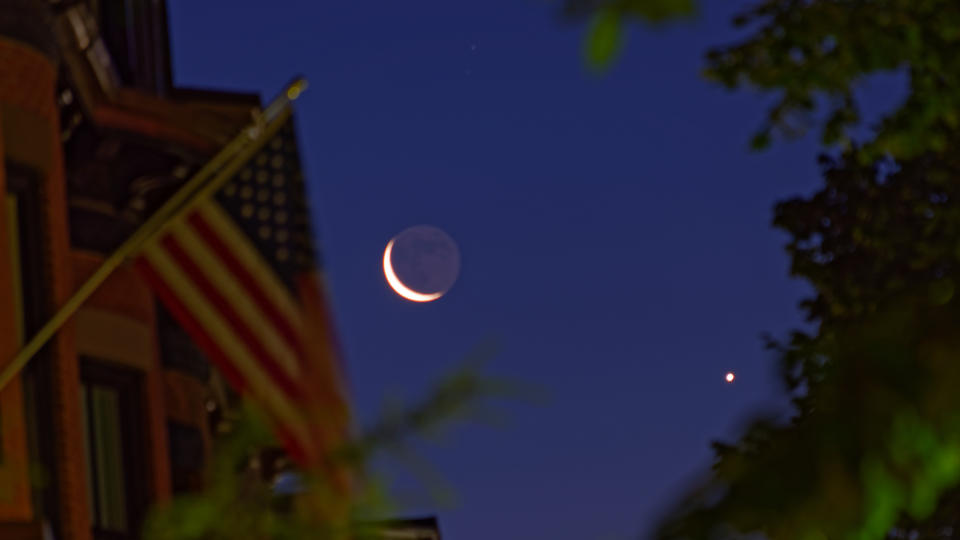
A two-day-old crescent Moon sits just a few degrees from brilliant Venus in the western sky after sunset — one of the most photogenic pairings of the month.
This is classic “nightscape astrophotography”: a bright foreground sky event framed within a terrestrial scene. The crescent moon will display Earthshine — sunlight reflected from Earth onto the moon’s dark side — giving it a ghostly glow. Wide-angle lenses naturally capture Earthshine well, but shooting in RAW will give you flexibility to balance the bright crescent with the dimmer surroundings.
Read: When to photograph the moon
May 30: Full ‘Blue Moon’ rises

How often are there two full moons in the same month? About every 2.5 years, yet the “once in a blue moon” event is enough of a novelty to get the media talking about the full moon. Expect headlines like “rare blue moon lights up night sky,” despite it being no different from any other. There are actually two definitions of a blue moon; May’s is a monthly blue moon — defined as the second full moon in a calendar month — which occasionally must occur because the moon orbits Earth every 29.5 days. When photographing the blue moon, avoid the temptation to tweak color settings to make it look blue — that way lies a credibility leak. If you want to get quick images of the moon, a smart telescope is the way to go.
Astrophotography shot of the month: The Milky Way returns

Between the last quarter Moon and new Moon, May offers one of your final chances before summer for truly dark skies in the Northern Hemisphere — but you’ll need to be in the middle of the night. The Milky Way’s core begins to climb into the southeast around 2:00 a.m. local time in the Northern Hemisphere (depending on latitude) — a soft, luminous band stretching across the sky.
Use a wide-angle lens (14-24mm), a fast aperture (f/2-f/2.8), ISO 1600–3200 and exposures of 10-20 seconds. A star tracker will allow much longer exposures and finer detail, revealing dust lanes and star clouds within.
Read more:
• Astrophotography tools: the best camera, lenses and gear
