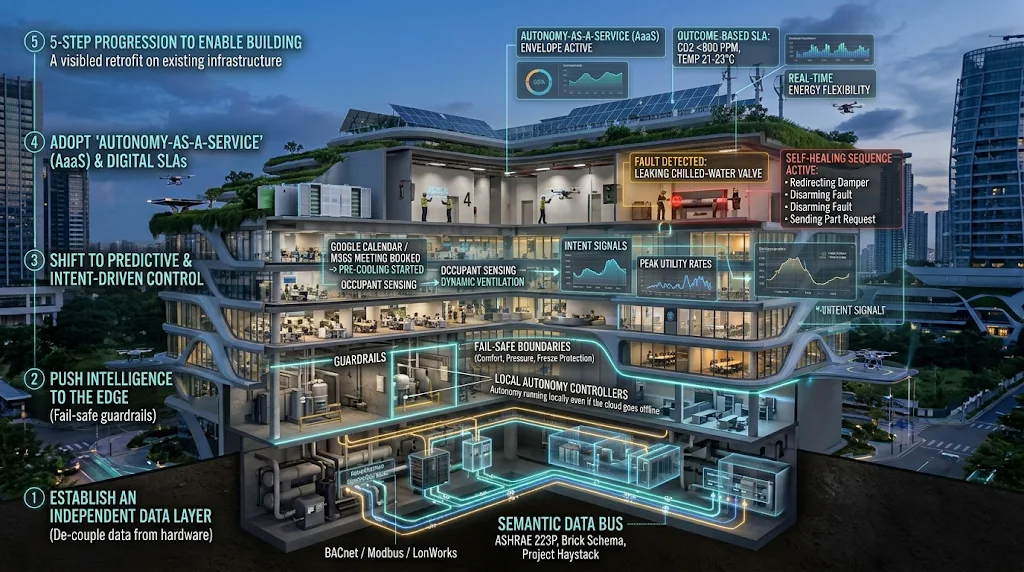
Enabling autonomy in existing or new buildings does not require ripping out functional HVAC, lighting, or electrical hardware. Instead, it requires layering semantic context, edge intelligence, and bounded supervisory controlon top of existing infrastructure.
Achieving practical building autonomy follows a structured five-step progression:
1. Establish an Independent Data Layer (Decouple Data from Hardware)
Most buildings fail at autonomy because their data is trapped inside proprietary Building Automation System (BAS) silos with cryptic point names (e.g., B1_FL2_VAV14_ZNT
).
- Deploy Middleware / Edge Brokers:Introduce an open data layer (such as Tridium Niagara, EdgeX Foundry, or an MQTT broker) that normalizes legacy protocols (BACnet, Modbus, LonWorks) into modern, accessible APIs.
- Implement Semantic Tagging:Apply open semantic ontologies— ASHRAE 223P, Brick Schema, or Project Haystack—to every sensor and actuator. When an AI agent knows that
Sensor_104is a zone temperature sensor feeding Conference Room B served by AHU-2 , it can reason about cause and effect without manual programming.
2. Push Intelligence to the Edge (Fail-Safe Guardrails)
Autonomy cannot depend entirely on cloud connectivity; latency or network drops would compromise safety and comfort.
- Edge-Native Execution:Deploy industrial edge controllers or open-architecture edge nodes (such as ARM or RISC-V gateways) capable of running lightweight machine-learning models (TinyML) and local optimization loops directly on-site.
- Hardwired & Software Guardrails:Program strict operational boundaries at the controller level (minimum airflow, freeze protection, pressure limits). The autonomous layer can optimize freely inside those guardrails, while the edge controller prevents any command from damaging equipment or violating safety codes.
3. Shift from Static Schedules to Predictive & Intent-Driven Control
Traditional automation reacts to conditions after they drift out of range. Autonomy anticipates them.
- Integrate Intent Signals:Connect calendar platforms (Google Workspace, Microsoft 365), access control badges, or anonymous occupancy sensors to predict room usage hours ahead.
- Deploy Model Predictive Control (MPC):Combine internal thermal models with external feeds (local weather forecasts, utility time-of-use tariffs, and grid carbon intensity). The building can then pre-cool spaces during off-peak energy windows or coast through peak demand events without sacrificing comfort.
4. Transition to Continuous, Automated Fault Management
True autonomy requires the building to monitor its own mechanical health rather than waiting for tenant complaints.
- Automated Fault Detection & Diagnostics (AFDD):Use continuous analytics to spot subtle anomalies—such as a leaking chilled-water valve, stuck economizer damper, or drifting CO? sensor—before they cause energy waste or equipment failure.
- Self-Healing Sequences:Configure fallback behaviors so that when a non-critical sensor or component fails, the system automatically switches to a backup sensor, adjusts adjacent zone dampers to compensate, and generates a diagnostic work order with root-cause context.
5. Adopt “Autonomy-as-a-Service” (AaaS) & Digital SLAs
Technical readiness only succeeds when aligned with how the building is operated and financed.
- Start with High-Value Use Cases:Rather than attempting full-building autonomy overnight, deploy targeted autonomous modules first—such as central chiller plant optimization, automated demand response (OpenADR), or dynamic zone ventilation.
- Define Machine-Readable Boundaries:Establish clear Service Level Agreements (SLAs) between landlords, tenants, and service providers (e.g., maintaining 21°C–23°C and <800 ppm CO?) so autonomous agents have explicit, auditable targets to optimize against.
Practical Starting Checklist
- Audit & Normalize:Map existing BACnet/Modbus points into a unified semantic graph (Brick/Haystack/223P).
- Secure the Edge:Upgrade to encrypted local communication (BACnet/SC, TLS-encrypted MQTT) and isolate OT networks from IT.
- Connect External Feeds:Ingest real-time utility pricing, weather data, and room-booking schedules.
- Pilot Closed-Loop Control:Enable supervisory setpoint optimization on one subsystem (e.g., an air handler or chiller loop) with human-in-the-loop approval before moving to fully unattended operation.