

Emergency response to HazMats - First Responder - Placard Table
By EHSO.com, the site for free, objective, practical information about the environment, health and safety in 2026!
Emergency response to HazMats - First Responder - Placard Table
How to Respond to Chemical Spills
Placards and the NFPA 704 Hazard Identification and First
Response System
Back to the Table of Contents page for information on many other subjects!
Emergency - no time to read this? To report oil and hazardous chemical spills, call the National Response Center 1-800-424-8802
- General Spills regulations and guidance
- Awareness Level response
- Operations Level response
- Other response considerations
- Resource contact list
- Glossary of relevant terms
- Placard Table
Hazardous Materials Guide for First Responders -
General Approach to a Hazmat Incident
The NFPA diamond
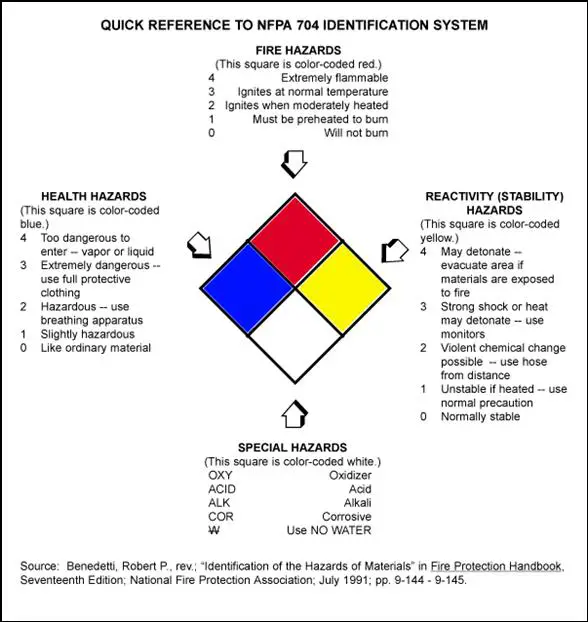
The US National Fire Protection Association (NFPA) has a marking system ("the NFPA fire diamond") designed for the benefit of first responders in chemical accidents. Though often used worldwide in transportation of chemicals and dangerous goods it is not required in transportation. It is intended for use on fixed installations storage containers, storage rooms and warehouses, entrances to laboratories, and chemical processing equipment.
| |
|---|
| Figure A6 -2 |
International labelling of dangerous goods
IMDG Code labels, marks and signs
Class
1


2


3


Elevated
temperature
mark
4


5- 6


7


8- 9


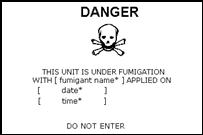
Fumigation
warning sign
*Insert details
as appropriate
Figure A6 - 1
USFA
Hazardous Materials Guide for First Responders
National Fire Protection Association (NFPA) Fire
Diamonds
(NFPA No. 704-1991)
Identification of Health Hazard
Color Code: BLUE
Identification of Flammability
Color Code: RED
Identification of Reactivity
Color Code: YELLOW
Type of Possible Injury
Susceptibility of Materials
to
Burning
Susceptibility to Release of
Energy
Signal
Signal
Signal
4
Materials that on very short exposure could cause death or major residual injury.
4
Materials that will rapidly or completely vaporize at atmospheric pressure and normal ambient temperature, or that are readily dispersed in air and that will burn readily.
4
Materials that in themselves are readily capable of detonation or of explosive decomposition or reaction at normal temperatures and pressures.
3
Materials that on short exposure could cause serious temporary or residual injury.
3
Liquids and solids that can be ignited under almost all ambient temperature conditions.
3
Materials that in themselves are capable of detonation or explosive decomposition but require a strong initiating source or which must be heated under confinement before initiation or which react explosively with water.
2
Materials that on intense or continued but not chronic exposure could cause temporary incapacitation or possible residual injury.
2
Materials that must be moderately heated or exposed to relatively high ambient temperatures before ignition can occur.
2
Materials that readily undergo violent chemical change at elevated temperatures and pressures or which react violently with water or which may form explosive mixtures with water.
1
Materials that on exposure would cause irritation but only minor residual injury.
1
Materials that must be preheated before ignition can occur.
1
Materials that in themselves are normally stable, but which become unstable at elevated temperatures and pressures.
0
Materials that on exposure under fire conditions would offer no hazard beyond that of ordinary combustible material.
0
Materials that will not burn.
0
Materials that in themselves are normally stable, even under fire exposure conditions, and which are not reactive with water.
Figure A6 - 3
USFA Hazardous Materials Guide for First
Responders
First Responder Strategy Using the NFPA 704
Diamond
NFPA Reactivity Rating 0 - 1 (Rating 2 - 4 Defensive Only)
N
F
P
A
H
e
a
l
t
h
R
a
t
i
n
g
4
Defensive operation only.
Defensive operation only.
Defensive operation only.
Defensive operation only.
Defensive operation only.
3
Defensive operation only when materials identified and deemed safe.
Defensive operation only when materials identified and deemed safe.
Defensive operation only when materials identified and deemed safe.
Defensive operation only when materials identified and deemed safe.
Defensive operation only when materials identified and deemed safe.
2
Attack from safe distance in full SCBA. Decontaminate personnel/equipment thoroughly when complete.
Attack from safe distance in full SCBA. Decontaminate personnel/equipment thoroughly when complete.
Attack from safe distance in full SCBA. Decontaminate personnel/equipment thoroughly when complete.
Attack from safe distance in full SCBA. Decontaminate personnel/equipment thoroughly when complete.
Attack from safe distance in full SCBA. Decontaminate personnel/equipment thoroughly when complete. Consider extra attack lines.
1
Attack with full protective clothing and SCBA. Decontaminate when finished.
Attack with full protective clothing and SCBA. Decontaminate when finished.
Attack with full protective clothing and SCBA. Decontaminate when finished.
Attack with full protective clothing and SCBA. Decontaminate when finished.
Attack with full protective clothing and SCBA. Decontaminate when finished. Consider extra attack lines.
0
Attack with full protective clothing and SCBA.
Attack with full protective clothing and SCBA.
Attack with full protective clothing and SCBA.
Attack with full protective clothing and SCBA.
Attack with full protective clothing and SCBA. Decontaminate when finished. Consider extra attack lines and master stream appliances.
0
1
2
3
4
NFPA Flammability Rating
Last Updated: November 3, 1998
Figure A6 - 4
The ADR Hazard Identification Number HIN
("The Kemler Code")
The ADR Hazard Identification Number HIN, also known as the Kemler Code, is carried on placards on tank cars and tank containers running by road under international ADR regulations. Identification numbers are shown in such a way, that the upper number is indicating the danger and the lower number identifies the substances with the UN-number given in the UN Recommendations on the Transport of Dangerous Goods.
An orange blank placard without any numbers indicates vehicle carrying dangerous load (drums, packages, etc.) or multi-load tanker.
The ADR Hazard Identification Number HIN
(The Kemler Code)
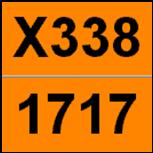
The substance's UN Number
Figure A6 - 5
The first figure of the Kemler Code
indicates the primary hazard:
The second and third figure
generally indicate
secondary hazards:
0
the hazard is adequately described by the first figure
2
gas
2
(flammable) gas may be given off
3
flammable liquid
3
fire risk
4
flammable solid
4
fire risk
5
oxidizing substance or organic peroxide
5
oxidizing risk
6
toxic substance
6
toxic risk
7
radioactive substance
8
corrosive substance
8
corrosive risk
9
miscellaneous/environmental hazard
9
risk of spontaneous, violent reaction
X
reacts dangerously with water
Doubling of a figure indicates an
intensification of that particular hazard. Where the hazard
associated with a substance can be adequately indicated by a single
figure, this is followed by a zero.
If a hazard identification number
is prefixed by letter 'X', this indicates that the substance will
react dangerously with water.
The hazard identification number combinations have following meanings:
| 20 |
inert gas |
| 22 |
refrigerated gas |
| 223 |
refrigerated flammable gas |
| 225 |
refrigerated oxidizing (fire-intensifying) gas |
| 23 |
flammable gas |
| 236 |
flammable gas, toxic |
| 239 |
flammable gas, which can spontaneously lead to violent reaction |
| 25 |
oxidizing (fire-intensifying) gas |
| 26 |
toxic gas |
| 265 |
toxic gas, oxidizing (fire-intensifying) |
| 266 |
highly toxic gas |
| 268 |
toxic gas, corrosive |
| 286 |
corrosive gas, toxic |
| 30 |
flammable liquid or self-heating liquid |
| 323 |
flammable liquid which reacts with water emitting flammable gases |
| X323 |
flammable liquid which reacts dangerously with water emitting flammable gases |
| 33 |
highly flammable liquid (flash point below 21 degrees C) |
| 333 |
pyrophoric liquid |
| X333 |
pyrophoric liquid which reacts dangerously with water |
| 336 |
highly flammable liquid, toxic |
| 338 |
highly flammable liquid, corrosive |
| X338 |
highly flammable liquid, corrosive, which reacts dangerously with water |
| 339 |
highly flammable liquid, which can spontaneously lead to violent reaction |
| 36 |
self-heating liquid, toxic |
| 362 |
flammable liquid, toxic |
| X362 |
flammable liquid, toxic, which reacts dangerously with water emitting flammable gases |
| 38 |
self-heating liquid, corrosive |
| 382 |
flammable liquid, corrosive, which reacts with water emitting flammable gases |
| X382 |
flammable liquid, corrosive, which reacts dangerously with water emitting flammable gases |
| 39 |
flammable liquid, which can spontaneously lead to violent reaction |
| 40 |
flammable self-heating solid |
| 423 |
solid, which reacts with water emitting flammable gases |
| X423 |
flammable solid, which reacts dangerously with water emitting flammable gases |
| 44 |
flammable solid, in molten state, at elevated temperature |
| 446 |
flammable solid, toxic, in molten state, at elevated temperature |
| 46 |
flammable or self-heating solid, toxic |
| 462 |
toxic solid, which reacts with water emitting flammable gases |
| 48 |
flammable or self-heating solid, corrosive |
| 482 |
corrosive solid, which reacts with water emitting flammable gases |
| 50 |
oxidizing (fire-intensifying) substance |
| 539 |
flammable organic peroxide |
| 55 |
strongly oxidizing substance |
| 556 |
strongly oxidizing substance, toxic |
| 558 |
strongly oxidizing substance, corrosive |
| 559 |
strongly oxidizing substance, which can spontaneously lead to violent reaction |
| 56 |
oxidizing substance, toxic |
| 568 |
oxidizing substance, toxic, corrosive |
| 58 |
oxidizing substance, corrosive |
| 59 |
oxidizing substance which can spontaneously lead to violent reaction |
| 60 |
toxic or harmful substance |
| 63 |
toxic or harmful substance, flammable (flash point between 21 degrees C and 55 degrees C) |
| 638 |
toxic or harmful substance, flammable (flash point between 21 degrees C and 55 degrees C), corrosive |
| 639 |
toxic or harmful substance, flammable (flash point between 21 degrees C and 55 degrees C), which can spontaneously lead to violent reaction |
| 66 |
highly toxic substance |
| 663 |
highly toxic substance (flash point not above 55 degrees C) |
| 68 |
toxic or harmful substance, corrosive |
| 69 |
toxic or harmful substance, which can spontaneously lead to violent reaction |
| 70 |
radioactive material |
| 72 |
radioactive gas |
| 723 |
radioactive gas, flammable |
| 73 |
radioactive liquid, flammable (flash point not above 55 degrees C) |
| 74 |
radioactive solid, flammable |
| 75 |
radioactive material, oxidizing |
| 76 |
radioactive material, toxic |
| 78 |
radioactive material, corrosive |
| 80 |
corrosive or slightly corrosive substance |
| X80 |
corrosive or slightly corrosive substance, which reacts dangerously with water |
| 83 |
corrosive or slightly corrosive substance, flammable (flash point between 21 degrees C and 55 degrees C) |
| X83 |
corrosive or slightly corrosive substance, flammable (flash point between 21 degrees C and 55 degrees C), , which reacts dangerously with water |
| 839 |
corrosive or slightly corrosive substance, flammable (flash point between 21 degrees C and 55 degrees C), which can spontaneously lead to violent reaction |
| X839 |
corrosive or slightly corrosive substance, flammable (flash point between 21 degrees C and 55 degrees C), which can spontaneously lead to violent reaction and which reacts dangerously with water |
| 85 |
corrosive or slightly corrosive substance, oxidizing (fire-intensifying) |
| 856 |
corrosive or slightly corrosive substance, oxidizing (fire-intensifying) and toxic |
| 86 |
corrosive or slightly corrosive substance, toxic |
| 88 |
highly corrosive substance |
| X88 |
highly corrosive substance, which reacts dangerously with water |
| 883 |
highly corrosive substance, flammable (flash point between 21 degrees C and 55 degrees C) |
| 885 |
highly corrosive substance, oxidizing (fire-intensifying) |
| 886 |
highly corrosive substance, toxic |
| X886 |
highly corrosive substance, toxic, which reacts dangerously with water |
| 89 |
corrosive or slightly corrosive substance, which can spontaneously lead to violent reaction |
| 90 |
miscellaneous dangerous substance |
Ways to save money AND help the environment:
Save water AND money
with this showerhead adapter, it lets the water flow until the water is hot, then shuts off water flow until you restart it, ShowerStart TSV Hot Water Standby Adapter
Eat healthier AND save money: Instant Pot Duo 7-in-1 Electric 8 QT Pressure Cooker, Slow Cooker, Rice Cooker, Steamer, Sauté, Yogurt Maker, Warmer, Sterilizer, Pot is Stainless Steel

Protect your health with these:
Mattress Dust mite-Bedbug protector
, 100% Waterproof, Hypoallergenic, Zippered 
Handheld Allergen Vacuum Cleaner with UV Sanitizing
for Allergies and Pet, Kills Mite, Virus, Molds, True HEPA with Powerful Suction removes Hair, Dander, Pollen, Dust ,
,
Immune Support
Supplement with Quercetin, Vitamin C, Zinc, Vitamin D3
GermGuardian Air Purifier with UV-C Light
and HEPA 13 Filter, R emoves 99.97% of Pollutants
HEPA Air Purifier
, HEPA Air Cleaner with Washable Pre-Filter, AQI Display, ECO Mode, Sleep Mode, Pet Mode for Pets, Dust, Pollen, Removes 99.97% of Particles, Smoke, Mold, Pet Dander, Dust, Odors
Interesting Reads:
THE PREPPER'S CANNING & PRESERVING BIBLE:
[13 in 1] Your Path to Food Self-Sufficiency. Canning, Dehydrating, Fermenting, Pickling & More, Plus The Food Preservation Calendar for a Sustainable Pantry 
The Backyard Homestead:
Produce all the food you need on just a quarter acre! P aperback
The Citizens' Guide to Geologic Hazards:
A Guide to Understanding Geologic Hazards Including Asbestos, Radon, Swelling Soils, Earthquakes, Volcanoes
The Uninhabitable Earth:
Life After Warming
Book: The Sixth Extinction:
An Unnatural History Paperback

