

If playback is interrupted, you can restart it.
As World Tourism Day approaches and the International Institute for Peace Through Tourism marks 40 years, Dr. Hormatallah Rafiei says restrictions on Iranian aviation threaten passengers, international connectivity and one of tourism’s most fundamental purposes: keeping people connected.
World Tourism Day is celebrated every September 27 by UN Tourism around the idea that travel can contribute to international understanding, sustainable development and peace.
This year, that message collides with a very different reality.
The United States has imposed sweeping new sanctions targeting Iran’s aviation sector, including the country’s remaining airlines. Whatever the geopolitical justification for Washington’s action, restricting airlines also restricts people — families, students, researchers, business travelers and tourists.
For Dr. Hormatallah Rafiei, President of the Iranian Association of Air Transport and Tourism Agencies (AATTAI)and a member of the World Tourism Network, this makes the latest sanctions more than a political or economic issue. He argues that aviation and tourism are the bridges that keep societies connected, particularly when governments are divided.
Against the backdrop of World Tourism Day and the 40th anniversary of the International Institute for Peace Through Tourism, Rafiei is calling on the international community and global tourism organizations to consider the humanitarian consequences of restrictions on aviation and international connectivity.
In a statement provided to eTurboNews, Dr. Rafiei says:

Statement of the Iranian Association of Air Transport and Tourism Agencies (AATTAI)
Addressed to the International Community and Global Tourism Organizations
The Iranian Association of Air Transport and Tourism Agencies expresses its deep concern regarding the recent restrictions affecting the aviation sector and their direct impact on passengers and international connectivity. We call upon the international community and relevant global tourism organizations to give due and urgent attention to the humanitarian and social consequences of such measures.
Aviation and tourism are not merely means of transportation. They are bridges connecting people, communities, and nations. Any sudden disruption to these channels of communication can affect families, students, researchers, business communities, and millions of travelers.
We are concerned about the adoption of sudden and unanticipated measures without sufficient consideration of their humanitarian and social consequences. The international community has witnessed painful tragedies in the past, including the loss of innocent children in Minab, events that have deeply affected the conscience of humanity and reminded us of the importance of protecting human dignity and human life.
We call upon international organizations and relevant authorities to make use of available mechanisms and capacities to help prevent sudden and restrictive measures, safeguard international air connectivity, and protect the rights, well-being, and peace of mind of travelers.
We believe that tourism is not merely about crossing borders; it is about bridging the distances between people.
Every journey is an opportunity for understanding;
Every understanding is a step toward mutual respect;
And every mutual understanding is a step toward peace.
Travel. Connection. Understanding. Peace.For a world that is closer and more connected.
Respectfully,
Dr. Hormatallah Rafiei
President, The Iranian Association of Air Transport and Tourism Agencies (AATTAI)
Washington Targets Iran’s Remaining Airlines
The statement comes after the U.S. Treasury imposed fresh Iran-related sanctions on one individual and 35 entities, including all 27 remaining Iranian airlines, dramatically widening U.S. pressure on Iran’s aviation sector and networks Washington says support sanctioned carrier Mahan Air.
The Office of Foreign Assets Control added airlines including Iran Aseman Airlines, Iran Airtour, Kish Air, Qeshm Air, Taban Airlines, Sepehran Airlines, Varesh Airlines, Zagros Airlines, Karun Airlines, Chabahar Airlines and Fly Persia to its Specially Designated Nationals list.
Newer carriers including Air Shiraz, Ava Airlines, Fly Kish, Mehr Airways, Raimon Airways and Soroush Air were also listed.
Saha Airlines, formerly listed as the Armed Forces Air Transport Service, was among those targeted. OFAC describes the airline as providing passenger and freight air transportation.
The Iranian airlines were designated under Executive Order 13902 and are subject to secondary sanctions. U.S. Treasury Secretary Scott Bessent issued a stark warning to companies continuing to conduct business with Iranian carriers:
“Let this be a warning to anyone doing business with Iran’s remaining airlines, all of which we sanctioned today: You are at risk of being cut off from the global financial system,” Bessent said.
He described the measures as part of Operation Economic Outcast, Washington’s campaign to cut financial lifelines to the Islamic Republic. The United States also sanctioned companies it says continue to support Mahan Air.
The new sanctions follow an August 24 determination by Treasury making Iran’s aviation sector, together with its digital asset, gold, shipping and technology sectors, subject to sanctions under Executive Order 13902.
Sanctions Reach Beyond Iran
The measures do not stop at Iran’s borders.
A separate group of designations targeted aviation and logistics companies outside Iran with alleged links to Mahan Air.
They included ECT Aviation Support in the United Arab Emirates, ECT Aviation Support Ltd in Britain, Malaysia-based iCargo, Kazakhstan-based Tour Invest and Turkish companies MES Cargo, S Sistem Logistics and Sky Phoenix Airways.
Dubai-based Aerobravo Airplane Management and Operation was also sanctioned through its connection to ECT Aviation Support. OFAC additionally designated Mahran Ibrahim, an Egyptian national based in the UAE, listing him as linked to ECT Aviation Support.
Mahan Air has been under U.S. counterterrorism sanctions since 2011. Washington accuses the carrier of serving as a conduit for Iran’s Islamic Revolutionary Guard Corps, including transporting personnel, weapons, and military equipment.
That is the national-security argument behind Washington’s policy. But there is another side to the aviation equation.
Every Sanctioned Airline Still Carries People
Airlines may appear on government sanctions lists as corporate entities, but aircraft carry people. Passengers are not abstract components of geopolitical policy.
They are families trying to see relatives. They are students traveling to universities. They are researchers attending conferences, businesspeople maintaining commercial relationships, tourists discovering another culture, and ordinary citizens whose ability to travel may have little connection to decisions made by their governments.
This is where the sanctions debate becomes a tourism issue.
Restrict aviation extensively enough and pressure intended for governments, companies and security structures inevitably reaches ordinary travelers.
That does not automatically invalidate the security rationale for sanctions. But it does create consequences that international tourism organizations should be prepared to discuss.
World Tourism Day Faces an Uncomfortable Question
This creates an uncomfortable contradiction as September 27 approaches. World Tourism Day celebrates tourism as a vehicle for understanding and peace.
Yet at the same time, one of the world’s most powerful governments is using restrictions affecting aviation connectivity as an instrument of geopolitical pressure. Can both positions coexist? Perhaps they can — but the tourism industry should at least be willing to ask the question.
If tourism really is a force for peace, maintaining people-to-people contact during periods of political confrontation should matter.
Peace through tourism cannot be reserved for countries already enjoying peaceful relations. Its greatest value may be precisely where governments disagree.
40 Years of Peace Through Tourism
That question carries additional significance as the International Institute for Peace Through Tourism celebrates its 40th yeartoday.
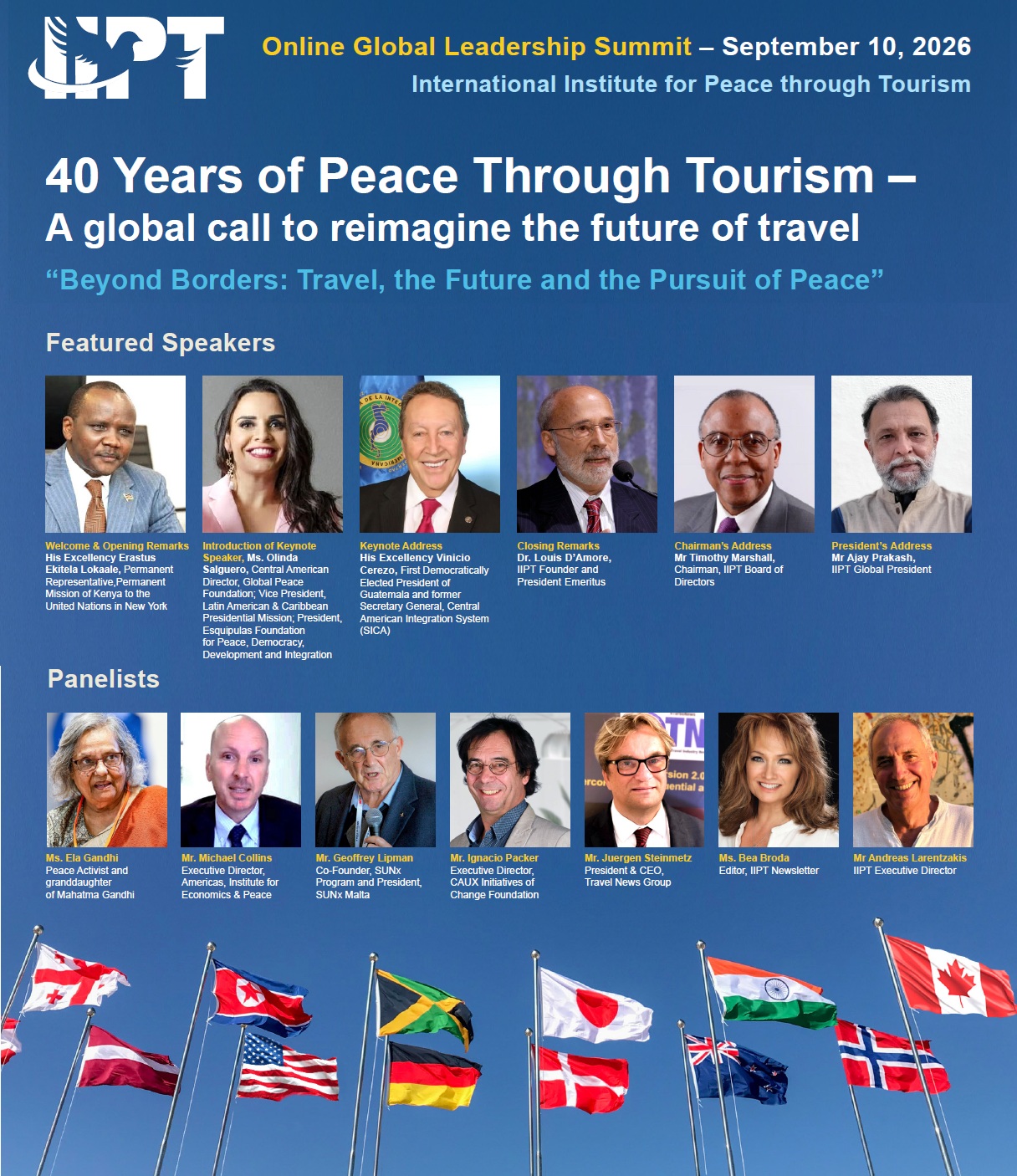
For four decades, the concept behind Peace Through Tourism has been both simple and ambitious: people who travel meet people they might otherwise know only through governments, news reports, political narratives or stereotypes.




Leave a Comment