

If playback is interrupted, you can restart it.
The Nepal flood disaster is catastrophic, with more than 1,300 bodies recovered and thousands still missing. But Nepal is not one disaster zone. World Tourism Network says the global travel industry should follow PATA’s lead: help those suffering,rely on verified information, and keep sending visitors to the many parts of Nepal that remain open.
KATHMANDU– Nepal is mourning one of the most devastating natural disasters in its recent history. At the same time, the Himalayan nation is sending another urgent message to the world:
Nepal is not closed.
For a country in which tourism supports an enormous network of guides, porters, drivers, hotels, restaurants, tour operators, homestays and small family businesses, this distinction could determine whether the natural disaster is followed by an unnecessary tourism and economic disaster.
World Tourism Network (WTN) is urging its members and the wider global travel and tourism industry not to abandon Nepal through blanket cancellations or generalized warnings covering destinations that remain operational.
WTN is instead recommending that the industry follow the lead being demonstrated by the Pacific Asia Travel Association (PATA), which has a long and particularly active presence in Nepal.
The latest situation in Nepal
The scale of the August 26 Bhote Koshi flood disaster is enormous.
According to the Government of Nepal’s Ministry of Foreign Affairs update issued at 2 p.m. Nepal time on September 8, search and rescue operations were continuing for a 14th day in Rasuwa, Nuwakot, Dhading and other areas along the affected river system.
Government agencies reported that 13,583 people had been rescued, including more than 300 foreign nationals. Approximately 5,300 people remained missing, including about 600 foreigners from 35 countries, while 1,357 bodies had been recovered.
Authorities cautioned that the numbers continue to change as search and verification operations proceed.
International teams from countries including India, China, South Korea, the United Arab Emirates, Malaysia and Australia are supporting Nepal’s search-and-rescue effort. Operations are continuing around several damaged hydropower projects, including Upper Trishuli 1, Upper Trishuli 3A and 3B, Chilime, Rasuwagadhi, Mailung Khola and Langtang.
The government says hopes of finding additional survivors remain.
Reuters reported on September 8 that rescue efforts were concentrating on several hydropower tunnels where workers may remain trapped beneath mud and debris. Oxygen has been supplied through pipes into some tunnels while rescuers attempt to establish access.
Four people have been rescued alive during recent operations.
The disaster has also inflicted staggering economic damage. Preliminary estimates have placed losses at approximately $2.56 billion, while thousands of homes and substantial road, bridge and hydropower infrastructure have been damaged.
This is a national tragedy that demands international assistance. It does not, however, mean that the entire country has been physically affected.
Nepal is not closed
That is where tourism communication becomes crucial. The Nepal Tourism Board has delivered perhaps the clearest message possible:
“NEPAL IS NOT CLOSED.”
NTB has said that while some areas have suffered terribly, much of Nepal continues to live, work, travel and welcome visitors. The tourism authority describes continued visitation as both economic support and an act of solidarity with communities whose livelihoods depend upon tourism.
A Quick Response Team has been established at Nepal’s Ministry of Culture, Tourism and Civil Aviation, while a Tourist Information Desk has been established at the Nepal Tourism Board in coordination with the Department of Tourism, Tourist Police and the private sector.
For international travelers, the question therefore should not simply be, “Is Nepal affected?” It should be: “Is the specific destination I am visiting affected?”
PATA draws the distinction
PATA has been among the tourism organizations taking a visible leadership role in communicating that distinction.
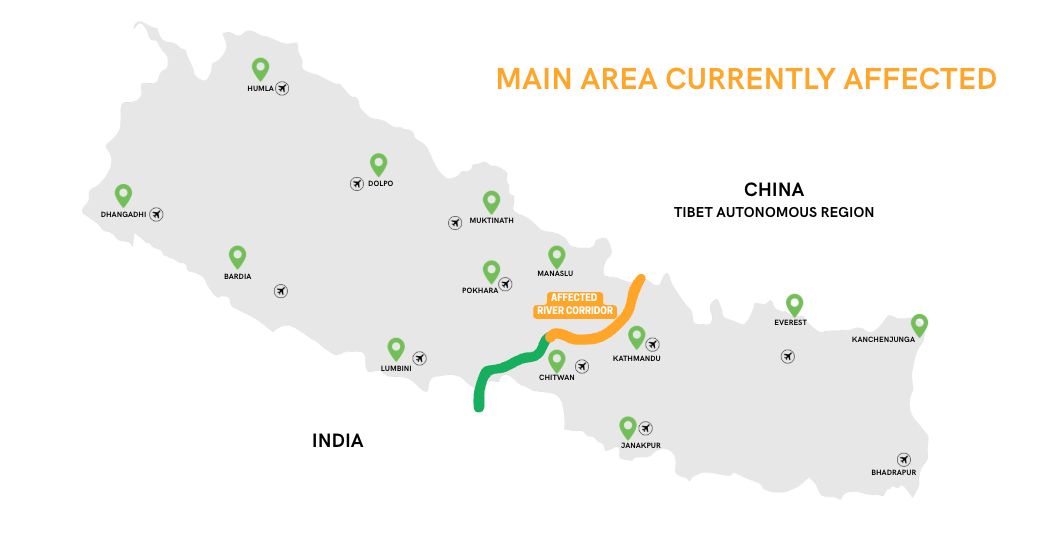
The PATA Nepal Chapter previously reported that the Langtang, Rasuwa and Bhote Koshi corridor was disrupted and that travel there was not possible while search-and-rescue operations continued.
At the same time, PATA reported normal tourism operations in Kathmandu Valley, Pokhara and the Annapurna region, Everest and Khumbu, Chitwan, Bardiya, Lumbini and the Terai. Nepal’s airports and major tourism infrastructure outside the affected area continued operating.
PATA Chairman Henry Oh and PATA Foundation Chairman Andrew Jones have now appealed directly to the international tourism community to distinguish between the affected corridor and the rest of Nepal.
Their message is particularly important because Nepal is approaching its critical autumn tourism season.
PATA is asking tourism companies, travel advisors, media organizations and other stakeholders to review what they are telling customers about Nepal and correct information that inaccurately presents the entire country as affected.
PATA has also announced that its Foundation’s Nepal Tourism Recovery Fund is being prepared to support tourism livelihoods directly affected by the disaster—including guides, drivers, porters and families operating homestays, lodges, teahouses and small hotels.
PATA’s message to its membership is not to ignore the catastrophe. It is to respond to it intelligently.
WTN: Follow PATA’s lead
World Tourism Network supports this approach and is encouraging its members and the wider industry to follow PATA’s lead.
There is an important difference between responsible caution and abandoning an entire tourism destination.
Travel to disaster-affected corridors should not take place where authorities say conditions are unsafe or where rescue and recovery operations remain underway.
But canceling a holiday in Pokhara, Kathmandu, Chitwan, the Everest region or another operational destination simply because dramatic images from another part of Nepal appear on television can compound the suffering.
It removes income from people who may have suffered no physical damage but whose livelihoods depend on visitors. For Nepal, tourism itself can become part of the recovery.
The tourism industry has a responsibility
WTN believes international tourism organizations should be proactive at precisely this kind of moment.
PATA has stepped forward with operational information, industry guidance, a recovery initiative and direct engagement with its Nepal Chapter.
Other organizations with a responsibility to global tourism should be equally visible.
Silence does little for a destination confronting both an enormous humanitarian emergency and the possibility of widespread tourism cancellations caused by misunderstanding the geography of the disaster.
The responsible message is not that everything in Nepal is normal. It clearly is not.
Thousands of families are experiencing unimaginable loss. Search teams are still looking for survivors and recovering victims. Infrastructure has been destroyed, and specific communities and tourism corridors face a long recovery.
The responsible message is that Nepal is a country, not a single disaster zone.
Visiting Nepal can be a form of assistance
Travelers considering Nepal should obtain current information about their specific itinerary, follow official instructions and avoid affected or restricted areas.
But where destinations remain open and authorities and tourism operators confirm normal operations, staying away does not necessarily help Nepal.
Visitors spend money in hotels, restaurants and shops. They employ guides and drivers. They buy handicrafts, book excursions and support hundreds of small businesses throughout the tourism supply chain.
That income becomes especially valuable during a national recovery.
Direct donations to legitimate disaster relief and recovery programs remain essential for the communities devastated by the floods.
But responsible travel to unaffected areas offers another kind of assistance: keeping Nepal’s tourism economy working.
Nepal needs solidarity — and visitors

Nepal has survived earthquakes, political upheaval, the pandemic and other crises. Its tourism industry has repeatedly demonstrated extraordinary resilience.
This disaster will test that resilience again. The global tourism community now has a choice. It can react to devastating images by treating Nepal as one giant disaster zone.
Or it can recognize the suffering, support those directly affected, demand accurate information, follow local authorities, and continue supporting tourism where tourism can safely continue.
World Tourism Network is choosing the second approach.
Support Nepal’s victims. Support its tourism workers. Follow verified information. Avoid affected areas. But don’t abandon Nepal.
For travelers able to responsibly visit the many destinations that remain open, Nepal’s message could hardly be clearer: Your visit matters.







Leave a Comment