

Riyadh- Along Saudi Arabia’s remote Red Sea coast, where mirrored walls were meant to rise from the desert and stretch for miles, a quieter reality is beginning to take hold.
Saudi officials have cancelled key construction contracts tied to NEOM, the kingdom’s $500 billion flagship development, in what analysts describe as one of the clearest signs yet that the futuristic project is being recalibrated amid mounting financial strain and escalating regional tensions.
The cancellations — including major tunneling works essential to The Line , NEOM’s planned 170-kilometer linear city — come at a moment of heightened uncertainty across the Gulf, as conflict involving Iran threatens infrastructure, investment flows and economic confidence.
A Project Meant to Redefine a Nation
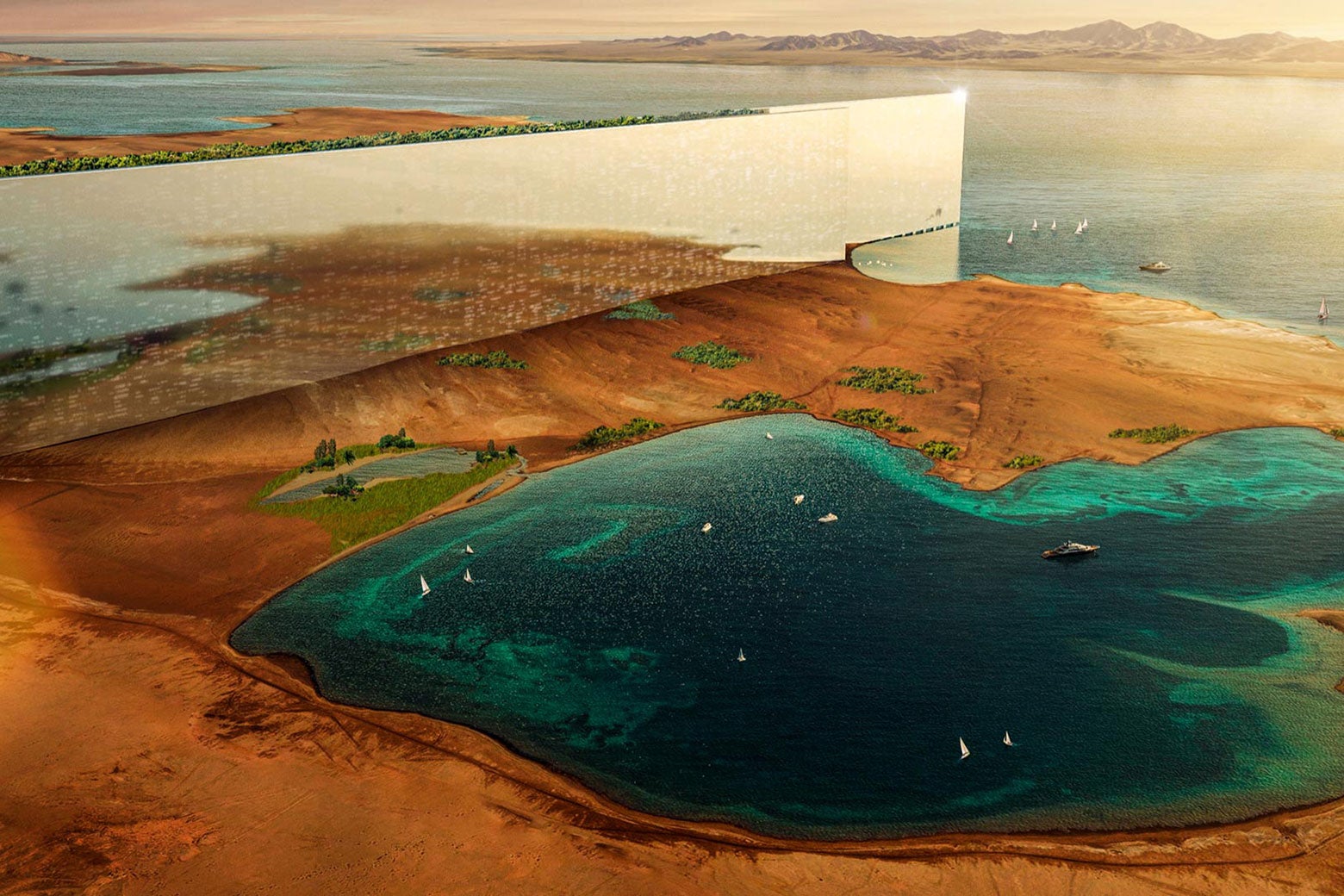

Unveiled in 2017 by Crown Prince Mohammed bin Salman, NEOM was conceived as the centerpiece of Saudi Arabia’s transformation away from oil dependence — a high-tech, carbon-neutral region designed to attract global capital, talent and tourism.
At its heart is The Line , a car-free city envisioned as two parallel skyscrapers running across the desert. Surrounding it are projects like Oxagon, a floating industrial hub, and Trojena, a luxury mountain resort where officials have promised year-round outdoor recreation — including winter sports in a country better known for its heat.
The ambition was not merely architectural. NEOM was intended to signal a new Saudi Arabia: digitally advanced, environmentally conscious and economically diversified.
Mounting Pressures
From the outset, the project’s scale raised questions about cost and feasibility. Those concerns have deepened in recent months.
The kingdom is simultaneously funding a sweeping slate of initiatives under its Vision 2030 program, including infrastructure, tourism expansion and preparations for global events such as Expo 2030 in Riyadh. Oil revenues — while still substantial — are increasingly stretched across competing priorities.

Now, a more immediate pressure has emerged.
Escalating tensions with Iran have disrupted energy markets and heightened security risks across the region. Recent exchanges involving strikes on energy facilities and shipping routes have rattled investor confidence and introduced new uncertainties into long-term planning.
“The geopolitical environment has shifted dramatically,” said a Gulf-based economist. “Projects like NEOM depend on sustained foreign investment and stability. Both are now under strain.”
Investment and Labor at Risk
The implications are already visible.
Foreign investment — critical to NEOM’s financing model — is expected to slow as global firms reassess exposure to regional risk. At the same time, international contractors and skilled workers have begun reconsidering long-term commitments in the Gulf.
Large-scale infrastructure projects, particularly those still in early phases, are often the first to be delayed or redesigned under such conditions.
The cancellation of tunneling contracts suggests a broader reassessment of priorities, rather than an isolated adjustment.
From Vision to Revision
Officials have not abandoned NEOM. Instead, they appear to be reshaping it.
Recent signals point to a scaling back of the most ambitious elements of The Line , alongside a shift toward projects with clearer economic returns — including logistics hubs, data infrastructure and targeted tourism developments.
Such recalibration is not unusual for mega-projects, particularly those launched during periods of economic optimism. What sets NEOM apart is the scale of its original promise — and its central role in Saudi Arabia’s national strategy.
Tourism Dreams Meet Regional Reality
Tourism remains a cornerstone of Vision 2030, with Saudi Arabia aiming to position itself as a global destination. NEOM’s resorts, coastal developments and high-tech urban experiences were meant to anchor that effort.
Yet tourism is acutely sensitive to perceptions of stability.
Regional conflict — even if geographically contained — can influence traveler behavior, insurance costs and airline operations. For a country still building its reputation as a leisure destination, such factors carry added weight.
The Stakes for Vision 2030
NEOM is more than a development project; it is a symbol of Saudi Arabia’s economic transformation.
Its success would demonstrate that the kingdom can pivot from oil dependency to a diversified, innovation-driven economy. Its struggles, however, risk reinforcing doubts about the pace and practicality of that transition.
With Expo 2030 approaching, Saudi Arabia faces a narrowing window to showcase tangible progress.
An Uncertain Path Forward
For now, the desert site where NEOM is rising remains active, but the tone has shifted — from boundless ambition to cautious recalibration.
The question is no longer whether NEOM will be built, but what form it will ultimately take.
In a region shaped as much by geopolitics as by grand design, even the most futuristic visions must contend with present realities.




Leave a Comment