
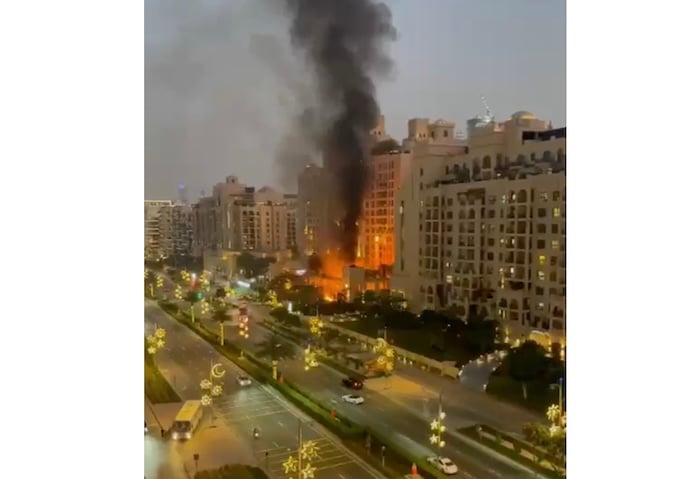
In this MEED live briefing, Colin Foreman and Ed James provide an updated analysis of the US–Israel–Iran conflict, focusing on what the latest developments mean for markets, infrastructure, and investment across the GCC. Drawing on MEED’s regional expertise, the session explores how the situation is evolving on the ground and the potential implications for key sectors and ongoing projects.
I. A Sky That Suddenly Changed
At 2:17 a.m., somewhere over eastern Europe, Flight EK204 from New York to Dubai began to deviate.
Passengers noticed it first on the seatback screens—what had been a straight arc toward the Gulf bent sharply southward. A murmur spread through the cabin. Flight attendants, moving briskly but calmly, avoided specifics. Hours later, the plane landed not in Dubai but in Athens.
“I thought maybe it was weather,” said Daniel Weiss, a German consultant returning from a business trip. “But then everyone started checking their phones, and you could see something bigger was happening.”
That “something bigger” was not immediately visible from 35,000 feet. But it was already reshaping the skies.
Across the Middle East, airspace was tightening. Airlines were rerouting. Some flights were canceled altogether. The intricate web of global aviation—so precise it runs on minutes—was being forced to improvise. And as experts warned in a recent MEED live briefing, this was only the beginning.
II. The Geography of Interconnection
For decades, the Gulf has quietly transformed itself into one of the world’s most critical crossroads. From Dubai, Doha and Abu Dhabi, it is possible to reach nearly any major city within eight hours. Airlines built entire business models around this geography, turning the region into a bridge between continents. But geography cuts both ways.
“The Gulf sits at the center of global movement,” said a senior aviation analyst who attended the MEED session. “That’s its strength—and in moments like this, it’s also its greatest vulnerability.”
The US–Israel–Iran conflict, as outlined in the briefing, is not confined to battlefields or diplomatic channels. It moves through systems—air routes, shipping lanes, supply chains. And when those systems are disrupted, the effects spread quickly and unevenly.
III. Aviation: A Network Under Stress
In the days following the escalation, the impact on aviation became unmistakable.
At Hamad International Airport in Doha, departure boards filled with delays. In Dubai, passengers queued for hours at transfer desks, clutching boarding passes for flights that no longer existed. Behind the scenes, airlines were scrambling.
“Every route had to be recalculated,” said a pilot for a major Gulf carrier, speaking on condition of anonymity because he was not authorized to comment publicly. “You’re avoiding certain airspaces, adding fuel reserves, and coordinating with new control zones. It’s like rebuilding the map in real time.”
The MEED briefing emphasized that aviation disruption is not merely an inconvenience—it is a structural shock. Flights that once took six hours now take eight or nine. Crews exceed planned duty times. Aircraft arrive late, depart later, and the delays cascade across entire fleets.
For airlines, the costs mount quickly. Fuel consumption rises with longer routes. Insurance premiums increase in high-risk areas. Passenger compensation adds another layer of expense.
“It’s death by a thousand cuts,” the pilot said. “No single thing breaks the system. But everything gets harder at once.”
IV. The Human Toll in Transit
For passengers, the experience is more immediate—and often more personal. At Athens International Airport, Weiss spent 14 hours waiting for a connecting flight that never came. Nearby, a family from India sat on the floor, their luggage stacked beside them, trying to rebook a journey to Toronto.
“We had a wedding to attend,” said Priya Mehta, the family’s mother. “Now we don’t even know if we’ll make it.” Air travel, once a symbol of globalization’s efficiency, becomes in these moments a reminder of its fragility.
Each disruption carries a human story:
- A missed funeral
- A postponed business deal
- A honeymoon delayed indefinitely
Individually, they are small inconveniences. Collectively, they reveal the scale of the system under strain.
V. Tourism: When Perception Becomes Reality
If aviation is the infrastructure, tourism is the narrative. The Gulf has spent years crafting an image of seamless luxury and safety—glass towers, pristine beaches, world-class events. But perception can shift quickly.
Within days of the escalation, travel agencies reported cancellations. Conference organizers began reconsidering venues. Tour operators fielded calls from anxious clients.
“People don’t differentiate between countries,” said Elena Markovic, a travel consultant based in Berlin. “They hear ‘Middle East’ and they think risk.”
The MEED session highlighted this dynamic, noting that tourism is uniquely sensitive to uncertainty. Even if a destination remains physically untouched, the perception of instability can be enough to deter visitors.
At a luxury hotel in Dubai, occupancy rates dipped noticeably. “We’re still operating,” said a hotel manager, who requested anonymity. “But bookings are softer. People are waiting. They want to see what happens next.” For a region investing heavily in tourism as part of economic diversification, the implications are significant.
VI. The Economics of Empty Rooms
Tourism is often measured in grand figures—billions in revenue, millions of visitors. But its impact is also granular.
It is the taxi driver waiting outside a hotel with fewer guests. The restaurant owner watching reservations disappear. The tour guide has no groups to lead. “These are not abstract losses,” said Markovic. “They are livelihoods.”
In Doha, a small-business owner who runs desert excursions described a sudden drop in demand. “Last week, I had bookings every day,” he said. “Now, nothing. People are canceling or postponing.”
For workers in the sector, the uncertainty is as challenging as the immediate loss of income. “You don’t know if it will be one week, one month,” he added. “You just wait.”
VII. Infrastructure: The Quiet Disruption
While airports and hotels reflect visible impacts, the deeper effects are unfolding in less visible spaces—construction sites, logistics hubs, investment offices.
The Gulf’s development model relies on continuity. Projects are planned years in advance, financed through complex arrangements, and executed with precision. Conflict introduces uncertainty into every stage.
“Even if nothing is physically damaged, the risk environment changes,” said an infrastructure consultant who participated in the MEED briefing. “That affects decisions.” Materials may take longer to arrive. Insurance costs rise. Financing becomes more cautious.
At a construction site in Saudi Arabia, a project manager described delays in receiving equipment. “We’re still working,” he said. “But timelines are slipping. And every delay costs money.” For large-scale projects, those costs can be substantial.
VIII. The Investor’s Dilemma
For investors, the question is not simply whether to stay or leave, but how to price risk. The Gulf has long been seen as a stable environment for investment, particularly compared to other parts of the region. Now, that perception is being tested.
“You’re seeing a reassessment,” said a financial analyst based in London. “Not a withdrawal, but a recalibration.”
Investors are asking:
- How long will the conflict last?
- How likely is escalation?
- What are the contingency plans?
In some cases, decisions are delayed. In others, projects proceed but under revised assumptions. “Capital doesn’t like uncertainty,” the analyst said. “It can tolerate risk, but it needs to understand it.”
IX. The Regional Ripple Effect
One of the most striking aspects of the current situation is how broadly its effects are felt. Countries not directly involved in military action are nonetheless experiencing consequences. Airspace closures affect regional connectivity. Security concerns influence operations. Economic ties transmit shocks.
“The Gulf operates as a system,” the MEED session emphasized. “And systems transmit stress.” This interconnectedness, once a source of strength, becomes a channel for disruption.
A delay in one airport affects another. A change in shipping routes alters supply chains. A shift in perception influences investment flows. The ripple effect is both immediate and far-reaching.
X. Global Consequences
Beyond the region, the implications are equally significant. Energy markets respond quickly to instability. Oil prices fluctuate. Governments monitor supply routes. But other sectors are affected as well.
Air cargo, which often passes through Gulf hubs, faces delays. Manufacturers experience disruptions. Consumers encounter higher costs. “It’s not always visible,” said the London-based analyst. “But it’s there.”
A shipment delayed here, a component unavailable there—these small disruptions accumulate. And in a global economy built on efficiency, even minor inefficiencies can have outsized effects.
XI. Duration: The Defining Variable
Throughout the MEED briefing, one theme emerged repeatedly: duration. A short-lived disruption, while significant, can be absorbed. Systems adjust. Operations resume.
A prolonged conflict is different. Over time, temporary measures become permanent changes. Airlines redesign routes. Travelers choose alternative destinations. Investors shift strategies. “It’s not just about what happens,” the analyst said. “It’s about how long it happens.” Duration transforms disruption into transformation.
XII. Lives in Suspension
For those directly affected, the conflict creates a sense of suspension. Travelers wait for rebooked flights. Workers wait for business to return. Investors wait for clarity. In Berlin, Markovic described the calls she receives daily.
“People ask, ‘Should I still go?’” she said. “And the answer is always the same: it depends.” It depends on risk tolerance. On timing. On information that is constantly changing. For many, the uncertainty is the hardest part.
“You can deal with bad news,” she said. “But not knowing—that’s what makes people hesitate.”
XIII. A System Under Test
The Gulf’s rise as a global hub has been one of the defining economic stories of the past two decades. It is a story of ambition, investment, and connectivity. Now, that system is being tested. Not by collapse, but by stress.
Airlines continue to fly. Hotels remain open. Projects move forward. But each operates under conditions that are more complex, more uncertain, more fragile.
XIV. Beyond the Immediate Crisis
It is too early to predict the long-term outcome. The conflict may de-escalate. Systems may recover. The region may return to its trajectory of growth. Or the disruption may persist, reshaping patterns of travel, trade, and investment.
What is clear, as the MEED briefing underscored, is that the impact extends far beyond the immediate. This is not a localized event. It is a systemic one.
XV. The New Geography of Risk
In a world defined by interconnection, geography is no longer just physical. It is also functional. Air routes, shipping lanes, data flows—these define the modern map.And when conflict intersects with these pathways, the effects are amplified.
“The map hasn’t changed,” the aviation analyst said. “But how we use it has.”
XVI. Conclusion: A Moment of Reckoning
For the Gulf, the current crisis represents both a challenge and a test. A challenge to its systems, its assumptions, its model of growth. And a test of its resilience, its adaptability, its capacity to absorb shocks.
For the world, it is a reminder of how interconnected everything has become. A disruption in one region can affect the lives of thousands of people thousands of miles away. A conflict can travel—not just through headlines, but through systems. And in that movement, it reshapes more than just the places where it begins.







Leave a Comment