

NEW YORK / VICTORIA, Seychelles —Seychelles President Dr. Patrick Herminie has taken a philosophy long associated with the island nation’s tourism diplomacy onto the world stage, telling the United Nations that Seychelles is “a friend to all, and an enemy to none” and describing non-alignment as “an active choice for peace.”
The message echoes an approach promoted internationally for years by former Seychelles Tourism Minister Alain St. Ange: welcome the world, maintain friendships across political divides and use tourism to connect rather than separate people.
Now the question is whether one of the world’s best-known island tourism destinations could turn that philosophy — together with its neutrality, hospitality and relationships across geopolitical camps — into another form of soft power: providing a discreet meeting place where adversaries can talk.
There is no public confirmation that Seychelles has been proposed for specific peace negotiations. But Herminie’s message at the UN raises an intriguing possibility for a country whose international identity has long been built around bringing people together.
From Tourism Diplomacy to Peace Diplomacy
For Alain St. Ange, “friend to all, enemy to none” was more than a political phrase.
As Seychelles’ Minister responsible for Tourism, he carried the message around the world while promoting an island nation whose tourism industry depended on openness to visitors from virtually everywhere.
Seychelles did not ask tourists to choose geopolitical camps before enjoying its beaches. That openness became part of the destination’s international identity.
But the philosophy itself went deeper than tourism…
A Small Country Talking to Everyone
On a map, Seychelles looks almost impossibly small.
The archipelago consists of 115 islands scattered across the western Indian Ocean, with a population of roughly 100,000. It has no great army, no permanent seat on the UN Security Council and none of the traditional instruments through which major powers project influence.
What it does have is something increasingly valuable in an increasingly divided world: the ability to maintain relationships across geopolitical lines.
Seychelles can engage India without defining itself against China. It can maintain longstanding relations with Russia while working closely with France, the United States, the European Union and other Western partners.
It can develop deep ties with the United Arab Emirates while remaining firmly rooted in Africa and the Indian Ocean region.
And it can welcome representatives of countries that may have considerable difficulty welcoming one another. That diplomatic balancing act has been particularly visible during Herminie’s first year in office.
On his inauguration day in October 2025, India’s Vice President and Mauritius’ Prime Minister were among the international guests at Unity Stadium.
In January, Herminie delivered the keynote address at the Blue Forum during Abu Dhabi Sustainability Week.
In February, he attended the World Governments Summit in Dubai before making his first State Visit to India, where Seychelles’ strategic position in the Indian Ocean featured prominently in discussions.
In March, Herminie made a State Visit to Mauritius and received the country’s highest national honour. Later that month, Chinese Vice President Han Zheng arrived in Victoria as Seychelles and China marked fifty years of diplomatic relations.
Then, in April, Herminie travelled to Moscow for talks with Russian President Vladimir Putin. Those relationships do not easily fit into today’s increasingly rigid geopolitical camps.
That may be precisely the point.
“Friend to All” Becomes Foreign Policy
During his visit to Moscow, Herminie was asked about great-power competition in the Indian Ocean. His response returned to the familiar Seychellois formulation.
Seychelles, he said, was a “friend to all, enemy to none.”
The significance of that phrase became clearer when he addressed the United Nations General Assembly in New York.
“We are a friend to all, and an enemy to none,” Herminie told world leaders. Then came the sentence that could define the next stage of Seychelles’ foreign policy:
“Our commitment to non-alignment is not passive indifference; it is an active choice for peace.”
The word activematters. Non-alignment can mean standing outside geopolitical conflicts.
Herminie’s formulation suggests something potentially more ambitious: using the ability to speak with different sides as an instrument of diplomacy.
“Small states like ours do not seek strategic competition; we seek shared solutions,” he told the General Assembly.
For one of the world’s smallest countries, that could represent a surprisingly large diplomatic opportunity.
The Island Advantage
Seychelles has another advantage that cannot be measured in military strength, GDP or diplomatic headcount. It is Seychelles.
For decades, its tourism industry has understood something diplomats sometimes forget:
Environment changes conversation.
Mahé, Praslin and Seychelles’ other islands offer privacy, security and physical separation from the political theatre of Washington, Moscow, Beijing, Brussels and other capitals.
They also provide something much harder to manufacture — psychological distance.
Put political adversaries inside a formal conference room in a major capital and every handshake can become a geopolitical statement.
- Every arrival is photographed.
- Every delegation is watched.
- Every seating arrangement can acquire political meaning.
Bring those same people to an island, away from television studios, demonstrations and much of the machinery of their respective governments, and there is at least the possibility of a different kind of conversation.
It is not difficult to imagine discreet delegations spending several days in Seychelles, conducting formal negotiations behind closed doors while allowing less formal conversations to take place in surroundings designed for precisely the opposite of confrontation.
The country already has much of the infrastructure such meetings require: international air connections, high-end accommodation, private resorts, security experience and locations where privacy can realistically be maintained.
Tourism could, in that sense, become an instrument of soft power.
The characteristics that persuaded travellers to cross continents — accessibility, hospitality, discretion, security and extraordinary natural surroundings — could potentially make Seychelles attractive to governments looking for somewhere neutral to talk.
Are There Backroom Talks in New York?
That brings the story to New York. And this is where speculation has to stop and facts have to begin.
President Herminie’s programme surrounding the UN General Assembly includes a series of high-level engagements and bilateral meetings.
Some are public.
Others, as is normal during General Assembly week, take place amid an enormous diplomatic ecosystem in which presidents, prime ministers, foreign ministers, diplomats and intermediaries are concentrated within a few square kilometres of Manhattan.
Seychelles is therefore unquestionably talking.
What cannot currently be established publicly is whether anyone is talking specifically about Seychelles as a peace venue.
There is no public confirmation that Seychelles has been formally proposed as the location for negotiations in a particular conflict.
There is also no verified evidence that Herminie is secretly mediating between specific governments. Those distinctions are important.
But perhaps the more interesting question is not whether a Seychelles peace conference is already being arranged behind closed doors in New York.
It is whether Herminie is positioning his country so that, when governments eventually need a neutral table, Seychelles is one of the places they think about.
His UN speech certainly leaves that door open.
The Golden Jubilee Sends a Message
The country’s 50th anniversary of independence offered an unusually visible demonstration of its diplomatic balancing act.
Seychelles celebrated its Golden Jubilee in June with partners representing very different centres of global power.
- Indian Prime Minister Narendra Modi attended as Guest of Honour.
- China sent a special envoy of President Xi Jinping.
- Mauritius’ Prime Minister returned.
- Russian servicemen participated in the National Day parade.
- At roughly the same period in Seychelles’ history, the country was also marking fifty years of diplomatic relations with partners including Japan and the United States.
- Then, in July, Herminie travelled to La Réunion as Guest of Honour for France’s National Day celebrations.
- In August, he addressed the SADC Summit in Durban.
- By September, he was in New York addressing the United Nations.
Viewed separately, these are bilateral relationships and ceremonial engagements. Viewed together, they tell a more interesting story.
Seychelles is attempting to maintain meaningful relationships with countries that increasingly view one another as strategic competitors.
Partnerships Without Choosing Camps
That balancing act is not purely symbolic.
Seychelles sits near strategically important Indian Ocean shipping routes in a region where maritime security, illegal fishing, narcotics trafficking, climate change and competition among major powers increasingly overlap.
Its partnerships therefore have practical consequences.
- India has supported Seychelles’ maritime security capabilities.
- The United Arab Emirates has invested heavily in the country and supported infrastructure and water-security projects.
- China has provided development assistance and financing.
- France remains an important regional and security partner.
- The United States maintains diplomatic and strategic engagement with Seychelles.
- Russia retains longstanding relations with the country.
The challenge for Victoria is to accept cooperation without allowing one partnership to determine all the others. That is where “friend to all, enemy to none” stops being a tourism slogan and becomes foreign policy.
Peace as a Seychellois Business
There is an appealing symmetry to the idea. Tourism taught Seychelles that being welcoming to everybody can be economically valuable. Diplomacy could demonstrate that it is strategically valuable as well.
In most countries, foreign policy belongs almost exclusively to foreign ministries. In Seychelles, tourism has always carried a piece of the country’s diplomacy because almost every international visitor represents an encounter between Seychelles and the outside world.
Alain St. Ange understood the value of that idea particularly well, when he was tourism minister. He sold Seychelles not simply as somewhere beautiful, but as somewhere the world could feel welcome.
Perhaps the next evolution is to make peace and dialogue part of that national brand. Not “peace tourism” in the commercial sense.
Rather, Seychelles as a trusted place where countries that cannot agree on much else can at least agree to sit down.
Small States Can Have Big Tables
There is international precedent for relatively small states exercising diplomatic influence far beyond their population or military strength. What matters in mediation is not always power.
- Sometimes it is access.
- Sometimes it is trust.
- Sometimes it is discretion.
And sometimes it is simply possessing a table at which both sides are willing to sit.
Seychelles already possesses several ingredients that could support such a role: political stability, geographic separation, strong international relationships, security cooperation, diplomatic neutrality and a hospitality industry accustomed to receiving presidents, billionaires, celebrities and other guests who value privacy.
But becoming an established diplomatic mediator would require more.
- Beautiful beaches cannot substitute for experienced negotiators.
- Luxury hotels cannot replace diplomatic institutions.
- Neutrality has value only when all sides believe in it.
- And any serious mediation role would require professional diplomatic capacity, confidentiality and the confidence of the parties involved.
Seychelles should therefore not be transformed overnight, at least in the imagination, into the Geneva of the Indian Ocean.
But neither should the possibility be dismissed because of its size. As Herminie himself told the United Nations:
“Size does not define sovereignty, and geography does not diminish dignity.”= The same might eventually be said of diplomatic influence.
From St. Ange to Herminie
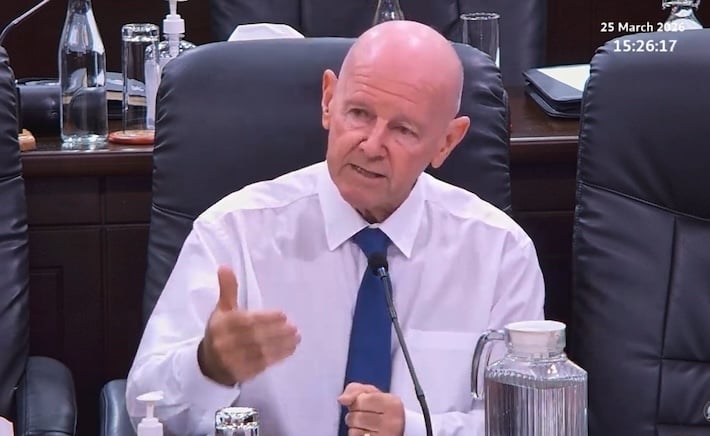
There is something distinctly Seychellois about the progression.
Alain St. Ange took “friend to all, enemy to none” around the world as part of the country’s tourism identity. The message was simple.
Everybody could come. Everybody could be welcomed.
Patrick Herminie is now applying essentially the same philosophy to a considerably more complicated world. Everybody can be spoken to.
Relationships with one country need not automatically require hostility toward another. And non-alignment need not mean silence.
“Our commitment to non-alignment is not passive indifference,” Herminie told the United Nations. “It is an active choice for peace.” That sentence deserves attention.
Because if activereally means active, Seychelles’ next diplomatic chapter may involve more than maintaining friendships.
It may involve putting those friendships to work.
Whether conversations taking place in New York this week will eventually lead adversaries to a quiet table overlooking the Indian Ocean remains unknown.
There is no evidence yet that such a meeting is being arranged. But perhaps that is precisely how successful diplomacy often begins.
- Not with an announcement.
- Not with cameras.
- Not even with a communiqué.
- With an invitation.
Come to Seychelles. Sit down. Talk.





Leave a Comment