
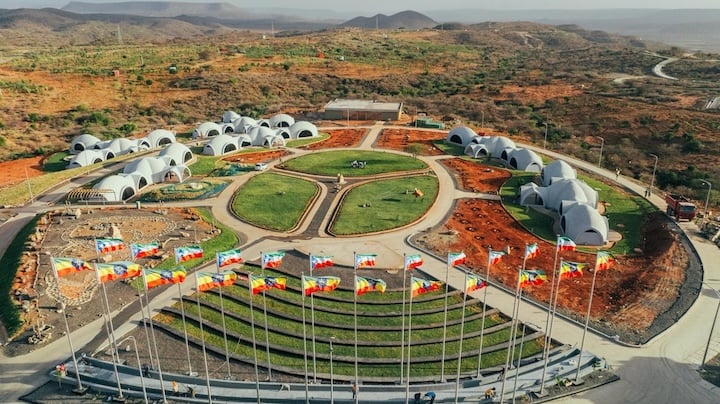
Jigjiga —A high-profile inauguration attended by leaders from across the Horn of Africa has put a spotlight on an ambitious new project: a 385-hectare resort and tourism complex designed to reposition Ethiopia’s Somali Region as a destination for leisure, conferences, and domestic travel—and, eventually, regional and international visitors.
Officials describe the resort as part of the federal government’s “Dine for Generation(s)” push to develop headline tourism assets outside Ethiopia’s traditional visitor circuit. In statements carried by state-affiliated outlets, the opening was framed as both an economic milestone and an image reset for a region historically defined in international headlines by security concerns and underinvestment.
Where the resort is—and why it matters
Despite its Somali cultural identity, the resort is inside Ethiopia, in the Somali Regional State, roughly 29 kilometers from Jigjiga, the region’s capital.
That location is strategic for three reasons:
- A “gateway” city:Jigjiga sits on Ethiopia’s eastern corridor, not far from the Somaliland/Somalia-facing trade routes that link inland Ethiopia to the wider Horn.
- Short-haul regional logic:The resort is positioned to attract domestic travelers and diaspora visitors first, then expand to nearby markets in Djibouti and Somalia as connectivity and perceptions improve. (
- Security and access can be concentrated:Resort-style tourism works best where authorities can focus infrastructure and protection on a defined zone—an important consideration in frontier regions.

Why is this called the “first resort”
Ethiopia has long had hotels and lodges nationwide, but what officials are emphasizing here is scale + purpose-built design: a large, integrated, leisure-and-events complex in the Somali Region—something the area has not previously had in a comparable form.
State media descriptions highlight features such as 15+ km of shaded walkways, a 10,000-tree fruit park, a camel park, and high-tech meeting halls—signals that the project is targeting not just sightseeing, but weekend leisure, family travel, and MICE tourism(meetings, incentives, conferences, exhibitions).
Other reporting refers to the opening as the first phaseof a broader “tourism center,” suggesting additional expansion could follow if demand materializes.
Tourism potential: what could work in the Somali Region
1) Domestic tourism is the near-term opportunity.
Ethiopia’s biggest realistic customer base at the start is Ethiopian domestic travelers—including business travelers, government delegations, and diaspora visitors coming through Addis Ababa. A resort near Jigjiga can function as a destination in itself, rather than relying on a dense catalog of nearby “must-see” attractions.
2) Conference and event tourism could be a differentiator.The inclusion of modern meeting facilities suggests planners want Jigjiga to compete for conferences that would otherwise be hosted in larger cities. This can create steadier year-round occupancy than purely seasonal leisure travel.
3) Cultural tourism is a strong supporting layer.Jigjiga and the surrounding Somali Region offer distinctive cuisine, music, design, and pastoral heritage—assets that can appeal to regional visitors seeking culturally familiar travel and to international visitors seeking new experiences, provided that safety and logistics meet expectations.
4) The constraint: international demand depends on confidence.
For non-regional international tourists, decisions will hinge less on amenities and more on travel advisories, perceived risk, and ease of transit.
Access and airports: how visitors would get there
Closest airport:Jigjiga is served by Jijiga Airport (Gerad Wilwal Airport), which provides a practical air bridge to the national network.
International gateway:Most international visitors would route through Addis Ababa Bole International Airportand then connect onward domestically.
Airline connectivity:Ethiopia’s flag carrier, Ethiopian Airlines, is a key enabler, with published flights on the Jijiga–Addis Ababa route (schedules and frequencies vary by season).
Road access:Reporting around the inauguration also stresses wider road-building and “corridor development” in and around Jigjiga—important because resort tourism typically requires reliable ground transport for supplies, staffing, and short excursions.
Security situation: promise meets reality
The Somali Region’s tourism upside is inseparable from its security profile.
What governments say:Ethiopian state-linked outlets portray the resort as evidence of stability and “transformation,” highlighting development gains and regional cooperation symbolism at the inauguration.
What travel advisories say:Multiple foreign governments continue to describe Ethiopia’s security environment as volatile overall, with specific cautions for border and peripheral areas.
- The UK’s UK Foreign, Commonwealth & Development Officeadvises against travel in significant parts of Ethiopia’s Somali Region—particularly near borders—reflecting ongoing concerns about cross-border insecurity and localized conflict risk.
- The U.S. Department of Statemaintains a “reconsider travel” level for Ethiopia, citing risks including conflict, unrest, and kidnapping in some areas (with “do not travel” sub-regions listed).
- Canada’s travel guidance similarly underscores instability and elevated risks in parts of the country.
- Australia notes the situation can change quickly and without warning.
What that means for Shabeely Resort’s outlook:
- Domestic and regional travel can grow even under mixed advisory conditions, especially for visitors familiar with the region and routing through controlled corridors.
- International leisure tourism will be slower to materializeuntil insurers, tour operators, and advisories reflect sustained confidence—often requiring a long track record of incident-free operations, dependable transport, and clear security protocols.
Bottom line: a bold first step, with tourism potential—but dependent on stability and connectivity
Abiy Ahmed and the Somali Region’s leadership are effectively placing a bet that infrastructure + flagship attractionscan change economic gravity in eastern Ethiopia.
In the near term, the most realistic pathway is domestic leisure + events + diaspora visits, anchored by air connections through Addis Ababa and short-haul flights into Jigjiga. Longer term, broader tourism growth hinges on two variables that no resort can solve alone: perceptions of safetyand sustained regional political calm






Leave a Comment