
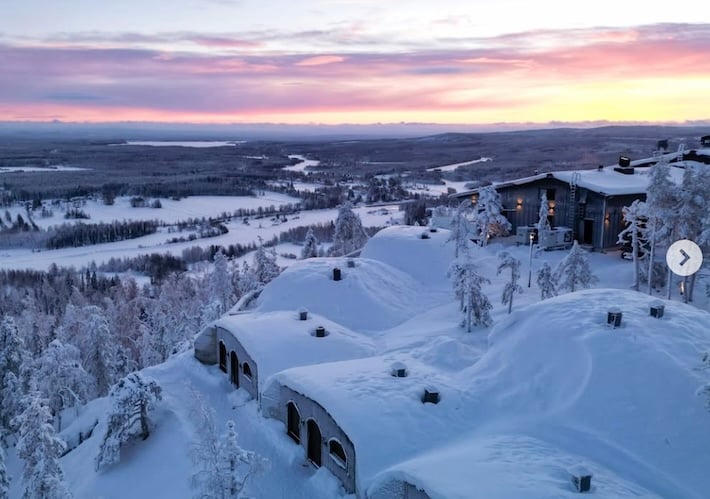
High above the Arctic Circle, tourism has always been about extremes — freezing temperatures, glowing skies, and landscapes that feel almost unreal. For decades, travellers came to Lapland to sleep in log cabins or watch the northern lights through glass igloos. Now, a new idea is quietly reshaping the way people imagine staying in the wild: going underground.
The newly opened Kaamos Lodge in Finnish Lapland introduces 80 earth-covered modular homes — concrete structures built in Estonia and embedded into a hillside to blend with the terrain. Unlike traditional chalets, these units sit beneath layers of soil, protected from wind and snow while remaining almost invisible in the landscape.
It’s a concept that feels futuristic yet strangely ancient — like returning to cave living, redesigned for modern travellers.
The Rise of Hidden Architecture in the Arctic
The creators behind the underground resort didn’t set out simply to build accommodation — they wanted to rethink tourism’s relationship with nature. Each 30-square-metre module was prefabricated and installed in just a day, forming a stepped layout where one grassy roof becomes the ground level for the next.
This design reflects a growing shift in Arctic travel: instead of building above the landscape, developers are learning to disappear into it.
In the harsh climate of northern Finland, practical advantages also matter. Earth-covered structures reduce exposure to storms and temperature swings, lowering maintenance while allowing operators to focus more on guest experience than constant repairs.
But beyond engineering, the underground concept signals something deeper — a change in what tourists want. Increasingly, visitors seek immersion rather than spectacle. They don’t just want to see Lapland; they want to feel part of it.
From Ice Palaces to Glass Igloos: The Creative Roots of Arctic Tourism
Long before underground resorts, Lapland became famous for turning architecture itself into an attraction.
The Ice Hotel Revolution
In 1990, the first permanent ice hotel opened in Jukkasjärvi, Sweden — rebuilt every winter entirely from snow and ice. Even beds, walls and glasses were sculpted from frozen river blocks, transforming accommodation into art.
Elsewhere in Finnish Lapland, seasonal attractions like SnowVillage reinvent themselves each year with themed ice worlds, giant sculptures and immersive installations that draw thousands of visitors. (
These icy creations proved that tourism could be more than shelter; it could be storytelling.
The Glass Igloo Era

Then came another breakthrough: glass-roofed igloos. Resorts like Kakslauttanen turned northern-lights watching into a luxury experience, allowing travellers to lie in bed while the sky shimmered overhead.
Researchers later described these innovations as a “whole new idea” that reshaped Arctic tourism — turning accommodation itself into a bucket-list attraction rather than just a place to sleep.
Each concept — ice, glass, snow — pushed the boundaries of what a hotel could be.
Underground: The Next Chapter of Experience-Driven Travel
The new underground resort feels like the next step in that creative lineage.
Where ice hotels embraced cold and glass igloos embraced the sky, subterranean lodges embrace the earth. Instead of dramatic silhouettes, they offer silence and shelter — rooms that feel carved from the hillside rather than built upon it.
This reflects a wider shift in travel trends:
- Sustainability through design:embedding buildings reduces visual impact and can improve energy efficiency.
- Longevity over novelty:unlike seasonal ice structures, underground modules are meant to last generations.
- Intimacy with nature:guests experience the Arctic not as spectators but as inhabitants of the landscape.
Tourism in Lapland has always thrived on imagination. One decade visitors slept inside frozen sculptures; the next, they watched auroras through heated glass domes. Now they descend beneath the snow.
Why Creative Architecture Is Becoming Tourism’s Strongest Currency
What connects underground lodges, ice palaces and glass igloos isn’t just design — it’s storytelling.
These projects turn architecture into narrative:
- Ice hotels tell stories of impermanence and artistry.
- Glass igloos frame the sky as a moving theatre.
- Underground resorts evoke mystery, warmth and timeless shelter.
In a world where destinations compete globally for attention, innovation has become as important as location. Travellers no longer chase only landmarks — they chase experiences that feel new, emotional and shareable.
The Arctic, once considered remote and inhospitable, has become a laboratory for this creativity. Harsh conditions push designers to experiment, and visitors reward bold ideas with curiosity.
A Future Written in Snow, Glass and Stone
Standing on a hillside in Lapland today, you might see very little — just rolling snow and a quiet valley. Yet beneath your feet lie dozens of hidden homes, proof that tourism is evolving in unexpected directions.
The underground resort doesn’t replace ice igloos or glass domes; it expands the vocabulary of Arctic travel. Each new concept builds on the last, layering innovation the way snow layers over tundra.
If the past decades taught us anything, it’s that the most successful tourism ideas aren’t just comfortable — they’re imaginative. And somewhere in the Arctic twilight, architects are already sketching the next impossible place to sleep.




Leave a Comment