

What is an Alm?
If playback is interrupted, you can restart it.
There are places in the Alps where luxury has nothing to do with marble bathrooms, infinity pools or five-star service. No concierge, no spa menu, and often no conventional road leading to the door.
Instead, there is silence. And cowbells.
This is the world of the Alm— one of the most authentic and perhaps least understood traditions of the Bavarian and Austrian Alps.
An Alm is difficult to translate into English. Calling it an “alpine hut” doesn’t quite capture it. Traditionally, an Alm is a mountain pasture where cattle spend the warmer months, often accompanied by a simple farmhouse or hut. Over generations, some of these places have evolved into small, family-run operations where hikers, neighbors, and returning visitors can stop for food, drink, and hospitality.
But they are not hotels in the conventional sense. And that is precisely their charm.
Hidden Above the Valley
In Upper Bavaria, many Alms sit in extraordinary locations, removed from towns and villages and sometimes reached only by small mountain or private roads.
One of these places is Pfeiffer Alm, near Krün, with its remarkable outlook toward the Zugspitze, Germany’s highest mountain.
For me, however, Pfeiffer Alm is more than a beautiful place in the mountains.
It is part of my childhood.
I first went there with my parents almost 60 years ago. They returned year after year — more than ten years in succession — becoming such familiar visitors that their loyalty was eventually recognized by the mayor of the little town of Krün.
Today, the same family name is still associated with the Alm. Two or three generations of the Pfeiffer family have come and gone, yet there is an extraordinary sense that the essential character of the place has survived.
And so has that view.
Across the landscape rises the Zugspitze and its surrounding mountain range, dominating the horizon with the kind of presence that photographs never quite manage to reproduce.
Where You Can Hear the Silence
There is an expression that sounds almost contradictory until you have experienced a place like this:
You can hear the silence.
Up on the Alm, that silence is occasionally interrupted by the sound of cowbells drifting across the pasture.
For someone accustomed to cities, airports, traffic, notifications and the constant background noise of modern life, the absence of sound becomes something you notice. It becomes a luxury in itself.
I remember being there as a young boy when the owner took me along to help milk a cow. It was probably an ordinary part of his day. For a child visiting from another world, it became one of those small experiences that remains in the memory for a lifetime.
There was nothing manufactured about it. No organized “farm experience,” no attraction created for tourists.
There was simply a cow that needed milking. And a boy who was invited to help.
Coming Back Almost 60 Years Later
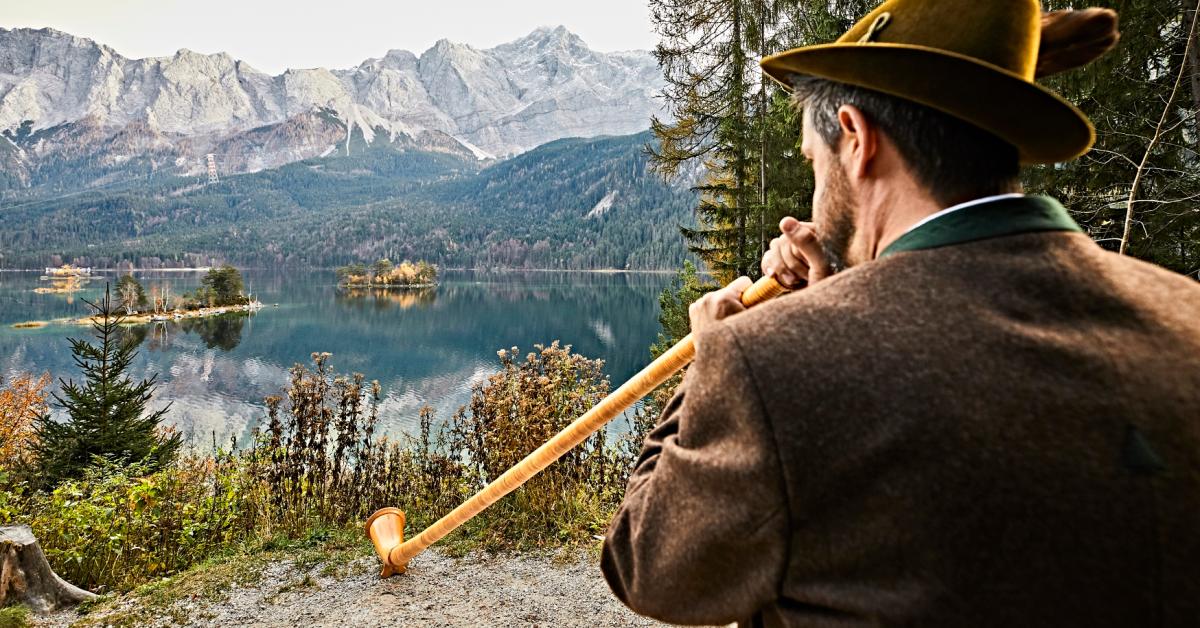
Almost 60 years later, I came back. Not for a week or even for a night. Just for an afternoon. And perhaps that made the experience even more powerful.
I sat outside on the terrace and, for a while, had the entire terrace to myself. I ordered a piece of homemade pie and an old-fashioned drip coffee — nothing elaborate, nothing that would appear on the menu of a fashionable resort.
And I simply sat there.
It was a beautiful, clear, sunny afternoon. In front of me stretched the magnificent Zugspitze mountain range, sharply outlined against the blue sky. Around me was almost complete silence.
And somewhere in the background came the gentle sound of cowbells.
That was it. Homemade pie. A cup of coffee. An empty terrace. Mountains. Sunshine. Silence. Cowbells.
For those few minutes, simply watching the Zugspitze mountain range, something remarkable happened: you forgot that there are problems on our beautiful planet.

The news, the worries, the conflicts, the deadlines, and all the noise of everyday life seemed impossibly far away. Nothing had actually disappeared, of course. But for a short time, none of it could reach this terrace.
There was only this extraordinary landscape.
I spent about three hours there that afternoon. Three hours doing almost nothing — and yet they felt restorative in a way that a carefully organized wellness program rarely can.
The German language has a particularly fitting word for it: Erholung.
“Recovery” or “relaxation” are close translations, but neither quite captures it. Erholung is the feeling of being restored, of recovering your energy and yourself.
Pure Recovery – Erholung
Those three hours were Erholung pur — pure recovery.
Perhaps because I had known the place as a little boy, there was something deeply emotional about sitting there again. Almost six decades of life separated the child who once helped milk a cow from the person now sitting quietly on that terrace.
And yet, looking across those mountains, the distance between those two moments suddenly did not seem very great at all.
And the Little Chapel Was Still There

There was one more reminder of the past. The little private chapel was still there.
I remembered it from all those years ago, and seeing it again somehow completed the feeling that this place had endured.
Small private chapels are part of the cultural landscape of rural Bavaria. Here, surrounded by mountains and pasture, the little chapel does not feel like a tourist attraction or a monument. It belongs to the place and to the generations of family life that have unfolded around it.
For me, seeing it still standing was deeply reassuring.
The world beyond these mountains had changed enormously in almost 60 years. I had changed. Generations had changed. Technology had reached even this secluded corner of Bavaria.
There was Wi-Fi now. But the little chapel was still there. Sometimes the smallest detail tells you most clearly that you have truly come home to a memory.
A Spa for the Mind
Today we often travel in search of wellness.
Hotels compete with ever-larger spas, elaborate treatments, heated pools, and carefully designed relaxation rooms.
An Alm offers almost the opposite. There may be no spa at all.

But perhaps it offers something closer to the original meaning of relaxation: space, mountains, fresh air, uncomplicated food, silence and the opportunity to do very little.
It is, in a sense, a spa for the mind.
No appointment is necessary. No treatment needs to be booked. There is no wellness program telling you how to relax.
- You sit down.
- You look at the mountains.
- You listen to the cowbells.
- And somehow, three hours later, you feel different.
- The experience isn’t designed. It simply exists.
Tourism Before Mass Tourism
Places such as these also represent a form of German and Austrian tourism that many international visitors never discover.
They are not the famous castles, large ski resorts or heavily promoted destinations appearing on everyone’s itinerary. Many Alms remain small, natural and family-run.
Their guests are often not people ticking another destination off a list. They are people who return.
Some come every summer. Some return for decades. Parents bring children; eventually those children return as adults, sometimes bringing children of their own.
That creates a relationship between visitor and place that is increasingly rare in modern tourism.
My parents were part of that tradition. Their repeated visits to Krün were not about constantly discovering somewhere new. They had discovered somewhere they wanted to know better.
There is an important difference.
Two Places That Can Make You Cry
I have seen many beautiful places, but today two stand apart for me as the most beautiful and remarkable places in the world.
One is the Grand Canyon
The other is this Alm in Upper Bavaria, looking toward the Zugspitze. They could hardly be more different. One is immense, almost beyond comprehension — a vast landscape carved through rock and time. The other is intimate: a terrace, a mountain pasture, a family-run Alm, cows grazing nearby and bells sounding quietly in the distance.
Yet they have something profound in common. They are both places that can make you want to cry simply because they are so beautiful.
Not because someone has designed them to impress you. Not because they are luxurious or fashionable. But because, standing or sitting before them, nature suddenly seems larger than everyday life.
There are moments when beauty becomes almost overwhelming. That clear, sunny afternoon on the terrace was one of them.
Almost 60 Years — and Still There

Somehow the long journey from the main road seems considerably shorter than the enormous expedition I remember from childhood — although perhaps that says as much about childhood memory as it does about modern roads.
Yet the remarkable thing is how much has notchanged.
- The Alm is still away from everything.
- The mountains are still there.
- The family name is still there.
- The cows are still there.
And the view toward the Zugspitze is every bit as majestic as I remembered it.
In a world where tourism increasingly means scale, convenience and standardization, these small Alms offer something very different.
They do not need to manufacture authenticity because they were never created as tourist products in the first place. They grew out of agriculture, family, landscape and generations of mountain life.
Time reaches even the most secluded mountain road. Wi-Fi now reaches where once there was none, cars travel roads that once felt impossibly remote, and each generation adapts the family operation to a changing world.
But the essence survives. Perhaps that is the real luxury of the Alm.
- Not five stars.
- No reward points
- Not a spa.
- Not a 24-hour lobby
- No marble bathroom
- A paradise for a walk, a hike, or skiing in the winter
Just a homemade piece of pie, an old-fashioned cup of coffee, a terrace overlooking the mountains, a family that has been there for generations — and the distant ringing of cowbells in a silence so complete that, for a few precious hours, the problems of the world seem very far away.







Leave a Comment