

If playback is interrupted, you can restart it.
World Travel Market London opens Tuesday, November 3, amid geopolitical uncertainty, changing tourism priorities, and questions about whether traditional big-spending destinations are getting the same return from international trade shows.
World Travel Market (WTM) London is preparing to welcome the global tourism industry to ExCeL London from November 3–5, 2026. Organizers are promoting another major international gathering following a record-breaking 2025 event, when attendance reached 46,500 and more than 40,000 business meetings took place. RX
Yet beyond the official optimism, a more revealing question is emerging: Are governments and national tourism organizations quietly reconsidering how much they spend on major international exhibitions?
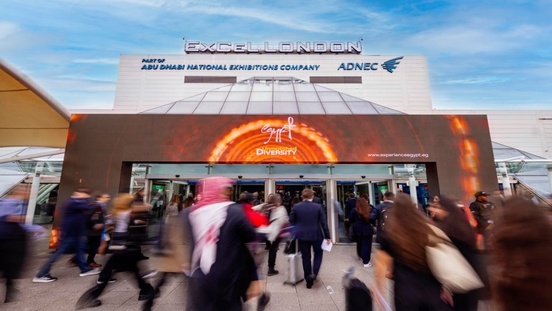
With geopolitical tensions affecting travel patterns, public budgets under scrutiny and new tourism markets competing for international attention, WTM London 2026 offers an opportunity to examine which destinations are expanding their presence, which remain committed and which may be reconsidering the value of expensive national pavilions.
The Middle East is not abandoning London
Despite regional geopolitical uncertainty, the Middle East remains one of WTM London’s most visible exhibiting regions.
A third-party analysis of the 2026 exhibitor directory identifies approximately 450 exhibitors concentrated across four exhibition halls dedicated largely to Middle Eastern and North African destinations. The United Arab Emirates, Saudi Arabia and Egypt account for particularly substantial representation. exposheet.com
Saudi Arabia’s tourism authority remains present alongside tourism companies and industry partners. The UAE maintains an extensive footprint, while Qatar has confirmed a delegation of 40 partners for its 12th consecutive WTM London appearance. World Travel Market Events+1
These commitments challenge any suggestion of a broad Middle Eastern withdrawal from London. They do not, however, establish whether individual national tourism budgets or pavilion sizes have increased or decreased compared with previous years.
For countries investing heavily in international visitor growth, maintaining visibility in London may be particularly important during periods of political uncertainty.
China is expanding its international tourism presence
China provides one of the clearest examples of a destination increasing its WTM London presence despite geopolitical and economic tensions.
Chinese tourism authorities have reported an approximately 22% expansion of the country’s exhibition pavilion compared with 2025, with more than 100 participating tourism enterprises and organizations.
The expansion suggests that China continues to view international travel-trade relationships as strategically important.
It also raises a broader question: While some established tourism markets reconsider promotional expenditure, are other destinations using global exhibitions to strengthen their position with international buyers?
Europe remains dominant, but participation varies
Italy and Spain remain among the largest national exhibitor groups at WTM London, followed by strong participation from Portugal and Türkiye.
Italy’s national tourism agency ENIT is promoting more than 2,000 square meters of exhibition space, representing 15 regions and eight institutions. World Travel Market Events
However, directory-based counts for countries such as Germany, France and the United States appear comparatively modest.
That contrast deserves investigation, but not premature conclusions.
Germany’s tourism promotion system, for example, involves national, regional and private-sector organizations with different commercial priorities. A lower number of exhibitors does not automatically indicate reduced government investment or declining interest in the British market.
The important comparison is not simply how many companies are listed under each country, but how national pavilion space, delegation size and public promotional expenditure have changed over time.
Egypt demonstrates that geopolitical uncertainty can encourage greater promotion
Egypt has been named WTM London’s Premier Partner for 2026, an especially visible role for a destination navigating regional uncertainty while pursuing international tourism growth.
According to WTM organizer RX, Egypt welcomed nearly 19 million international visitors in 2025, an increase of 21% over the previous year. RX
Egypt’s prominent participation suggests that geopolitical exposure does not necessarily lead tourism authorities to reduce international promotion. In some circumstances, maintaining confidence among tour operators and travelers may make participation more valuable.
Social media enthusiasm meets commercial reality
Publicly visible professional discussions around WTM London have emphasized networking appointments, destination presentations, product launches and meetings with international buyers.
The organizers are also expanding travel technology programming and introducing paid visitor registration from the beginning of the booking period. RX
Behind the promotional messaging lies a practical business question: Can independent hotels, smaller destinations and tourism SMEs still achieve a reasonable return on participation?
National tourism boards may justify substantial exhibition spending through destination branding, airline relationships and long-term economic diplomacy. Smaller businesses often need more immediate results: contracts, bookings and profitable distribution partnerships.
These competing expectations could become one of WTM London’s most consequential discussions.
What the participation figures cannot tell us
Public exhibitor directories provide a useful snapshot, but they are not reliable measures of government spending.
A country with 40 companies sharing one pavilion may have a larger physical presence than a destination with 80 separately listed exhibitors. Similarly, a government might reduce its exhibition budget while increasing spending on digital marketing, airline partnerships or consumer campaigns.
Comparisons also require caution because third-party databases can mix different years or use different counting methods.
There is currently insufficient verified evidence to conclude that traditional major tourism spenders are collectively withdrawing from WTM London 2026 because of geopolitical developments.
What is clear is that countries are pursuing different strategies, and some of the most visible exhibitors are continuing to invest heavily in international promotion.
WTM London faces a changing tourism marketplace
The most important question as WTM London opens may not be whether the exhibition halls are full.
It is whether the countries filling those halls are spending their tourism budgets differently—and whether the world’s traditional tourism powers are being challenged by destinations willing to invest more aggressively in global visibility.
For organizers, the measure of success will be international participation, buyer engagement and commercial results.
For tourism ministers and national tourism boards, the question is increasingly strategic: Does a large pavilion in London still deliver better results than targeted airline partnerships, digital campaigns or alternative regional trade events?
WTM London 2026 may reveal less about who is leaving the global tourism marketplace than about who is prepared to pay for influence within it.






Leave a Comment