
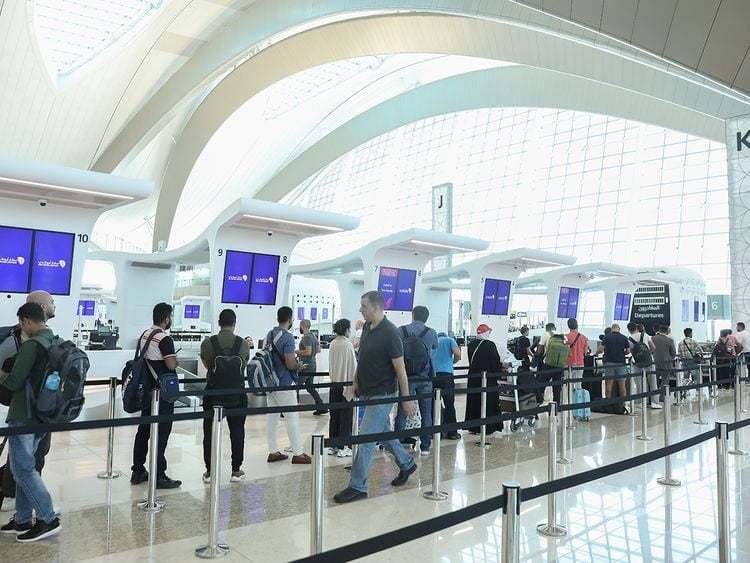
Major terminal upgrades are translating into happier travelers, but passengers still want airports to focus on navigation, convenience, local character, and relief from construction disruption.
After years of construction barriers, temporary walkways, closed concessions and major capital spending, North American airports are beginning to see a measurable payoff: passengers are becoming more satisfied with the airport experience even as terminals remain busy.
The 2026 J.D. Power North America Airport Satisfaction Study found that overall passenger satisfaction increased across all three airport-size categories. Minneapolis-Saint Paul International Airport ranked highest among mega airports, Tampa International Airport led the large-airport category, and Charleston International Airport took the top position among medium airports.
The findings suggest that the billions of dollars airports have invested in terminal renovations, passenger-flow improvements, technology, concessions and other infrastructure are increasingly visible to travelers.
But the results also carry an important message for airport planners: expensive construction by itself does not guarantee a better passenger experience. Travelers appear to respond most positively when investment makes the airport easier to navigate, more comfortable and more reflective of the region it serves.
Years of Airport Investment Begin to Show Results
Airport modernization has become a defining feature of North American aviation over the past decade. Airports have expanded terminals, modernized security and baggage areas, installed new passenger information systems, added restaurants and retail outlets, and redesigned aging facilities to accommodate growing passenger volumes.
Those improvements have often come with a short-term cost. Travelers at airports undergoing redevelopment have faced construction walls, changed traffic patterns, temporary facilities and longer walking routes. The 2026 results indicate that airports completing major phases of those projects are beginning to capture the benefits.
J.D. Power reported that satisfaction increased by 14 points among mega airports, 13 points among large airports and 16 points among medium airports, based on its 1,000-point scale. The study collected 24,710 surveys from U.S. and Canadian residents between July 2025 and July 2026.
The improvement also continues a broader trend. J.D. Power reported rising airport satisfaction in 2025 despite crowded terminals, flight delays, higher prices, and record passenger traffic.
The Airports Leading the Rankings
Minneapolis-Saint Paul International Airport earned a score of 684, taking the top position among mega airports for the third consecutive year. Detroit Metropolitan Wayne County Airport followed at 663, while Phoenix Sky Harbor International Airport ranked third at 642.
MSP’s performance comes after substantial modernization. In December 2025, the Metropolitan Airports Commission and Delta Air Lines announced completion of a $242 million modernization programcovering six Terminal 1 concourses and roughly 75 Delta gate areas. Improvements included updated flight-information screens, new seating and power outlets, lighting, flooring and refreshed gate areas.
The airport says it is not finished. MSP is preparing a major concessions redevelopment that is expected to introduce 47 new venues by 2029, including both Minnesota businesses and nationally recognized brands. Airport research identified passenger demand for more coffee, quick-service choices, convenience options and better dwell space.
Among large airports, Tampa International Airport scored 715, ahead of Portland International Airport at 708 and Dallas Love Field at 698. Charleston International Airport led medium airports with 712, followed by Ontario International Airport at 705 and Indianapolis International Airport at 695.
What Passengers Actually Value
One of the clearest findings from the study is that successful airport design combines practical efficiency with a memorable experience.
Passengers place considerable value on clear signage and intuitive wayfinding. An impressive terminal may still produce frustration when travelers struggle to locate security checkpoints, gates, baggage claim, ground transportation or connecting flights.
At the same time, travelers increasingly respond to airports that have a recognizable local identity. Architecture, artwork, restaurants and retail concepts associated with the surrounding city or region can make a terminal feel less generic.
Food and retail are another increasingly important part of the experience. Satisfaction with food, beverage and retail programs improved eight points year over year across airport categories. J.D. Power found that local restaurants and brands can improve travelers’ impressions, but passengers also continue to value familiar national brands.
The challenge for airports is therefore balance: provide enough local character to distinguish the terminal while maintaining familiar, predictable choices for travelers who may simply want a quick meal or coffee before boarding.
Better Experience, More Passenger Spending
Passenger satisfaction is not merely a reputational issue for airport operators. It can also have significant commercial consequences.
According to J.D. Power, passengers describing their airport experience as “perfect” spent an average of $47.60inside the terminal. That was $20.22 morethan passengers who described their experience as merely “just OK.” Only 12% of airport journeys received the highest assessment, however.
The finding gives airports and concession operators a financial incentive to think about the entire passenger journey. Comfortable seating, understandable signs, attractive spaces and convenient restaurants can influence not only satisfaction but also how travelers use their time before departure.
A passenger who is stressed about finding a gate may hurry through the terminal. A passenger who feels confident about where to go and how long it will take has more opportunity to stop at a restaurant or store.
Feedback Shows Where Improvements Can Continue
The study points to several areas where airport investment can produce noticeable passenger benefits.
Wayfinding remains fundamental. Airports can continue improving signs, digital flight-information displays and the consistency of directions between parking, check-in, security, gates and baggage claim.
Comfort is another opportunity. More seating, charging access, improved restrooms, accessible facilities and better spaces for passengers waiting between flights can turn architectural modernization into practical improvement.
MSP’s recently completed Terminal 1 modernization, for example, included new gate seating with power outlets, brighter lighting and technology upgrades alongside aesthetic changes.
Food and retail strategies also need continued adjustment. MSP’s next concessions program specifically responds to research indicating demand for more coffee, quick-service restaurants, convenience retail and passenger dwell space.
Tampa, meanwhile, continues to invest despite its leading satisfaction result. Its FY2026 capital program includes 34 projects totaling $835.5 million, including a $298.6 million checked-baggage modernization and a $285.7 million expansion and renovation of the Main Terminal ticketing level.
Construction Remains One of the Biggest Challenges
The same projects that promise a better future experience can create significant inconvenience while they are being built.
Denver International Airport illustrates that tension. Passenger satisfaction there improved, but the airport remained near the bottom of the mega-airport rankings in the 2026 study as major construction continued.
That creates a difficult management problem. Airports must expand and replace aging infrastructure while continuing to process thousands—or tens of thousands—of passengers every day.
Temporary closures can change walking routes. Road construction can complicate drop-off and pickup. Renovations can remove seating or concessions from service. New systems must sometimes be introduced while older ones continue operating.
Airport authorities therefore have to manage not just construction itself, but communication about construction.
Public Input Has a Role in Airport Planning
Public participation is another part of the modernization process, particularly when airports develop long-range master plans.
Tampa International Airport, for example, has held public meetings on its master-plan update where airport officials and consultants presented future plans, answered questions and accepted public comments. The airport also provided a virtual participation option and an online mechanism for submitting feedback.
Such engagement can help airports identify concerns that may not be obvious from architectural plans alone—from roadway access and parking to accessibility, concessions and the ease of moving through terminals.
Passenger surveys provide another form of public input. The J.D. Power study measures satisfaction across seven areas: ease of travel through the airport, trust in the airport, terminal facilities, airport staff, the departure and airport-access experience, food and retail, and the arrival and onward-travel experience.
Together, formal consultation and passenger-experience research give airport authorities a clearer picture of how infrastructure decisions affect the people actually using the facilities.
The Next Challenge: Making Investment Feel Useful
The 2026 results suggest that North America’s airport construction boom is beginning to deliver measurable passenger benefits. Yet they also demonstrate that travelers do not necessarily judge an airport by the size or price of its newest terminal.
Passengers experience airports at a much more practical level: Can they find their gate? Is there somewhere comfortable to sit? Can they charge a phone? Are the restrooms clean and accessible? Can they find food they want at the time they need it? Does the terminal feel connected to the city they are visiting?
That may be the most important lesson from the latest rankings.
Large-scale construction provides the physical infrastructure, but the details determine whether passengers perceive the investment as an improvement. As another generation of airport projects moves from construction drawings to operating terminals, success will increasingly depend on whether airports combine capacity and architectural ambition with clarity, convenience, accessibility and a passenger experience shaped by continuing public feedback.






Leave a Comment