
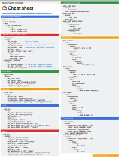
The following workflow provides a concise overview of the Workflows syntax that can be used for quick reference. For more information, click the links in the workflow. You can also download the printable PDF:
 main
: params
: [ args
] steps
:
    # Runtime arguments
- read_runtime_args: assign
:
          - arg1: ${args.arg1}
          - arg2: ${args.arg2}
    # Variables
and data types
- data_types: assign
:
          - my_integer: 1      # 64 bit, signed
          - my_double: 4.1     # 64 bit, signed floating point number
          - my_string: "hello" # unicode <= 256 KB length
          - my_boolean: true   # true/false, True/False, TRUE/FALSE
          - my_null: null
          - my_list: ["zero","one","two"]
          - my_map:
              name: Alex
              last_name: Taylor
              birthYear: 1990
    - conversion_functions: assign
:
          - to_double: double("2.7") # string, integer to double
          - to_int: int(2.7)         # string, double to integer
          - to_string: string(1.7)   # int, double, boolean to string
    # Boolean
- logical_ops: assign
:
          - my_true: true
          - my_false: false
          - my_false: ${my_true and my_false}
          - my_true: ${my_true or my_false}
          - my_false: ${not my_true}
    # Strings
- string_ops: assign
:
          - my_string: "hello"
          - string_len: ${len(my_string)}
          - string_plus_string: ${my_string+" "+"world"}
          - string_plus_int: ${my_string+" "+string(my_integer)}
          - string_escaped: '${"a: " +my_string}'
    # Lists
- list_ops: assign
:
          - my_list: ["zero","one","two"]
          - my_list_len: ${len(my_list)}
          - key_exists: ${"Key1" in my_list}
          - my_list[0]: 0
          - idx: 0
          - my_list[idx + 1]: 1
          - my_list[my_list_len - 1]: 2
          - my_list: ${list.concat(my_list, 3)}
          - my_multi_dimen_list: [[10, 11, 12], [20, 21, 22]]
          - my_multi_dimen_list[0][1]: "Value11"
    # Maps
- map_ops: assign
:
          - my_map: {"Key1": "hello"}
          - map_len: ${len(my_map)}
          - key_exists: ${"Key1" in my_map}
          - key_list: ${keys(my_map)}
          - key_is_null: ${default(map.get(my_map, "Key1"), "Couldn't find key!")}
          - key_with_special_char: '${"fruit" + var.key["special!key"]}'
          - key_str: "Key"
          - my_map.Key1: "Value1"
          - my_map["Key2"]: "Value2"
          - my_map[key_str + "3"]: "Value3"
          - my_nested_map: {"NestedMapKey": {"Key1":"Value1"}}
          - my_nested_map.NestedMapKey.Key2: "Value2"
    # Jumps
- step_with_next: assign
:
          - fruit: "apple" next
: step_with_nested_steps
    # Complete execution
- step_with_end: assign
:
           - fruit: "apple" next
: end
# Nested steps
- step_with_nested_steps: steps
:
            - nested_step_1: assign
:
                  - fruit: "apple"
            - nested_step_2: assign
:
                  - fruit: "apple"
    # Iteration
- for-in-list: steps
:
          - assignList: assign
:
                  - list: [1, 2, 3, 4, 5]
                  - sum: 0
          - loopList: for
:
                  value: v
                  in: ${list} steps
:
                      - sumList: assign
:
                              - sum: ${sum + v}
    - for-in-map: steps
:
          - assignMap: assign
:
                  - map: {1: 10, 2: 20, 3: 30}
                  - sum: 0
          - loopMap: for
:
                  value: key
                  in: ${keys(map)} steps
:
                      - sumMap: assign
:
                              - sum: ${sum + map[key]}
    - for-range: steps
:
          - assignRange: assign
:
                  - sum: 0
          - loopRange: for
:
                  value: v
                  range: [1, 9] steps
:
                      - sumRange: assign
:
                              - sum: ${sum + v}
    # Parallel branches
- init: assign
:
          - user: {}
          - notification: {}
    - parallel_branches: parallel
:
          shared: [user, notification] branches
:
            - getUser: steps
:
                  - getUserCall: call
: http.get args
:
                        url: ${"https://example.com/users/" + args.userId} result
: user
            - getNotification: steps
:
                  - getNotificationCall: call
: http.get args
:
                        url: ${"https://example.com/notification/" + args.notificationId} result
: notification
    # Parallel iteration
- init: assign
:
          - total: 0
    - parallel_loop: parallel
:
          shared: [total] for
:
            value: postId
            in: ${args.posts} steps
:
              - getPostCommentCount: call
: http.get args
:
                    url: ${"https://example.com/postComments/" + postId} result
: numComments
              - add: assign
:
                    - total: ${total + numComments}
    # Conditions
- switch_basic: switch
:
          - condition
: ${my_integer < 10} next
: switch_embedded_steps
          - condition
: ${my_boolean} next
: switch_embedded_steps
          - condition
: true # optional, default condition next
: switch_embedded_steps next
: switch_embedded_steps
    - switch_embedded_steps: switch
:
          - condition
: ${my_integer < 10} steps
:
              - stepA: assign
:
                    - fruit: "apple"
              - stepB: assign
:
                    - fruit: "apple"
    # Subworkflows
- call_subworkflow: call
: subworkflow_name_message args
:
            first_name: "Alex"
            last_name: "Taylor" result
: output
    - call_subworkflow2: assign
:
          - output2: ${subworkflow_name_message("Sherlock","Holmes")}
    # Raise errors
- raise_custom_string_error: raise
: "Something went wrong."
    - raise_custom_map_error: raise
:
            code: 55
            message: "Something went wrong."
    # Catch errors
- try_retry_except: try
: steps
: # steps is only needed if multiple steps
              - step_a: call
: http.get args
:
                      url: https://host.com/api result
: api_response1
              - step_b: call
: http.get args
:
                      url: https://host.com/api2 result
: api_response2
        # Retry steps
(optional)
        # Either, you can use a retry with default policy
        # retry
: ${http.default_retry}
        # Or, you can use a more fine-grained policy
        # retry
:
        #   predicate: ${http.default_retry_predicate}
        #   max_retries: 10
        #   backoff:
        #       initial_delay: 1
        #       max_delay: 90
        #       multiplier: 3 except
:
            as: e steps
:
                - known_errors: switch
:
                    - condition
: ${not("HttpError" in e.tags)} return
: "Connection problem."
                    - condition
: ${e.code == 404} return
: "Sorry, URL wasn't found."
                    - condition
: ${e.code == 403} return
: "Authentication error."
                - unhandled_exception: raise
: ${e}
    # Standard library
## Make an HTTP request
- http_get: call
: http.get args
:
            url: https://en.wikipedia.org/w/api.php
            headers:
                Content-Type: "text/plain"
            query:
                action: opensearch
                search: monday result
: wikiResult
    - http_post: call
: http.post args
:
            url: https://us-central1-myproject123.cloudfunctions.net/myfunc1
            auth:
                type: OIDC
            body:
                some_val: "Hello World"
                another_val: 123 result
: the_message
    ## Function sys.log
- log: call
: sys.log args
:
          data: ${wikiResult}
    ## Function sys.get_env
- get_env_vars: assign
:
          - projectNumber: ${sys.get_env("GOOGLE_CLOUD_PROJECT_NUMBER")}
          - projectID: ${sys.get_env("GOOGLE_CLOUD_PROJECT_ID")}
          - location: ${sys.get_env("GOOGLE_CLOUD_LOCATION")}
          - workflowId: ${sys.get_env("GOOGLE_CLOUD_WORKFLOW_ID")}
          - workflowRevisionId: ${sys.get_env("GOOGLE_CLOUD_WORKFLOW_REVISION_ID")}
          - workflowExecutionId: ${sys.get_env("GOOGLE_CLOUD_WORKFLOW_EXECUTION_ID")}
    ## Function sys.now
- get_now: assign
:
          - now: ${sys.now()}
    ## Function sys.sleep
- wait: call
: sys.sleep args
:
            seconds: 10
    # Connectors
## Compute Engine API connector
- insert_machine: call
: googleapis.compute.v1.instances.insert args
:
            project: ${projectID}
            zone: europe-west1-b
            body:
              name: my-machine
              machineType: zones/europe-west1-b/e2-small
              disks:
              - initializeParams:
                  sourceImage: "projects/debian-cloud/global/images/debian-10-buster-v20201112"
                boot: true
                autoDelete: true
              networkInterfaces:
              - network: "global/networks/default"
    # Return from workflow
- return_multiple_values: return
:
          my_integer: ${my_integer}
          my_string: ${my_string}
          my_true: ${my_true}
          my_false: ${my_false}
          my_list: ${my_list}
          my_multi_dimen_list: ${my_multi_dimen_list}
          my_map: ${my_map}
          my_nested_map: ${my_nested_map}
    - return_single_value: return
: ${my_integer}

# Subworkflow
subworkflow_name_message: params
: [first_name, last_name, country: "England"] steps
:
        - prepareMessage: return
: ${"Hello " + first_name + " " + last_name + " from " + country + "."}
