Build a Google Chat app with an Agent2Agent agent

This page explains how to build a Google Workspace add-on that works in Google Chat and interfaces with an AI agent that uses the Agent2Agent (A2A) protocol. You develop the agent using the Agent Development Kit (ADK) , and host it in Vertex AI Agent Engine .

Note: In Google Chat, add-ons appear to users as Google Chat apps. You can also build your Chat app using Google Chat API interaction events . To learn more, see the Extend Google Chat overview .

AI agents autonomously perceive their environment, reason, and execute complex, multi-step actions to achieve a defined goal. In this tutorial, you deploy the LLM Auditor multi-agent sample that critiques and revises facts using Gemini and Google Search grounding.
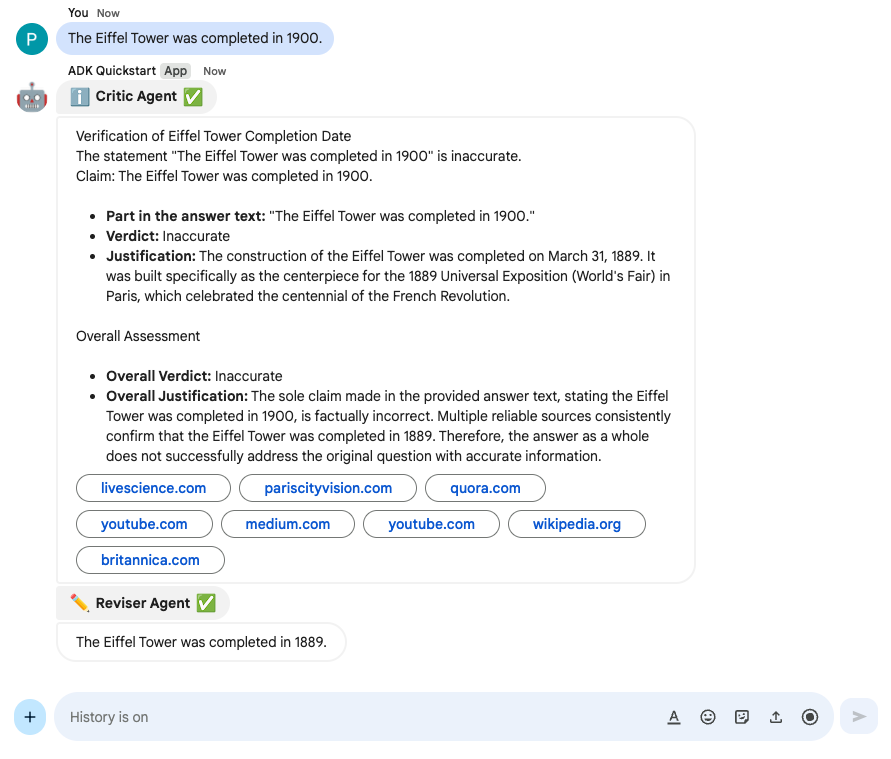
LLM Auditor multi-agent sample as Chat app.

The following diagram shows the architecture and messaging pattern:
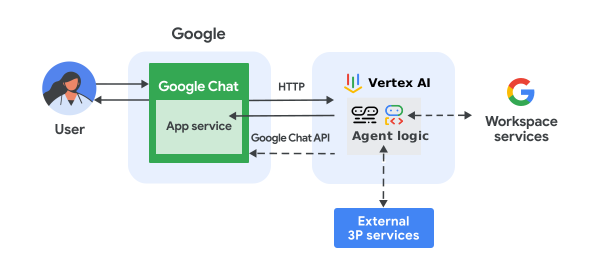
Architecture of a Chat app implemented with an A2A AI agent.

In the diagram, a user interacting with a Chat app implemented with an A2A agent has the following flow of information:

  1. A user sends a message to a Chat app, either in a direct message or in a Chat space.
  2. The Chat app logic that's implemented either in Apps Script or as a web server with HTTP endpoints receives and processes the message.
  3. The A2A agent hosted with Vertex AI Agent Engine receives and processes the interaction.
  4. Optionally, the Chat app or AI agent can integrate with Google Workspace services, such as Calendar or Sheets, or other Google Services, such as Google Maps or YouTube.
  5. The Chat app sends responses asynchronously, using the Google Chat API to communicate the AI agent's progress.
  6. The responses are delivered to the user.

Objectives

  • Set up your environment.
  • Deploy the A2A agent.
  • Deploy the Chat app.
  • Configure the Chat app.
  • Test the Chat app.

Prerequisites

Set up your environment

Enable the Google Cloud APIs

Before using Google APIs, you need to turn them on in a Google Cloud project. You can turn on one or more APIs in a single Google Cloud project.
  • In the Google Cloud console, enable the Google Chat, Vertex AI, and Cloud Resource Manager APIs.

    Enable the APIs

Configure the OAuth consent screen

All apps using OAuth 2.0 require a consent screen configuration. Configuring your app's OAuth consent screen defines what is displayed to users and app reviewers, and registers your app so you can publish it later.

  1. In the Google Cloud console, go to Menu > Google Auth platform > Branding .

    Go to Branding

  2. If you have already configured the Google Auth platform, you can configure the following OAuth Consent Screen settings in Branding , Audience , and Data Access . If you see a message that says Google Auth platform not configured yet , click Get Started :
    1. Under App Information , in App name , enter a name for the app.
    2. In User support email , choose a support email address where users can contact you if they have questions about their consent.
    3. Click Next .
    4. Under Audience , select Internal .
    5. Click Next .
    6. Under Contact Information , enter an Email address where you can be notified about any changes to your project.
    7. Click Next .
    8. Under Finish , review the Google API Services User Data Policy and if you agree, select I agree to the Google API Services: User Data Policy .
    9. Click Continue .
    10. Click Create .
  3. For now, you can skip adding scopes. In the future, when you create an app for use outside of your Google Workspace organization, you must change the User type to External . Then add the authorization scopes that your app requires. To learn more, see the full Configure OAuth consent guide.

Create a new service account with the role Vertex AI User by following these steps:

Google Cloud console

  1. In the Google Cloud console, go to Menu > IAM & Admin > Service Accounts .

    Go to Service Accounts

  2. Click Create service account .
  3. Fill in the service account details, then click Create and continue .
  4. Optional: Assign roles to your service account to grant access to your Google Cloud project's resources. For more details, refer to Granting, changing, and revoking access to resources .
  5. Click Continue .
  6. Optional: Enter users or groups that can manage and perform actions with this service account. For more details, refer to Managing service account impersonation .
  7. Click Done . Make a note of the email address for the service account.

gcloud CLI

  1. Create the service account:
      gcloud iam service-accounts create  SERVICE_ACCOUNT_NAME 
     
    \ 
     --display-name="  SERVICE_ACCOUNT_NAME 
     
    " 
     
    
  2. Optional: Assign roles to your service account to grant access to your Google Cloud project's resources. For more details, refer to Granting, changing, and revoking access to resources .

The service account appears on the service account page.

Create a private key

To create and download a private key for the service account, follow these steps:

  1. In the Google Cloud console, go to Menu > IAM & Admin > Service Accounts .

    Go to Service Accounts

  2. Select your service account.
  3. Click Keys > Add key > Create new key .
  4. Select JSON , then click Create .

    Your new public/private key pair is generated and downloaded to your machine as a new file. Save the downloaded JSON file as credentials.json in your working directory. This file is the only copy of this key. For information about how to store your key securely, see Managing service account keys .

  5. Click Close .

For more information about service accounts, see service accounts in the Google Cloud IAM documentation .

Deploy the A2A agent

  1. If you haven't done so, authenticate with your Google Cloud account and configure the Google Cloud CLI to use your Google Cloud project.

     gcloud  
    auth  
    application-default  
    login 
     gcloud  
    config  
     set 
      
    project  
     PROJECT_ID 
     
     gcloud  
    auth  
    application-default  
    set-quota-project  
     PROJECT_ID 


    Replace PROJECT_ID with the ID of your Cloud project.

  2. Download the ADK samples GitHub repository using this button:

    Download adk-samples

  3. In your preferred local development environment, extract the downloaded archive file and open the adk-samples/python/agents/llm-auditor directory.

     unzip  
    adk-samples-main.zip 
      cd 
      
    adk-samples-main/python/agents/llm-auditor 
    
  4. Update the implementation to deploy the ADK agent as an A2A remote agent:

    1. pyproject.toml: Add ADK and A2A SDK dependencies in deployment group.

      apps-script/chat/a2a-ai-agent/llm-auditor/pyproject.toml
       [project] 
       name 
        
       = 
        
       "llm-auditor" 
       version 
        
       = 
        
       "0.1.0" 
       description 
        
       = 
        
       "The LLM Auditor evaluates LLM-generated answers, verifies actual accuracy using the web, and refines the response to ensure alignment with real-world knowledge." 
       authors 
        
       = 
        
       [ 
        
       { 
        
       name 
        
       = 
        
       "Chun-Sung Ferng" 
       , 
        
       email 
        
       = 
        
       "csferng@google.com" 
        
       }, 
        
       { 
        
       name 
        
       = 
        
       "Cyrus Rashtchian" 
       , 
        
       email 
        
       = 
        
       "cyroid@google.com" 
        
       }, 
        
       { 
        
       name 
        
       = 
        
       "Da-Cheng Juan" 
       , 
        
       email 
        
       = 
        
       "dacheng@google.com" 
        
       }, 
        
       { 
        
       name 
        
       = 
        
       "Ivan Kuznetsov" 
       , 
        
       email 
        
       = 
        
       "ivanku@google.com" 
        
       }, 
       ] 
       license 
        
       = 
        
       "Apache License 2.0" 
       readme 
        
       = 
        
       "README.md" 
       [tool.poetry.dependencies] 
       python 
        
       = 
        
       "^3.10" 
       google-adk 
        
       = 
        
       "^1.0.0" 
       google-cloud-aiplatform 
        
       = 
        
       { 
        
       extras 
        
       = 
        
       [ 
        
       "adk" 
       , 
        
       "agent-engines" 
       , 
       ], 
        
       version 
        
       = 
        
       "^1.93.0" 
        
       } 
       google-genai 
        
       = 
        
       "^1.9.0" 
       pydantic 
        
       = 
        
       "^2.10.6" 
       python-dotenv 
        
       = 
        
       "^1.0.1" 
       [tool.poetry.group.dev] 
       optional 
        
       = 
        
       true 
       [tool.poetry.group.dev.dependencies] 
       google-adk 
        
       = 
        
       { 
        
       version 
        
       = 
        
       "^1.0.0" 
       , 
        
       extras 
        
       = 
        
       [ 
       "eval" 
       ] 
        
       } 
       pytest 
        
       = 
        
       "^8.3.5" 
       pytest-asyncio 
        
       = 
        
       "^0.26.0" 
       [tool.poetry.group.deployment] 
       optional 
        
       = 
        
       true 
       [tool.poetry.group.deployment.dependencies] 
       absl-py 
        
       = 
        
       "^2.2.1" 
        google-adk 
        
       = 
        
       "^1.0.0" 
        a2a-sdk 
        
       = 
        
       "^0.3.0" 
       [build-system] 
       requires 
        
       = 
        
       [ 
       "poetry-core>=2.0.0,<3.0.0" 
       ] 
       build-backend 
        
       = 
        
       "poetry.core.masonry.api" 
      
    2. deployment/deploy.py: Replace the ADK app deployment with an A2A agent and card.

      apps-script/chat/a2a-ai-agent/llm-auditor/deployment/deploy.py
       # Copyright 2025 Google LLC 
       # 
       # Licensed under the Apache License, Version 2.0 (the "License"); 
       # you may not use this file except in compliance with the License. 
       # You may obtain a copy of the License at 
       # 
       #     http://www.apache.org/licenses/LICENSE-2.0 
       # 
       # Unless required by applicable law or agreed to in writing, software 
       # distributed under the License is distributed on an "AS IS" BASIS, 
       # WITHOUT WARRANTIES OR CONDITIONS OF ANY KIND, either express or implied. 
       # See the License for the specific language governing permissions and 
       # limitations under the License. 
       """Deployment script for LLM Auditor.""" 
       import 
        
       os 
       from 
        
       absl 
        
       import 
       app 
       from 
        
       absl 
        
       import 
       flags 
       from 
        
       dotenv 
        
       import 
       load_dotenv 
       from 
        
       llm_auditor.agent 
        
       import 
       root_agent 
       import 
        
       vertexai 
       from 
        
       vertexai 
        
       import 
       agent_engines 
       # A2A wrapping 
       from 
        
       a2a.types 
        
       import 
       AgentSkill 
       from 
        
       google.adk.a2a.executor.a2a_agent_executor 
        
       import 
       A2aAgentExecutor 
       from 
        
       google.adk.runners 
        
       import 
       InMemoryRunner 
       from 
        
       vertexai.preview.reasoning_engines.templates.a2a 
        
       import 
       create_agent_card 
       from 
        
       vertexai.preview.reasoning_engines 
        
       import 
       A2aAgent 
       FLAGS 
       = 
       flags 
       . 
       FLAGS 
       flags 
       . 
       DEFINE_string 
       ( 
       "project_id" 
       , 
       None 
       , 
       "GCP project ID." 
       ) 
       flags 
       . 
       DEFINE_string 
       ( 
       "location" 
       , 
       None 
       , 
       "GCP location." 
       ) 
       flags 
       . 
       DEFINE_string 
       ( 
       "bucket" 
       , 
       None 
       , 
       "GCP bucket." 
       ) 
       flags 
       . 
       DEFINE_string 
       ( 
       "resource_id" 
       , 
       None 
       , 
       "ReasoningEngine resource ID." 
       ) 
       flags 
       . 
       DEFINE_bool 
       ( 
       "list" 
       , 
       False 
       , 
       "List all agents." 
       ) 
       flags 
       . 
       DEFINE_bool 
       ( 
       "create" 
       , 
       False 
       , 
       "Creates a new agent." 
       ) 
       flags 
       . 
       DEFINE_bool 
       ( 
       "delete" 
       , 
       False 
       , 
       "Deletes an existing agent." 
       ) 
       flags 
       . 
       mark_bool_flags_as_mutual_exclusive 
       ([ 
       "create" 
       , 
       "delete" 
       ]) 
        def 
        
       create 
       () 
       - 
      > None 
       : 
         
       """Creates an agent engine for LLM Auditor.""" 
        agent_card 
       = 
       create_agent_card 
       ( 
        agent_name 
       = 
       root_agent 
       . 
       name 
       , 
        description 
       = 
       root_agent 
       . 
       description 
       , 
        skills 
       = 
       [ 
       AgentSkill 
       ( 
        id 
       = 
       'audit_llm_output' 
       , 
        name 
       = 
       'Audit LLM Output' 
       , 
        description 
       = 
       'Critiques and revises outputs from large language models.' 
       , 
        tags 
       = 
       [ 
       'LLM' 
       , 
       'Audit' 
       , 
       'Revision' 
       ], 
        examples 
       = 
       [ 
        'The earth is flat.' 
       , 
        'The capital of France is Berlin.' 
       , 
        'The last winner of the Super Bowl was the New England Patriots in 2020.' 
       , 
        ], 
        )] 
        ) 
        a2a_agent 
       = 
       A2aAgent 
       ( 
        agent_card 
       = 
       agent_card 
       , 
        agent_executor_builder 
       = 
       lambda 
       : 
       A2aAgentExecutor 
       ( 
        runner 
       = 
       InMemoryRunner 
       ( 
        app_name 
       = 
       root_agent 
       . 
       name 
       , 
        agent 
       = 
       root_agent 
       , 
        ) 
        ) 
        ) 
        a2a_agent 
       . 
       set_up 
       () 
         remote_agent 
       = 
       agent_engines 
       . 
       create 
       ( 
        a2a_agent 
       , 
        display_name 
       = 
       root_agent 
       . 
       name 
       , 
        requirements 
       = 
       [ 
        "google-adk (>=0.0.2)" 
       , 
        "google-cloud-aiplatform[agent_engines] (>=1.88.0,<2.0.0)" 
       , 
        "google-genai (>=1.5.0,<2.0.0)" 
       , 
        "pydantic (>=2.10.6,<3.0.0)" 
       , 
        "absl-py (>=2.2.1,<3.0.0)" 
       , 
        "a2a-sdk>=0.3.22" 
       , 
        "uvicorn" 
       , 
        ], 
        # In-memory runner 
        max_instances 
       = 
       1 
       , 
        env_vars 
       = 
       { 
        "NUM_WORKERS" 
       : 
       "1" 
        }, 
        extra_packages 
       = 
       [ 
       "./llm_auditor" 
       ], 
        ) 
        print 
       ( 
       f 
       "Created remote agent: 
       { 
       remote_agent 
       . 
       resource_name 
       } 
       " 
       ) 
       def 
        
       delete 
       ( 
       resource_id 
       : 
       str 
       ) 
       - 
      > None 
       : 
       remote_agent 
       = 
       agent_engines 
       . 
       get 
       ( 
       resource_id 
       ) 
       remote_agent 
       . 
       delete 
       ( 
       force 
       = 
       True 
       ) 
       print 
       ( 
       f 
       "Deleted remote agent: 
       { 
       resource_id 
       } 
       " 
       ) 
       def 
        
       list_agents 
       () 
       - 
      > None 
       : 
       remote_agents 
       = 
       agent_engines 
       . 
       list 
       () 
       TEMPLATE 
       = 
       ''' 
       {agent.name} 
       (" 
       {agent.display_name} 
       ") 
       - Create time: 
       {agent.create_time} 
       - Update time: 
       {agent.update_time} 
       ''' 
       remote_agents_string 
       = 
       ' 
       \n 
       ' 
       . 
       join 
       ( 
       TEMPLATE 
       . 
       format 
       ( 
       agent 
       = 
       agent 
       ) 
       for 
       agent 
       in 
       remote_agents 
       ) 
       print 
       ( 
       f 
       "All remote agents: 
       \n 
       { 
       remote_agents_string 
       } 
       " 
       ) 
       def 
        
       main 
       ( 
       argv 
       : 
       list 
       [ 
       str 
       ]) 
       - 
      > None 
       : 
       del 
       argv 
       # unused 
       load_dotenv 
       () 
       project_id 
       = 
       ( 
       FLAGS 
       . 
       project_id 
       if 
       FLAGS 
       . 
       project_id 
       else 
       os 
       . 
       getenv 
       ( 
       "GOOGLE_CLOUD_PROJECT" 
       ) 
       ) 
       location 
       = 
       ( 
       FLAGS 
       . 
       location 
       if 
       FLAGS 
       . 
       location 
       else 
       os 
       . 
       getenv 
       ( 
       "GOOGLE_CLOUD_LOCATION" 
       ) 
       ) 
       bucket 
       = 
       ( 
       FLAGS 
       . 
       bucket 
       if 
       FLAGS 
       . 
       bucket 
       else 
       os 
       . 
       getenv 
       ( 
       "GOOGLE_CLOUD_STORAGE_BUCKET" 
       ) 
       ) 
       print 
       ( 
       f 
       "PROJECT: 
       { 
       project_id 
       } 
       " 
       ) 
       print 
       ( 
       f 
       "LOCATION: 
       { 
       location 
       } 
       " 
       ) 
       print 
       ( 
       f 
       "BUCKET: 
       { 
       bucket 
       } 
       " 
       ) 
       if 
       not 
       project_id 
       : 
       print 
       ( 
       "Missing required environment variable: GOOGLE_CLOUD_PROJECT" 
       ) 
       return 
       elif 
       not 
       location 
       : 
       print 
       ( 
       "Missing required environment variable: GOOGLE_CLOUD_LOCATION" 
       ) 
       return 
       elif 
       not 
       bucket 
       : 
       print 
       ( 
       "Missing required environment variable: GOOGLE_CLOUD_STORAGE_BUCKET" 
       ) 
       return 
       vertexai 
       . 
       init 
       ( 
       project 
       = 
       project_id 
       , 
       location 
       = 
       location 
       , 
       staging_bucket 
       = 
       f 
       "gs:// 
       { 
       bucket 
       } 
       " 
       , 
       ) 
       if 
       FLAGS 
       . 
       list 
       : 
       list_agents 
       () 
       elif 
       FLAGS 
       . 
       create 
       : 
       create 
       () 
       elif 
       FLAGS 
       . 
       delete 
       : 
       if 
       not 
       FLAGS 
       . 
       resource_id 
       : 
       print 
       ( 
       "resource_id is required for delete" 
       ) 
       return 
       delete 
       ( 
       FLAGS 
       . 
       resource_id 
       ) 
       else 
       : 
       print 
       ( 
       "Unknown command" 
       ) 
       if 
       __name__ 
       == 
       "__main__" 
       : 
       app 
       . 
       run 
       ( 
       main 
       ) 
      
  5. Create a new Cloud Storage bucket dedicated to the ADK agent.

     gcloud  
    storage  
    buckets  
    create  
    gs:// CLOUD_STORAGE_BUCKET_NAME 
      
    --project = 
     PROJECT_ID 
      
    --location = 
     PROJECT_LOCATION 


    Replace the following:

    1. CLOUD_STORAGE_BUCKET_NAME with a unique bucket name you want to use.
    2. PROJECT_ID with the ID of your Cloud project.
    3. PROJECT_LOCATION with the location of your Cloud project.
  6. Set the following environment variables:

      export 
      
     GOOGLE_GENAI_USE_VERTEXAI 
     = 
     true 
     
      export 
      
     GOOGLE_CLOUD_PROJECT 
     = 
     PROJECT_ID 
     
      export 
      
     GOOGLE_CLOUD_LOCATION 
     = 
     PROJECT_LOCATION 
     
      export 
      
     GOOGLE_CLOUD_STORAGE_BUCKET 
     = 
     CLOUD_STORAGE_BUCKET_NAME 


    Replace the following:

    1. CLOUD_STORAGE_BUCKET_NAME with the name of the bucket you created.
    2. PROJECT_ID with the ID of your Cloud project.
    3. PROJECT_LOCATION with the location your Cloud project.
  7. Install and deploy ADK agent from virtual environment.

     python3  
    -m  
    venv  
    myenv 
      source 
      
    myenv/bin/activate 
     poetry  
    install  
    --with  
    deployment 
     python3  
    deployment/deploy.py  
    --create 
    
  8. Retrieve the agent ID. You need it later, when you configure the Chat app.

     python3  
    deployment/deploy.py  
    --list 
    

Create and configure the Chat app project

  1. Click the following button to open the A2A AI Agent QuickstartApps Script project.

    Open the project

  2. Click Overview > The icon for making a copy Make a copy.

  3. In your Apps Script project, clickThe icon for project settings Project Settings > Edit script properties > Add script propertyto add the following script properties:

    1. REASONING_ENGINE_RESOURCE_NAME with the Vertex AI agent resource name copied in previous steps.
    2. SERVICE_ACCOUNT_KEY with the JSON key from the service account downloaded in previous steps such as { ... } .
  4. Click Save script properties.

  5. In the Google Cloud console, go to Menu > IAM & Admin > Settings.

    Go to IAM & Admin Settings

  6. In the Project numberfield, copy the value.

  7. In your Apps Script project, clickThe icon for project settings Project Settings.

  8. Under Google Cloud Platform (GCP) Project, click Change project.

  9. In GCP project number, paste the Google Cloud project number copied in previous steps.

  10. Click Set project. The Cloud project and Apps Script project are now connected.

Create a test deployment

You need a deployment ID for this Apps Script project, so that you can use it in the next step.

To get the head deployment ID, do the following:

  1. In the Chat app Apps Script project, click Deploy > Test deployments.
  2. Under Head deployment ID, clickThe icon for making a copy Copy.
  3. Click Done.

Configure the Chat app

Using your Apps Script deployment, follow these steps to deploy the Google Chat app for testing:

  1. In the console , search for Google Chat API , and click Google Chat API.
  2. Click Manage.
  3. Click Configurationand set up the Chat app:

    1. In the App namefield, enter A2A Quickstart .
    2. In the Avatar URLfield, enter https://developers.google.com/workspace/add-ons/images/quickstart-app-avatar.png .
    3. In the Descriptionfield, enter A2A Quickstart .
    4. Under Functionality, select Join spaces and group conversations.
    5. Under Connection settings, select Apps Script project.
    6. In the Deployment IDfield, paste the Head deployment ID that you previously copied.
    7. Under Visibility, select Specific people and groups in your domain, and enter your email.
  4. Click Save.

The Chat app is ready to respond to messages.

Test the Chat app

To test your Chat app, open a direct message space with the Chat app and send a message:

  1. Open Google Chat using the Google Workspace account that you provided when you added yourself as a trusted tester.

    Go to Google Chat

  2. Click New chat .
  3. In the Add 1 or more people field, type the name of your Chat app.
  4. Select your Chat app from the results. A direct message opens.

  5. In the new direct message with the app, type The Eiffel Tower was completed in 1900 and press enter .

    The Chat app replies with Critic and Reviser sub-agent responses.

To add trusted testers and learn more about testing interactive features, see Test interactive features for Google Chat apps .

Troubleshoot

When a Google Chat app or card returns an error, the Chat interface surfaces a message saying "Something went wrong." or "Unable to process your request." Sometimes the Chat UI doesn't display any error message, but the Chat app or card produces an unexpected result; for example, a card message might not appear.

Although an error message might not display in the Chat UI, descriptive error messages and log data are available to help you fix errors when error logging for Chat apps is turned on. For help viewing, debugging, and fixing errors, see Troubleshoot and fix Google Chat errors .

Clean up

To avoid incurring charges to your Google Cloud account for the resources used in this tutorial, we recommend that you delete the Cloud project.

  1. In the Google Cloud console, go to the Manage resources page. Click Menu > IAM & Admin > Manage Resources .

    Go to Resource Manager

  2. In the project list, select the project you want to delete and then click Delete .
  3. In the dialog, type the project ID and then click Shut down to delete the project.
Create a Mobile Website
View Site in Mobile | Classic
Share by:
