


This page provides a conceptual overview of Google Kubernetes Engine (GKE) for AI/ML workloads. GKE is a Google-managed implementation of the Kubernetes open source container orchestration platform.
Google Kubernetes Engine provides a scalable, flexible, and cost-effective platform for running all your containerized workloads, including artificial intelligence and machine learning (AI/ML) applications. Whether you're training large foundation models, serving inference requests at scale, or building a comprehensive AI platform, GKE offers the control and performance you need.
This page is for Data and AI specialists, Cloud architects, Operators, and Developers who are looking for a scalable, automated, managed Kubernetes solution to run AI/ML workloads. To learn more about common roles, see Common GKE user roles and tasks .
Get started with AI/ML workloads on GKE
You can start exploring GKE in minutes by using GKE's free tier , which lets you get started with Kubernetes without incurring costs for cluster management.
- Try these quickstarts:
- Inference on GKE : deploy an AI large language model (LLM) on GKE for inference using a pre-defined architecture.
- Training on GKE : deploy an AI training model on GKE and store the predictions in Cloud Storage.
- Read About accelerator consumption options for AI/ML workloads , which has guidance and resources for planning and obtaining accelerators (GPUs and TPUs) for your platform.
Common use cases
GKE provides a unified platform that can support all of your AI workloads.
- Building an AI platform: for enterprise platform teams, GKE provides the flexibility to build a standardized, multi-tenant platform that serves diverse needs.
- Low-latency online serving: For developers building generative AI applications, GKE with the Inference Gateway provides the optimized routing and autoscaling needed to deliver a responsive user experience while controlling costs.
Choose the right platform for your AI/ML workload
Google Cloud offers a spectrum of AI infrastructure products to support your ML journey, from fully managed to fully configurable. Choosing the right platform depends on your specific needs for control, flexibility, and level of management.
Choose GKE when you need deep control, portability, and the ability to build a customized, high-performance AI platform.
- Infrastructure control and flexibility: you require a high degree of control over your infrastructure, need to use custom pipelines, or require kernel-level customizations.
- Large-scale training and inference: you want to train very large models or serve models with minimal latency, by using GKE's scaling and high performance.
- Cost efficiency at scale: you want to prioritize cost optimization by using GKE's integration with Spot VMs and Flex-start VMs to effectively manage costs.
- Portability and open standards: you want to avoid vendor lock-in and run your workloads anywhere with Kubernetes, and you already have existing Kubernetes expertise or a multi-cloud strategy.
You can also consider these alternatives:
| Google Cloud service | Best for |
|---|---|
| Vertex AI | A fully managed, end-to-end platform to accelerate development and offload infrastructure management. Works well for teams focused on MLOps and rapid time-to-value. For more information, watch Choosing between self-hosted GKE and managed Vertex AI to host AI models . |
| Cloud Run | A serverless platform for containerized inference workloads that can scale to zero. Works well for event-driven applications and serving smaller models cost-effectively. For a comparative deep-dive, see GKE and Cloud Run . |
How GKE powers AI/ML workloads
GKE offers a suite of specialized components that simplify and accelerate each stage of the AI/ML lifecycle, from large-scale training to low-latency inference.
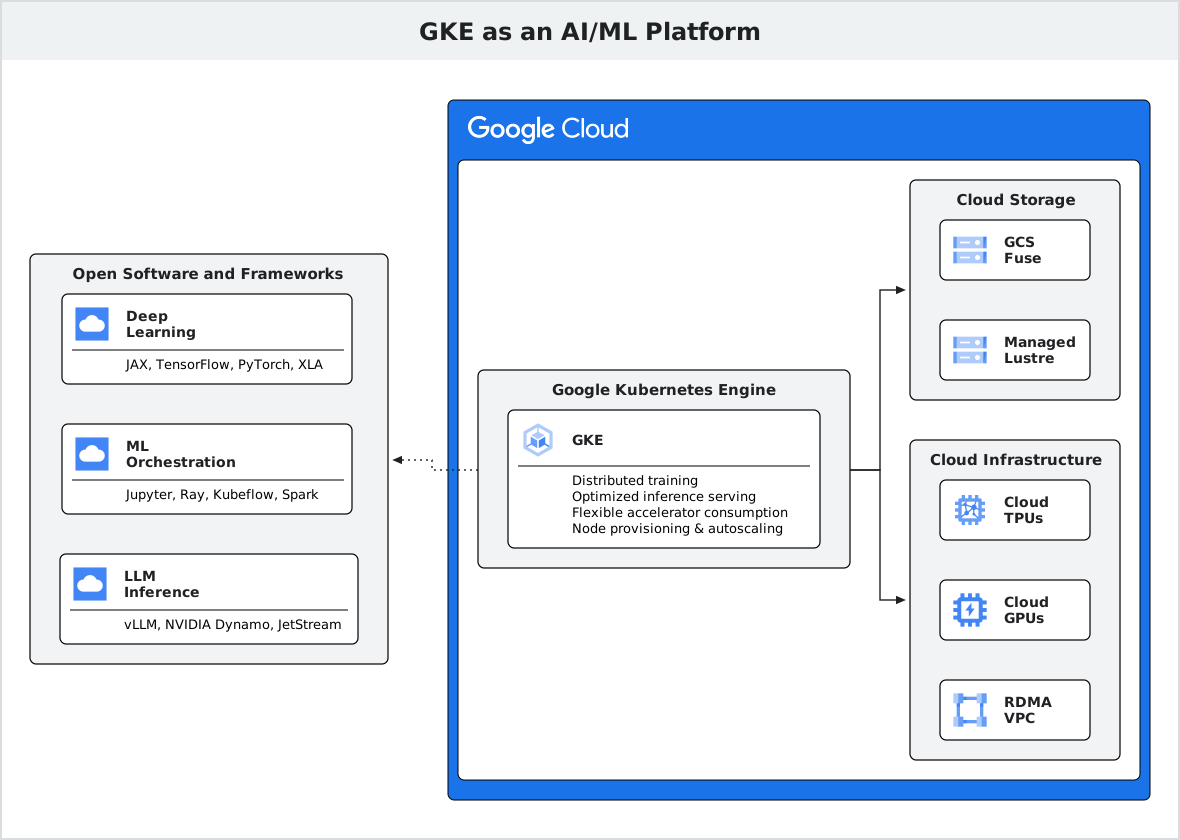
The following table summarizes the GKE features that support your AI/ML workloads or operational goals.
- Accelerator flexibility : GKE supports both GPUs and TPUs for inference.
- GKE Inference Gateway : a model-aware gateway that provides intelligent routing and load balancing specifically for AI inference workloads.
- GKE Inference Quickstart : a tool to simplify performance analysis and deployment by providing a set of benchmarked profiles for popular AI models.
- GKE Autopilot : a GKE operational mode that automates cluster operations and capacity right-sizing, reducing overhead.
- Faster startup nodes : an optimization designed specifically for GPU workloads that reduces node startup times by up to 80%.
- flex-start provisioning mode powered by Dynamic Workload Scheduler : improves your ability to secure scarce GPU and TPU accelerators for short-duration training workloads.
- Kueue : a Kubernetes-native job queueing system that manages resource allocation, scheduling, quota management, and prioritization for batch workloads.
- TPU multislice : a hardware and networking architecture that allows multiple TPU slices to communicate with each other over the Data Center Network (DCN) to achieve large scale training.
- Ray on GKE add-on : abstracts Kubernetes infrastructure, letting you scale workloads like large-scale data preprocessing, distributed training, and online serving with minimal code changes.
What's next
- To explore our extensive collections of official guides, tutorials, and other resources for running AI/ML workloads on GKE, visit the AI/ML orchestration on GKE portal .
- Learn about techniques to obtain computing accelerators, such as GPUs or TPUs, for your AI/ML workloads on GKE .
- Learn about AI/ML model inference on GKE .
- Learn about Ray on GKE .
- Explore experimental samples for leveraging GKE to accelerate your AI/ML initiatives in GKE AI Labs .
- View details for your AI/ML workloads in Google Cloud console , including resources such as JobSets, RayJobs, PyTorchJobs, and Deployments for inference serving.
