


PR

Sofiaw
Study notes on Oracle certification exams: databases, SQL, Java, cloud and Fusion apps. Each post takes one exam and covers what it tests, how it is set up and how to plan your study. Written by the team behind DBExam.
カレンダー
カテゴリ
1Z0-1155-2【改訂ポイント】: What Changes in 1Z0-1155-3, and Which AI Agent Studio Exam to Book Before January 8, 2027
1Z0-182【30日勉強法】: A 30-Day Study Plan for Oracle's AI Database Administration Associate Exam
1Z0-183【よくある失敗と対策】: 7 Mistakes That Cost Points on Oracle's DBA Professional Exam
1Z0-071 vs 1Z0-171【違いと選び方】: Two Oracle SQL Exams With Almost the Same Topic List
コメント新着
キーワードサーチ

【要約】Oracle AI Database Administration Professional(1Z0-183)は、65問・120分・合格ライン60%の上級DBA試験です。日本語版の 1Z0-183-JPN に合格すると ORACLE MASTER Gold DBA Oracle AI Database 26ai に認定されますが、前提資格や受験言語を間違えると認定されません。この記事では、受験者が点数や時間を失いやすい7つの失敗と、その対策を公式情報に基づいてまとめました。
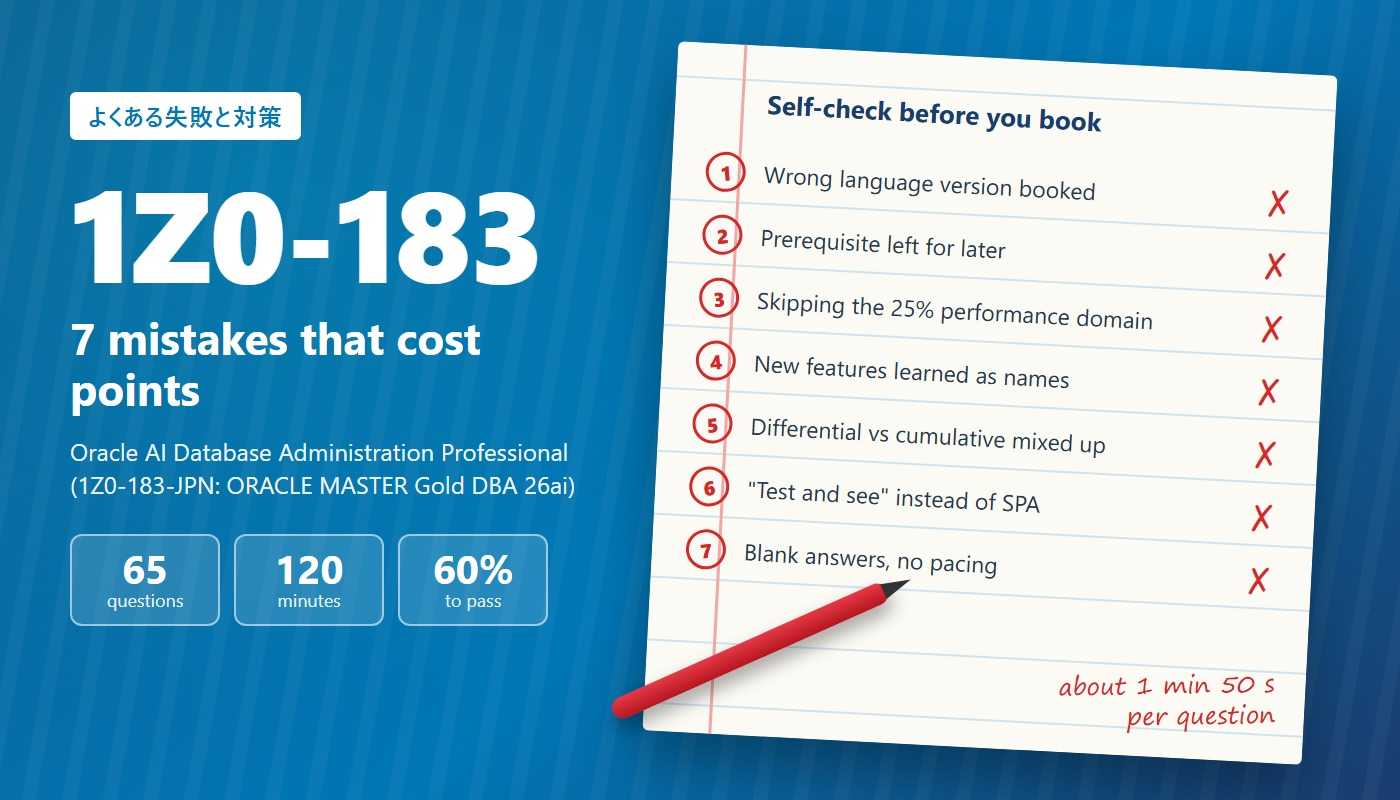
The mistakes that cost the most on 1Z0-183 are not about hard questions. They are about booking the wrong version, studying the wrong share of topics and running out of clock. The exam has 65 questions, 120 minutes and a 60% pass mark, and the biggest single domain, performance tuning, carries 25% of the score.
We read Oracle's MyLearn exam page, the Oracle Japan exam page and the Oracle AI Database 26ai documentation on October 31, 2026. The exam facts below are Oracle's. The question estimates, the timing sums and the list of mistakes are ours, drawn from what those pages say a candidate must know.
What does 1Z0-183 look like on paper?
It is a 120-minute, proctored, multiple-choice exam with 65 questions and a 60% pass mark. Passing earns the Oracle AI Database Administration Certified Professional credential, according to Oracle's MyLearn page for exam 1Z0-183 .
| Item | 1Z0-183 |
|---|---|
| Exam name | Oracle AI Database Administration Professional |
| Credential | Oracle AI Database Administration Certified Professional |
| Questions | 65 |
| Time | 120 minutes |
| Passing score | 60% |
| Format | Multiple choice, proctored online |
| Time per question (our sum) | about 1 minute 50 seconds |
| Correct answers to pass (our sum, if every question counts the same) | 39 |
| Japanese version | 1Z0-183-JPN, linked to ORACLE MASTER Gold DBA Oracle AI Database 26ai |
The MyLearn page shows no price when you are signed out. Oracle's own certification FAQ is the place to look for that.
The FAQ entry on what an exam attempt costs and whether it includes a retake values one attempt at US$245 and says a purchased attempt does not come with a free retake. The same entry says Professional level exams expect at least twelve months of hands-on experience with the product.
Mistake 1: Why is the English exam the wrong booking for ORACLE MASTER Gold?
Because only the Japanese exam leads to the ORACLE MASTER title. If your goal is ORACLE MASTER Gold DBA Oracle AI Database 26ai, you must pass 1Z0-183-JPN, not the English 1Z0-183.
The Oracle Japan page for exam 1Z0-183-JPN says this plainly. It also says the two versions are bought differently: a Japanese exam ticket for Pearson VUE delivery for the Japanese exam, and an Exam Subscription for the English one. Passing the Japanese exam grants the global Oracle AI Database Administration Certified Professional credential at the same time, so you lose nothing on the global side by taking it in Japanese.
The fix is simple. Decide which title your employer asks for before you buy anything, and buy the matching product.
Mistake 2: Can you sort out the prerequisite after you pass?
No. ORACLE MASTER Gold DBA 26ai needs two things: one prerequisite credential and a pass on 1Z0-183-JPN. Passing the exam alone does not make you ORACLE MASTER Gold.
The good news is that the list of accepted prerequisites is long. Oracle Japan accepts any one of these:
- ORACLE MASTER Silver DBA Oracle AI Database 26ai
- ORACLE MASTER Silver DBA 2019
- ORACLE MASTER Silver Oracle Database 12c or 11g
- ORACLE MASTER Gold DBA 2019
- ORACLE MASTER Gold Oracle Database 12c or 11g
So a DBA who earned Silver DBA 2019 years ago does not need to take the new Silver exam first. Oracle Japan's ORACLE MASTER 26ai page also says course attendance is not required for Gold DBA 26ai. Check your CertView record for the exact title you hold before you book, because a Bronze credential is not on the list.
Mistake 3: Why does studying by habit cost points?
Because most DBAs study what they do every day, and the exam weights do not follow anyone's daily routine. Performance tuning carries the largest share, and Oracle Japan's ORACLE MASTER 26ai page notes that performance management was added to the main Gold DBA areas in this release.
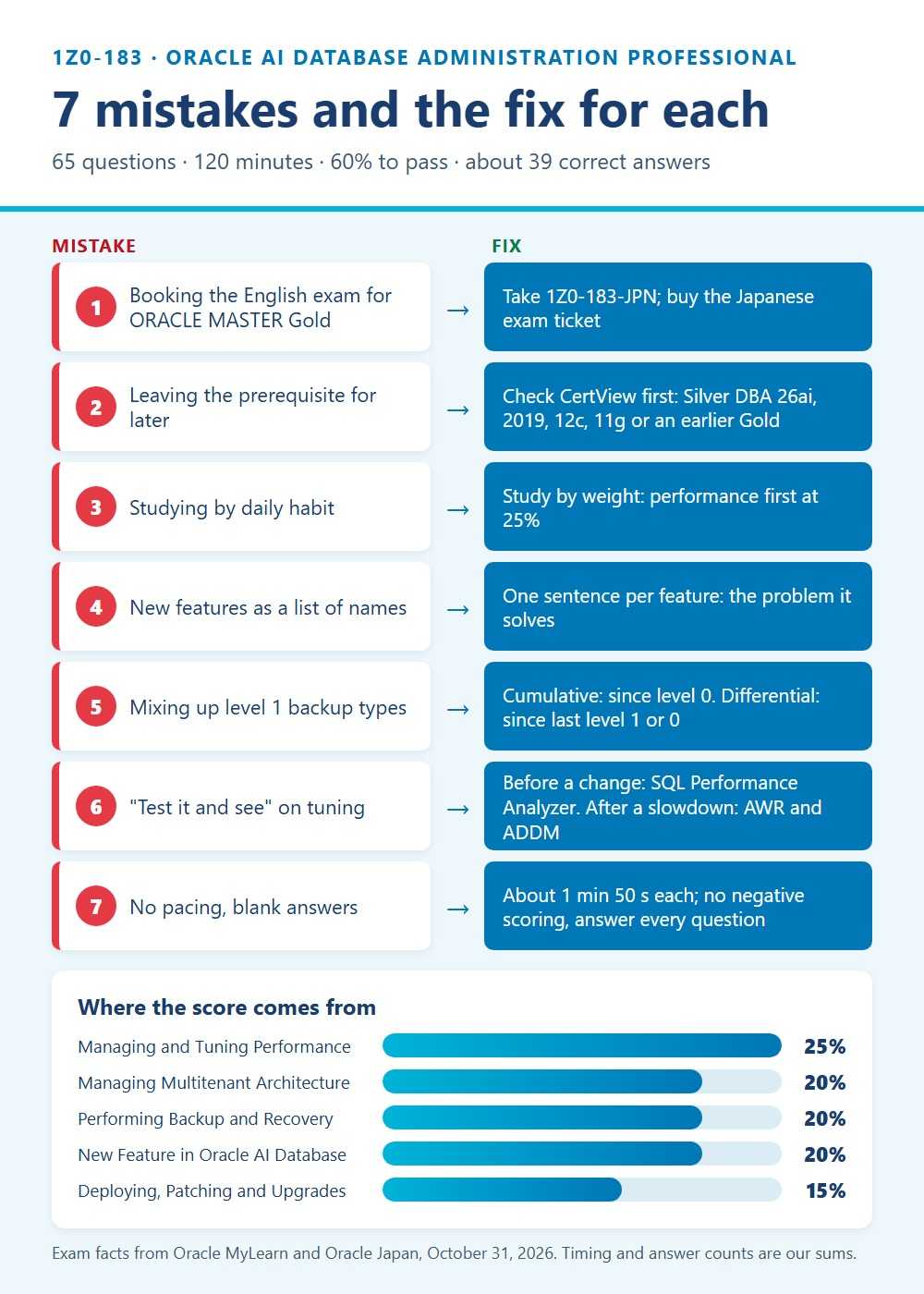
| Objective | Weight | Our estimate of questions | Topic lines on the page |
|---|---|---|---|
|
Managing and Tuning Performance
|
25% | about 16 | 9 |
|
Managing Multitenant Architecture
|
20% | 13 | 5 |
|
Performing Backup and Recovery
|
20% | 13 | 9 |
|
New Feature in Oracle AI Database
|
20% | 13 | 5 |
|
Deploying, Patching and Upgrades
|
15% | about 10 | 6 |
Oracle does not publish question counts per objective. Our estimates simply multiply each weight by 65. Treat them as a planning guide.
Two things stand out. Multitenant and new features each carry 20% with only five topic lines, so each line is worth more there than anywhere else. And the deployment domain is the smallest, yet it is the one many DBAs spend the most study time on because installs feel concrete.
Mistake 4: Why is learning new features as a list of names risky?
Because a name tells you nothing about when to use the feature, and the New Feature objective is worth 20%. The MyLearn overview names Lock-Free Reservations, True Cache and Blockchain Tables as examples. For each one, know the problem it solves, not only the name.
Take lock-free reservation. Oracle's guide to using lock-free reservation on numeric columns defines reservable as a property of a numeric column that keeps journals of changes, used for concurrency control. The problem it solves is the hot row: a stock count or a seat count that many sessions update at once, where a normal update would hold the row lock until commit.
Give Blockchain Tables, the third example on the MyLearn page, the same treatment. Read Oracle's own description of each feature and write one sentence about the job it does. If you cannot write that sentence, you are not ready for a scenario question on it.
True Cache is the other common mix-up. Oracle's overview of True Cache calls it an in-memory, read-only cache in front of the database, a mostly diskless replica that takes query load off the primary. It is not a place to send writes, and it is not the same thing as the In-Memory column store, which you switch on with the INMEMORY_SIZE parameter.
Mistake 5: Do you mix up differential and cumulative backups?
Many candidates do, and backup and recovery is worth 20%. A differential level 1 backup copies the blocks changed since the most recent level 1 or level 0 backup. A cumulative level 1 backup copies the blocks changed since the most recent level 0 backup.
Oracle's RMAN backup concepts chapter adds two details that make good exam questions. Incremental backups are differential by default. And cumulative backups are the better choice when recovery time matters more than disk space, because fewer backups must be applied during recovery.
A quick way to keep them apart: cumulative grows until the next level 0, differential resets after every backup. Then practise the restore side too, since the objective list also covers failure analysis, complete recovery, Flashback, duplication and tuning RMAN itself.
Mistake 6: Why is "test it and see" the wrong answer on tuning questions?
Because the exam expects Oracle's own tools for measuring change, not a guess. The performance domain lists Real Application Testing, AWR-based tools and SQL statement processing, and those questions usually ask which tool fits a situation.
Oracle's introduction to SQL Performance Analyzer lays out the order you should know by heart: capture the workload in a SQL tuning set, run a pre-change trial, make the change, run a post-change trial, then compare. The report lists the statements that improved, stayed the same or regressed.
ADDM is the other name to place correctly. It reads AWR data between two snapshots, looks for the root cause of a slowdown and gives recommendations. If a question asks what happened last night, think AWR and ADDM. If it asks what will happen after a change, think SQL Performance Analyzer.
The same habit applies to upgrades. Oracle's page about the AutoUpgrade utility calls it the recommended tool for upgrades, so an answer built on manual scripts is rarely the best one.
Mistake 7: Why do candidates leave points on the table at the end?
Because they run short of time or leave hard questions blank. With 65 questions in 120 minutes you have about 1 minute 50 seconds each, and long scenario questions eat that fast.
Oracle's FAQ on how exam scores are reviewed settles the blank-answer question: a wrong answer counts as zero, there is no negative scoring, and it is better to answer than to leave a question empty. The score report in CertView then lists the objectives to work on if you need a second attempt.
A simple pacing rule helps. Check the clock after question 20 and question 40. By question 20 you want about 37 minutes used, and by question 40 about 74. Mark long questions, move on, and come back with the time you saved.
How can you turn these mistakes into a four-week plan?
Spend your hours in the same order as the weights, and keep the last week for timing. This plan assumes about an hour on weekdays and two on weekend days.
| Week | Main focus | Mistake it fixes |
|---|---|---|
|
1
|
Book the right version, check your prerequisite in CertView, then performance: AWR, ADDM, SQL Performance Analyzer, instance tuning | 1, 2, 6 |
|
2
|
Multitenant (CDB and PDB creation, application PDBs, common and local users, PDB upgrade and transport) and new features, one sentence per feature | 3, 4 |
|
3
|
RMAN: backup types, restore and recovery, Flashback, duplication; one hands-on restore in a lab | 5 |
|
4
|
Deployment and upgrade review (Grid Infrastructure, Oracle Restart, AutoUpgrade), then two timed 65-question rounds | 6, 7 |
A timing routine that works well in week 4:
- Set a 120-minute timer and work through a 65-question mock round without notes.
- Check the clock at question 20 and question 40.
- Mark any question that takes longer than three minutes and come back to it.
- After the round, sort every miss by objective, not by question.
- Spend the next study hour on the objective with the most misses.
Is there a video on the closest topic?
Our channel has no video on 1Z0-183 yet. The closest one is a short on vector indexes in Oracle AI Database, made for 1Z0-1159-26. It fits the "Implement AI Vector Search" line of the new features objective and takes under a minute.
Frequently asked questions
1. How many questions are on 1Z0-183 and what is the passing score?
1Z0-183 has 65 multiple-choice questions, a 120-minute time limit and a 60% passing score. The Japanese version, 1Z0-183-JPN, has the same count, time and pass mark.
2. What credential does 1Z0-183 earn?
The English exam earns Oracle AI Database Administration Certified Professional. Passing 1Z0-183-JPN with a valid prerequisite earns ORACLE MASTER Gold DBA Oracle AI Database 26ai and the same global credential at once.
3. Do I need Silver DBA 26ai before I take 1Z0-183-JPN?
No. Oracle Japan accepts Silver DBA 26ai, Silver DBA 2019, Silver 12c or 11g, or any earlier Gold DBA credential as the prerequisite for ORACLE MASTER Gold DBA 26ai.
4. Which objective carries the most weight on 1Z0-183?
Managing and Tuning Performance, at 25%. Multitenant, backup and recovery, and new features follow at 20% each, and deploying, patching and upgrades carries 15%.
5. Is a retake included when I buy a 1Z0-183 attempt?
No. Oracle's certification FAQ says a purchased exam attempt has no free retake, and each registration uses one attempt. The same FAQ values one attempt at US$245.
Written by the team behind DBExam, from Oracle's exam pages and documentation as they stood on October 31, 2026.


