
A 


The legendary entertainer reflects on major events throughout her remarkable life.
By The Associated Press
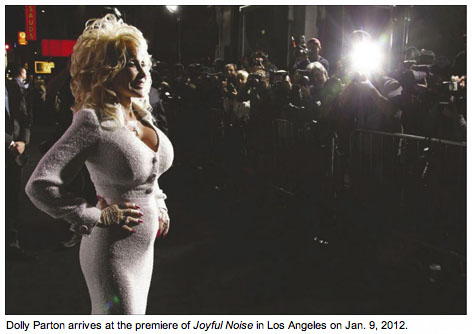
 or nearly five decades, Dolly Parton talked with Associated Press reporters about far more than the songs that made her famous. She talked about movie stardom, kissing a president and her charity work, among other things.
Those interviews captured a Parton who could be funny and self-deprecating but also clear-eyed about who she was and what she wanted.
Here is Parton, who died on August 25 at age 80, in her own words, as compiled by AP Music Writer Maria Sherman.
Parton knew she would be famous before Hollywood came calling
"I never thought of myself as a movie star. I knew I'd be a star, but as a singer or as a writer of songs or books or poetry. I wanted to be a famous performer and wear flashy cloths, but singing in movies was not one of my ambitions. My family lived in the mountains and we didn't see movies."
"I can't act a part, but if they allow me to be myself, then I can handle it. If they find me a story that allows me to be me, then I'm interested; if they don't, I'm not." (July 1979)
On kissing President Jimmy Carter at the White House
"My husband wants a picture of this, too." (October 1979)
Critical in her self-review of her performance in '9 to 5'
"In places I was real good. In places I was real average and in others I was... (sticking out her tongue). All in all, for the first time out, I was proud of it." (December 1980)
Parton worried 'The Best Little Whorehouse in Texas' would offend her preacher grandfather
"I'll admit I had some misgivings about the title of the movie. After all, my grandaddy was a preacher, and I'm a spiritual person myself. I didn't want to do anything that might be considered offensive. Then I saw the play and I realized it was just a foot-stompin' good time." (December 1981)
Parton saw Dollywood as a way to let Appalachia tell its own story
"It's something I want to take pride in, to preserve the Smoky Mountain heritage rather than have Hollywood portray us as they often do." (July 1985)
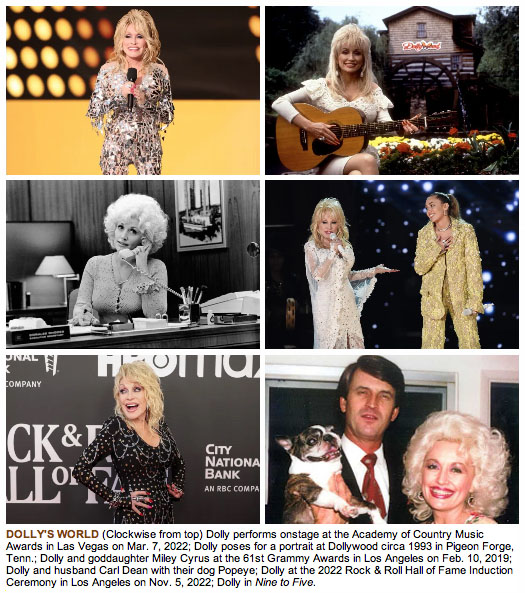 On husband Carl Dean and happiness
"It was love at first sight. I see people who turn my head all the time. It's just that nobody's turned my head around as much as him." (May 1992)
On singing with Emmylou Harris and Linda Ronstadt
"We do love to sing. Your whole life you wait to find those compatible voices. It's like making love. ...I get off on it. I do. I get so thrilled. When it buzzes, it is good. It's just like sex in that way. Don't fight it." (March 1999)
On Elvis' legacy in Eastern Tennessee
"I don't think he will ever die down. He's considered by many to be like a religious figure, like Jesus. ...I don't know how to explain it, but it's there, and it's real, and people love it." (August 2002)
Why she never wanted to retire
"I'll be like Bob Hope, touring when I'm 100. I love being busy. ...I will never retire. I hope to fall dead in the middle of some great event or some great song I'm singing. Then they'll say, 'Oh well, she went happy and doing what she loves.'" (April 2004)
On her award show performance after Janet Jackson and Justin Timberlake's Super Bowl show
"There's not going to be no wardrobe malfunction this evening. There's not supposed to be, it's not planned. But as tight as my clothes are there's no telling what will happen. If it does happen, I'm going to wipe out the first three rows." (April 2004)
Her label, Dolly Records, was an investment in herself
"I'm looking at it like an investment. I thought, 'I've made enough money. I can afford to invest a little in myself." (March 2008)
On receiving her honorary doctorate
"Just think, I am Dr. Dolly! So when people say something about 'Double-D,' they will be thinking of something entirely different." (May 2009)
Looking back on 25 years of Dollywood
"I always thought that if I made it big or got successful at what I had started out to do, that I wanted to come back to my part of the country and do something great, something that would bring a lot of jobs into this area. Sure enough, I was lucky, and God was good to me and things happened good." (April 2010)
On being proud of Miley Cyrus

People thought Whitney Houston wrote one of her most famous songs
"People always tell me, 'I thought that was Whitney's song. I didn't know you wrote it. I thought she wrote it. And I tell them, 'She can have the credit. I'll just take the cash.'" (December 2018)
On her charity work
"I don't do it for attention. But look! I'm getting a lot of attention by doing it." (October 2022)
On taking to rock music like 'a duck on a June bug'
"I just didn't think that I had done enough in the rock world to be considered, to be put in the Rock & Roll Hall of Fame when there were so many great rock artists that are not even in the Rock & Roll Hall of Fame. ...They were going to put me in anyway, so I just accepted it gracefully. But I thought, 'Well, I'm going to have to earn my keep.' ...I jumped on that like a duck on a June bug." (November 2023)
On her family album and legacy
"My grandpa used to say, when I got famous, he said, 'Well, she came out crying in the key of D.' I think we all did."
"I hope that a lot of my songs may last that long. And I hope I'll be remembered as somebody that tried to do some good in the world and left, you know, a few good things." (November 2024)
On leaning into faith after losing husband Carl Dean and being a superstar
"I am a person of faith, and I truly believe that I'm going to see him again someday. And I see him every day in my memories and in my heart, and in all the things that we've built together. You just kind of have to learn to make new plans -- but that's the hardest part."
"I don't think about my life in terms of 'superstar.' I'm just a workin' girl. I always say -- and it's the truth -- that I am a workhorse that looks like a show horse. But I gotta keep it up and I enjoy all of it. My husband always said, 'If anybody was ever born to be a star, it's you.'" (May 2025)

From People 's June 3, 1974 issue.
CICELY TYSON RECEIVES HER OVERDUE FLOWERS FOR SOUNDER AND JANE PITTMAN
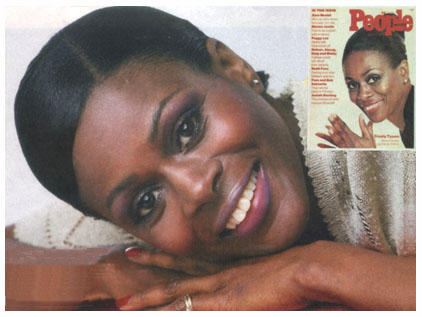
 icely Tyson's long string of roles have always been meticulously chosen. The first Off-Broadway was "The Blacks," the production she terms "the beginning of serious Black theater in this country." She left the show to do other plays but kept returning ("Everybody did," she notes. "It was home.") Tyson, 49, found box office meaning in her movie career with Sounder
, for which she earned an Oscar nod as Rebecca, the wife of a southern sharecropper. "I just waited for two months while they tested everybody else they could find ; I never felt for one moment that the part wasn't mine," she says. She loves the adulation and requests for autographs "because it means I've done something that makes someone happy." The Autobiography of Miss Jane Pittman
, a two-hour TV depiction of the story of an ex-slave, was the challenge of any actress's career: When she got the role, Tyson recalls, she was "paralyzed for four days thinking about the enormity of the part and its demands. She tackled it in her habitual way: "I learn the role and become the woman."
icely Tyson's long string of roles have always been meticulously chosen. The first Off-Broadway was "The Blacks," the production she terms "the beginning of serious Black theater in this country." She left the show to do other plays but kept returning ("Everybody did," she notes. "It was home.") Tyson, 49, found box office meaning in her movie career with Sounder
, for which she earned an Oscar nod as Rebecca, the wife of a southern sharecropper. "I just waited for two months while they tested everybody else they could find ; I never felt for one moment that the part wasn't mine," she says. She loves the adulation and requests for autographs "because it means I've done something that makes someone happy." The Autobiography of Miss Jane Pittman
, a two-hour TV depiction of the story of an ex-slave, was the challenge of any actress's career: When she got the role, Tyson recalls, she was "paralyzed for four days thinking about the enormity of the part and its demands. She tackled it in her habitual way: "I learn the role and become the woman."
IN THE NEWS: JUNE 1974
 Dressing:
"I have ordered a whole wardrobe of sexy shoes and stockings. It's marvelous to see slender legs again, and I'm enjoying showing them off," says Peggy Lee
.
Dressing:
"I have ordered a whole wardrobe of sexy shoes and stockings. It's marvelous to see slender legs again, and I'm enjoying showing them off," says Peggy Lee
.
Election: Valéry Giscard d'Estaing , 48, became the new president of France with 50.7 of the vote.
Retirement: Chicago Bears linebacker Dick Butkus , 31, announced his retirement from the NFL because of a lingering right knee injury.
Party:
Metro-Goldwyn-Mayer united with 50 stars including Elizabeth Taylor, Gene Kelly
and Fred Astaire
to premiere the film That's Entertainment!
.
STAR TRACKS
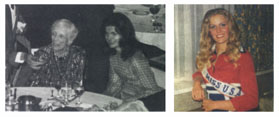
Very Important Women Theodore Roosevelt's daughter Alice joined Jackie Kennedy Onassis 's table as the former First Lady made her second visit to the capitol since her husband John F. Kennedy's death.
Pageant Queen
Miss Illinois, Karen Morrison
, won the national title of Miss USA. "This is the American girl's's dream come true," the 19-year-old said.
 Main Page
| Seventies Single Spotlight
| Seventies Usenet Forums
| Seventies Almanac
| Search The RockSite/The Web
Main Page
| Seventies Single Spotlight
| Seventies Usenet Forums
| Seventies Almanac
| Search The RockSite/The Web
