

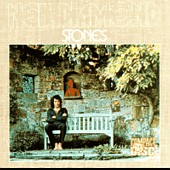
Neil Diamond
Uni 55278
Apr. 1971
Billboard: #4


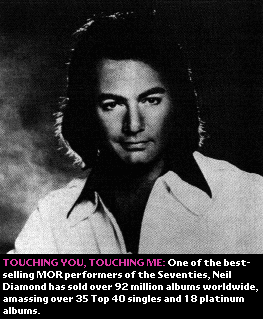
 hroughout the '60s, popular music seemed to stay one step ahead of the industry moguls who tried to contain it. By the '70s the industry had caught up and learned how to package its product so seamlessly that any expression of honesty was suspected to be nothing more than a highly subversive means of manipulation. Neil Diamond was a particularly suspicious character since he had never been aligned with the hipper segment of the music industry and because any analysis of his lyrics often could discern no specific point of view.
- "I am," I said
- To no one there
- And no one heard at all
- Not even the chair.
I think, therefore I am. If a tree falls in the forest and nobody hears it, does it make any sound?
- But I got an emptiness deep inside.
- And I've tried but it won't let me go.
- And I'm not a man who likes to swear,
- But I've never cared for the sound of being alone.
Would life be more meaningful if it were less lonely? If we were happier, would life have more meaning?
This is simplified (or simple-minded) profundity at its best. The words work magically to make you identify strongly with the sincere personality singing the lyrics. The melody can convince you even further that the song could be about you, or for you; it could even be your story. It is a brilliant moment when fundamental lyrical passion is joined seamlessly with an inspirational arrangement. "I Am, I Said" is just such a moment.
Diamond later told True Oldies Channel host Scott Shannon his inspiration for writing "I Am, I Said." After traveling to L.A. for what would turn out to be a failed screen test, he became homesick for his beloved New York City and wrote the mournful ballad in his hotel room.
- Thomas Ryan, American Hit Radio,
Prima Entertainment, 1996.
 Reader's Comments
No comments so far, be the first to comment .
 Main Page
| Additional Singles Intro
| Singles By Month
| Seventies Almanac
| Search The RockSite/The Web
Main Page
| Additional Singles Intro
| Singles By Month
| Seventies Almanac
| Search The RockSite/The Web
