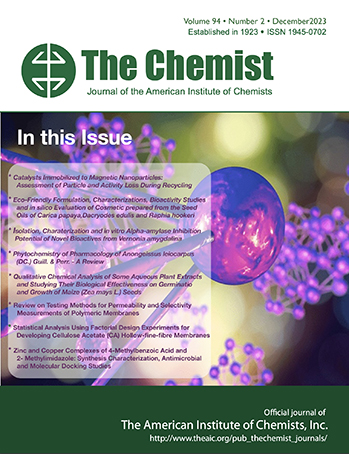
The Chemist | Journal of the American Institute of Chemists
The Chemist Volume 94 | Number 2
print Download (pdf)
ISSN 1945-0702
Editorial:
Alexander G. Zestos
American University, USA
( azestos@theaic.org )
Nayiri Kaissarian
( nmkaissa@theaic.org )


Chemistry remains at the forefront of society’s past, present, and future. We are currently living through a seemingly continuous COVID-19 pandemic in addition to other infectious diseases such as Respiratory Syncytial Virus Infection (RSV), monkeypox, and several others. The depletion of natural resources such as oil, gas, coal, fossil fuels, and others have led the race towards clean, green, sustainable, and renewable energy sources such as hydrothermal, geothermal, solar, wind, nuclear, and others. The safety, efficiency, and feasibility of these alternative sources are primarily determined by engineers and chemists alike. Chemistry is often referred to as “The Central Science” because it is at the intersection of the physical and life sciences and integrates several fields of knowledge through high impact research and relevant studies. Several subdisciplines such as electrochemistry are incredibly diverse as they encompass several fields such as sensors, catalysis, batteries, electroanalytical, and many more.

We are proud to announce that Prof. Robert Savinell from the Department of Chemical Engineering at Case Western Reserve University and Prof. Kara Bren from the Department of Chemistry at the University of Rochester have been named our Chemical Pioneer awardees for the year 2023 at the AIC Annual meeting in May of 2023. Their contributions to The Chemist are currently planned to be included in a subsequent issue.

In this issue of The Chemist published by the American Institute of Chemists (AIC), we explore several research topics relevant to all forms of chemistry. We begin this issue with a contribution from Dr. Thad Le-Vasicek, who details the development of catalysts immobilized to magnetic nanoparticles. The study ultimately shows that increasing the recovery of the magnetic nanoparticles decreases the loss of recycled enzyme activity illustrating the importance of optimizing particle recovery to increase the retained activity of recycled catalysts, which has been shown to be a crucial parameter for the industrial use of enzymes to magnetic nanoparticles.

We sincerely hope that you enjoy reading this issue and wish you a safe and prosperous New Year.

Download (pdf)

Table of Contents

Editorial:
Alexander G. Zestos, Nayiri M. Kaissarian
iii
*
ARTICLES
Catalysts Immobilized to Magnetic Nanoparticles: Assessment of Particle and Activity Loss              During Recycling
Angela, Corbin D. Snavely, Blakely M. Adair-Hudson, Thaddeus W. Vasicek
1
Eco-Friendly Formulation, Characterizations, Bioactivity Studies and in silico Evaluation of              Cosmetic prepared from the Seed Oils of Carica papaya, Dacryodes edulis and Raphia hookeri
Stephen Olubunmi Oguntoye, Oluebube Love Ezennaya, Olaniyi Kamil Yussuf, Olubunmi Atolani
14
Isolation, Charaterization and in vitro Alpha-amylase Inhibition Potential of Novel Bioactives from         Vernonia amygdalina
Olubunmi Atolani , Adedamola Elizabeth Ayeni, Mohammed Abubakar Usman, Jamiu Opeyemi             Adejumo, Olamilekan Joseph Ibukun, Adeola T. Kola-Mustapha, Ngaitad S. Njinga, Luqman A.        Quadri, Emmanuel O. Ajani, Tajudeen O. Amusa, Moji T. Bakare-Odunola, Adenike T. Oladiji,             Learnmore Kambizi
38
Phytochemistry of Pharmacology of Anongeissus leiocarpus (DC.) Guill. & Perr. - A Review
Ifeoluwa Samuel Adedotun, Mohammad Torequl Islam, Olubunmi Atolani
50
Qualitative Chemical Analysis of Some Aqueous Plant Extracts and Studying Their Biological              Effectiveness on Germination and Growth of Maize ( Zea mays L.) Seeds
Manar Abdullah Abou Hassan, Mariam Abdul Razak Drakli
76
Review on Testing Methods for Permeability and Selectivity Measurements of Polymeric              Membranes
Yousef Alqaheem
87

Statistical Analysis Using Factorial Design Experiments for Developing Cellulose Acetate (CA)              Hollow-fine-fibre Membranes
Akram Tawari, Bashir Brika

105
Zinc and Copper Complexes of 4-Methylbenzoic Acid and 2- Methylimidazole: Synthesis,              Characterization, Antimicrobial and Molecular Docking Studies
Hassan K. Busari, Luqmon A. Azeez, Harun K. Aremu, Sheriff O. Ayinla, Lukmon A. Jinadu,             Joshua A. Obaleye
121
*
The AIC Code of Ethics 146
Manuscript Style Guide 148
*
ANNOUNCEMENTS
Invitation to Authors 153
154

All rights are reserved. © The AIC 2023.
The American Institute of Chemists, Inc. does not necessarily endorse any of the facts or opinions expressed in the articles, book reviews, or advertisements appearing in The Chemist.

Web site designed and developed by RHWD

The American Institute of Chemists, Inc.
315 Chestnut Street, Philadelphia, PA 19106-2702.
Phone (215) 873-8224 | Fax: (215) 629-5224
E-mail: aicoffice@TheAIC.org
Design a Mobile Website
View Site in Mobile | Classic
Share by: