

If playback is interrupted, you can restart it.
WONSAN, North Korea —North Korea’s flagship seaside resort on its east coast is drawing large numbers of domestic visitors in its second summer, while authorities continue expanding transport and leisure facilities around a project that leader Kim Jong Un has promoted as a model for the country’s tourism industry.
The Wonsan-Kalma Coastal Tourist Area, stretching along roughly four kilometers of white sand on the Kalma Peninsula, opened to domestic tourists on July 1, 2025. North Korean state media initially said its hotels and other accommodation could house nearly 20,000 guests. Subsequent reporting has put the maximum daily capacity of its beach and associated service facilities at as many as 40,000 people.
The scale is unusual for North Korea. A tourism map released around the resort’s opening showed six hotels, 37 inns, 35 food and beverage outlets, 29 shops and a dozen sports and cultural facilities, alongside cottages, guesthouses and other accommodation. Independent analysis has cautioned that not every building shown or constructed around the sprawling complex was necessarily operational when the resort opened.
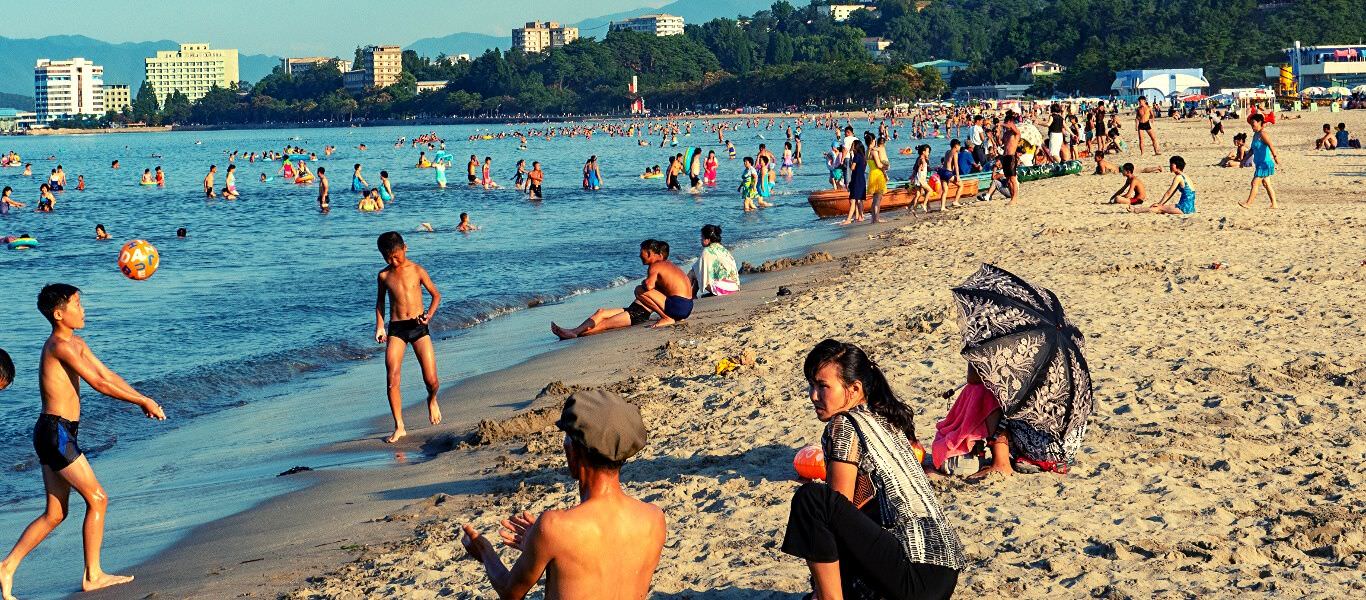
State television footage this summer has shown crowded beaches and visitors using water attractions, while North Korean media have promoted the resort heavily as a destination for workers and families from across the country.
One recent account of summer recreation in North Korea said the resort has about 2,500 beach loungers and a variety of marine attractions, including motorboats and towable water rides. It cited Korean Central Television as reporting tens of thousands of visitors during a month of summer operations.
That follows an even busier first season. Rodong Sinmun claimed in August 2025 that “hundreds of thousands” of people had visited during the resort’s first 40 days. Satellite imagery analyzed by NK Pro appeared to support the picture of significant organized domestic tourism: the resort’s main bus parking areas filled with vehicles from around mid-July until late August before activity declined as the summer season ended. The imagery, however, could not independently establish the total number of visitors.
Cold noodles, water slides and virtual reality
Wonsan-Kalma was designed as considerably more than a collection of beachfront hotels.
Its entertainment and commercial facilities include swimming pools and water slides, sports areas, shops, restaurants and amusement facilities. A branch of Pyongyang’s well-known Okryu Restaurant serves the capital’s signature cold buckwheat noodles at the resort. North Korean tourism material has also highlighted Korean dishes and international food served at restaurants throughout the complex.
Gaming is another conspicuous part of the leisure offering.
A 2025 edition of the state-published Pyongyang Times described visitors using virtual-reality attractions that simulate flying, sightseeing, boxing and combat-style games. The newspaper portrayed the amusement facilities as particularly popular with holidaymakers.
Students from Korea University in Tokyo, an institution closely associated with the pro-Pyongyang General Association of Korean Residents in Japan, also visited the tourist area in summer 2025. Accounts of their visit described a wristband-based payment system within the resort, allowing purchases and services to be handled without visitors relying on conventional cash transactions throughout the complex.
North Korean television has meanwhile presented enthusiastic testimonials from holidaymakers, including visitors describing Wonsan-Kalma in superlative terms and calling it the “world’s best.” Such comments form part of a sustained state-media campaign presenting the complex as a showcase of modern recreation and Kim’s tourism policy.
A resort still being built out
The opening in 2025 did not mark the end of construction.
Kim returned to the area in June 2026 to inspect new infrastructure, including the Kalma Tourist Railway Station and an emergency medical facility. State media said he examined the station’s construction and operational readiness and called for lessons from the project to be applied to railway modernization elsewhere in the country.
On Aug. 28, North Korean media announced the completion of another major rail facility, Myongsasimni Station. The roughly 7,000-square-meter station was described by KCNA as a model for provincial tourist railway stations. Domestic air connections have also expanded: state carrier Air Koryo has operated flights between Pyongyang and Wonsan since July, adding another route for bringing visitors to the coast.
The continuing investment underscores Wonsan-Kalma’s significance beyond a single beach development. North Korea enacted a national Tourism Act in 2023 and legislation specifically governing the Wonsan-Kalma zone in 2025, suggesting an effort to establish a broader legal and administrative framework for tourism development.
Foreign visitors remain tightly controlled
International access has developed much more cautiously.
North Korea shut its borders to ordinary foreign tourism during the COVID-19 pandemic and has reopened tourism only selectively. Russian travelers became the most visible foreign guests at Wonsan-Kalma after the resort opened, arriving through organized group tours. Even after North Korea announced a temporary suspension of foreign tourist entry in July 2025, Russian groups continued to be admitted on several occasions, according to South Korea’s Unification Ministry.
The resort has simultaneously become a venue for diplomacy.
Russian Foreign Minister Sergei Lavrov traveled directly to Wonsan in July 2025 for meetings with Kim. Satellite imagery examined by 38 North showed Lavrov’s aircraft at Wonsan Kalma Airport, while state television imagery indicated that he stayed at the resort’s Myongsasimni Hotel.
Chinese access has also increased at the official level. China’s ambassador and embassy personnel visited the resort around Lunar New Year in 2026, and the Chinese Embassy later published a series of photographs introducing Wonsan-Kalma to a Chinese audience. The posting prompted speculation that broader Chinese tourism could eventually resume, although regular Chinese tourist flows had not yet returned at that point.
In July 2026, an even more senior Chinese delegation led by Wang Huning, China’s fourth-ranking official, toured Wonsan-Kalma during a three-day visit to North Korea. Wang praised the development during the visit, according to North Korean state media.
Tourism itself is not prohibited by United Nations sanctions imposed over North Korea’s nuclear weapons and ballistic-missile programs. Nevertheless, Pyongyang maintains unusually tight control over foreign travel, movement and contact inside the country, making the pace and extent of any wider tourism reopening a political decision as much as a commercial one.
From long-delayed project to showcase destination
Wonsan-Kalma’s emergence as a functioning resort followed years of delays.
The project was under construction well before the pandemic and missed earlier completion targets. Satellite analysis in 2024 showed renewed road paving and construction work after a lengthy period of limited activity, indicating that authorities were again preparing the complex for an eventual opening.
Kim formally inaugurated the development on June 24, 2025, accompanied by senior officials and members of his family, before domestic tourism began a week later. State media called its completion one of the country’s major achievements of the year.
Since then, Wonsan-Kalma has become both a holiday destination and a carefully presented symbol of North Korea’s development ambitions.
Independent satellite imagery provides evidence that substantial numbers of buses and visitors were reaching the complex during its first peak season, while the continuing construction of railway, medical and transport infrastructure shows that Pyongyang is still investing in the site. At the same time, the precise visitor totals and many descriptions of demand come from North Korean state media and therefore cannot be independently verified.
What is clearer is the priority being placed on the project. From beachgoers arriving on organized domestic trips to Russian tourists and senior Chinese and Russian officials, Wonsan-Kalma has evolved from a long-delayed construction project into one of North Korea’s most prominent public showcases — and a testing ground for how far Pyongyang intends to expand tourism after years of restricted international access.









Leave a Comment