
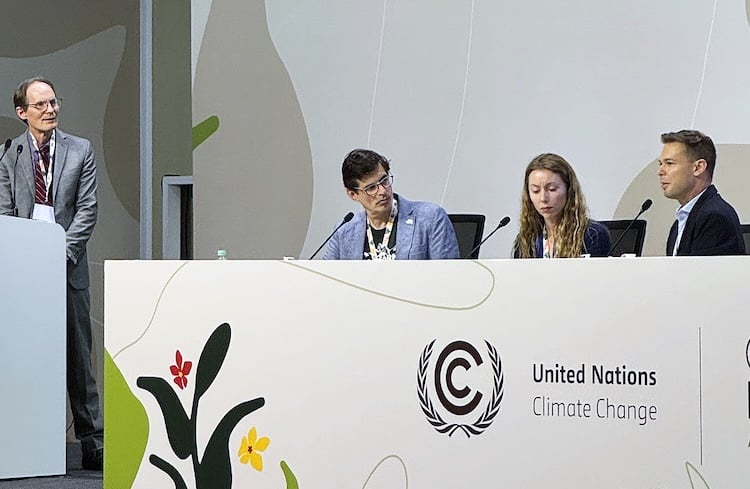
BELÉM, BRAZIL —As the sweltering Amazonian heat pushed delegates into the shadows of COP30’s pavilions, a distinctly American tension rippled through the global climate summit. On one side stood an administration in Washington determined to dismantle clean-energy gains. On the other stood the governors, state senators, mayors, and local leaders who arrived in force to deliver a strikingly different message: the United States is not retreating from the climate fight .
They were not speaking for the federal government. They were speaking for themselves — and for the millions of Americans whose lives, jobs, and futures are now staked on a clean-energy transition that refuses to slow down.
A Quiet Revolution, Loudly Announced
“We are moving forward,” California State Senator Josh Becker declared, his voice echoing across a packed side event at the summit. “And I hope other states follow our lead.”
Becker wasn’t boasting. California — now the world’s fourth-largest economy— ran on two-thirds clean power in 2023and has achieved 100 percent clean electricity for parts of almost every day in 2025. That’s a feat unmatched anywhere else on Earth. And it didn’t happen by accident.
Despite a full-court assault from Washington on renewable-energy programs, states like California, New York, Maine, and dozens more have accelerated their climate policies, not slowed them. Clean power projects, from offshore wind to large-scale solar to battery storage, continue to break ground. City councils are passing electrification ordinances. Statehouses are enacting efficiency standards. Governors are investing in climate-resilient infrastructure.
At COP30, these leaders came to make one thing unmistakably clear: the transition is not optional—and it is unstoppable.
The Economics Are Irrefutable
Barry Vesser, Chief Program Officer at The Climate Center, put it bluntly. “Clean energy is cheaper to implement than polluting fossil fuels. It’s driving economic growth. States are proving that.”
The International Renewable Energy Agency agrees: renewables are now the cheapest form of power in the world.
When California passed one of the most ambitious energy-affordability laws in decades — delivering billions in savings while boosting grid reliability — it shattered the familiar myth that climate action raises costs. Instead, it showed what clean-energy economists have argued for years: the real expense comes from clinging to fossil fuels.
Small States, Big Impacts
If California provides the scale, Maine provides the shock value.
A state with barely 1.3 million people, Maine has become a quiet powerhouse in climate resilience. It ranks 10th in the nation for energy efficiency, has already surpassed its 2030 oil-reduction goal, and is on track to meet its 2050 target. More than 15,600 clean-energy jobsnow fuel its growing green economy.
“In 2024, the portion of Maine households relying on heating oil fell to 50 percent,” said Alex Cornell du Houx, President of Elected Officials to Protect America and a former Marine combat veteran. His voice tightened slightly as he connected the dots between climate policy and global stability. “The war in Ukraine shows what happens when nations depend on a single energy source controlled by dictators. Distributed clean energy is secure, costs less, and creates prosperity.”
Maine now boasts nearly 700 heat-pump installers, a figure that would have been unimaginable a decade ago.
A Shadow Over COP30 — and a Beacon
Hovering over the summit was the uneasy reality that U.S. federal climate leadership remains uncertain until at least 2028. Yet instead of despair, subnational leaders brought determination — and volume.
“We will not allow our country to become numb or debilitated by those standing in the way of progress,” said Gina McCarthy, former EPA Administrator and co-chair of America Is All In, the coalition that brought more than 100 U.S. mayors, governors, and state officialsto Brazil.
Their presence turned the summit’s Local Leaders Forum in Rio de Janeiro into an unmistakable show of American defiance — a climate coalition operating with or without Washington’s blessing.
The Stakes: A Possible 56% Emissions Cut
A new analysis from America Is All In and the University of Maryland’s Center for Global Sustainability delivers the most dramatic revelation of all: if states, cities, and regions expand climate action now — and if federal leadership returns in 2028 — the U.S. could slash emissions 56 percent below 2005 levels by 2035.
That would pull the country onto a pathway once considered impossible.
The Future Will Be Built from the Bottom Up
Elected Officials to Protect America, the network uniting climate-focused public servants, stresses that this is not simply about megawatts or greenhouse gases. It is also about democracy, justice, and people — from wildfire-stricken towns in California to oil-dependent rural communities in Maine transitioning toward resilience and stability.
The message from COP30 was unmistakable: America’s climate future is being written right now — not in Washington, but in statehouses, city halls, and town councils across the country.
And the leaders who gathered in Belém made it clear they do not intend to surrender the pen.




Leave a Comment