
UPDATE (5/20/26 @ 7:30am AZ time):
The GCU Library's updated version of LopeCat, the library’s online catalog, is live! For more details on what has changed, visit the What's New Guide .
Citing Sources in MLA: Locating Citation Information
Getting Started Using Sources
The first step in citing sources is determining what type a source is.
Online sources can be many different source types. Journal articles, books, blogs, news articles, government documents, videos, and webpages are all different source types that may be found on a website. Just because a source is accessed through a website does not make it a webpage—take care to determine if a more specific source format applies before using the webpage format.
On this page are a few examples of sources found inside and outside the library, how to identify them, and showing where the different parts of the citation are located. Visit the Examplespage for more on the different formats by source type.
Using Database Citation Tools
Many databases have a citation tool. This tool will collect the citation information for you, and make a first attempt at formatting it for you.
Many of the databases will also identify the source type for you by using an icon next to it or labeling them. You can see an example under EBSCO.
Always correct database generated citations by comparing to the format. These are computer generated, not corrected by a person—capitalization, punctuation, and other details may be incorrect.
EBSCO
EBSCO databases include the LopeSearch, Academic Search Complete, CINAHL and many others. Database citation tools are automatically generated--which means that a person doesn't double-check them for accuracy. They can have mistakes, and don't always keep up with the latest rules. It is your responsibility to review your citations.
Most databases label sources with their type. In EBSCO and LopeSearch searches there is a label above each search result to identify the source type:

Always double check a computer created reference against a style guide.
Especially look for mistakes in capitalization, punctuation, information that shouldn't be included, and missing information.
Click on the title of the article to access the detailed record, with the tools menu at the top.

Click the Cite button on the tools menu, which looks like a quotation mark.
Select the citation style you need from the drop down menu.

Highlight the reference, then copy and paste it into your paper.
Don't forget to double check the formatting!
ProQuest
Always double-check a computer created reference against a style guide.
Especially look for mistakes in capitalization, punctuation, information that shouldn't be included, and missing information.
ProQuest databases include ABI/Inform, Dissertations & Theses, and many more.
Click on the title of an article.
There will be a tool menu on the upper right.

Click Cite. A box will open in the middle of the screen.
Change the menu to the citation style you need.

Copy and paste the citation into your paper. For APA You will need to check carefully against the format, as ProQuest has not yet updated to APA 7.
Gale
Always double-check a computer created reference against a style guide.
Gale Databases include Opposing Viewpoints and the In Context databases among others.
Locate an article and click on the title. You will see a tools menu at the top. Click on Cite.

A window will pop up with the citation. Change it to the citation style you need.

Copy and paste the citation into your paper.
Don't forget to double-check the formatting!
Credo
Always double-check a computer created reference against a style guide.
Click on an article you want to cite.
Just above and to the right, there is a row of icons. Locate 'Citation'.

A window will appear in the middle of the screen.
Choose the style you need. Copy and paste the citation into your paper.

Don't forget to double-check the formatting!
Ebook Central

Make sure to select the format needed from the menu.

In Books 24/7

Then choose the citation style you need. Choose Chicago for Turabian and then double-check the format.

PubMed
Always double-check a computer created reference against a style guide.
PubMed has a citation tool in the new version. As with other automatic citation tools, you will need to examine the computer generated citation against the format for accuracy, especially in punctuation and capitalization.
- Click on Cite in the side column.
- On the Citation pop-up, make sure to change the 'Format' to APA.The default is AMA which will not be correct.
- Click 'Copy' to copy the citation to the clipboard, then paste into your document.
- Double-check the citation for accuracy and fix any typos.

You can also find all of this information on the abstract page in PubMed.
Video Databases
In Films on Demand


Permalink:

PsycTherapy also has a Cite Tool. They provide the citation in APA only.


Sage Education:

The permalink in available by clicking the image of a chain.
Then choose the format needed:

Building Citations From Library Sources
Not all library resources have citation tools, so sometimes you will need to create the entire citation yourself. All will clearly display citation elements, but where on the page they appear can vary widely. You will also need to create the citation for any print sources you use.
Below are examples from a few databases that do not have citation tools, showing how to collect the main pieces of information to build a citation. Always check the information you have gathered against your format to ensure you have gathered all the elements you need.
Locating the Information for a Journal Article Citation

For articles that don't have a citation tool, make sure you locate:
- The article title
- The Journal title
- The authors
- The volume, issue, and page numbers
- The date of publication
- The DOI if there is one
- The permalink for Turabian. APA does not include the permalink.
Proprietary Databases
Not every article in the library is a journal article. These two databases publish a particular kind of source, evidence based practice and systematic reviews. It is important to carefully consider what type of source an item is, even in the library searches.
Cochrane Library
This database contains a specific type of resource, systematic reviews conducted by Cochrane, that have a unique citation format. Cochrane is the publisher of the systematic reviews found in the database, and will need to be included in the citation.
APA format:
Example:
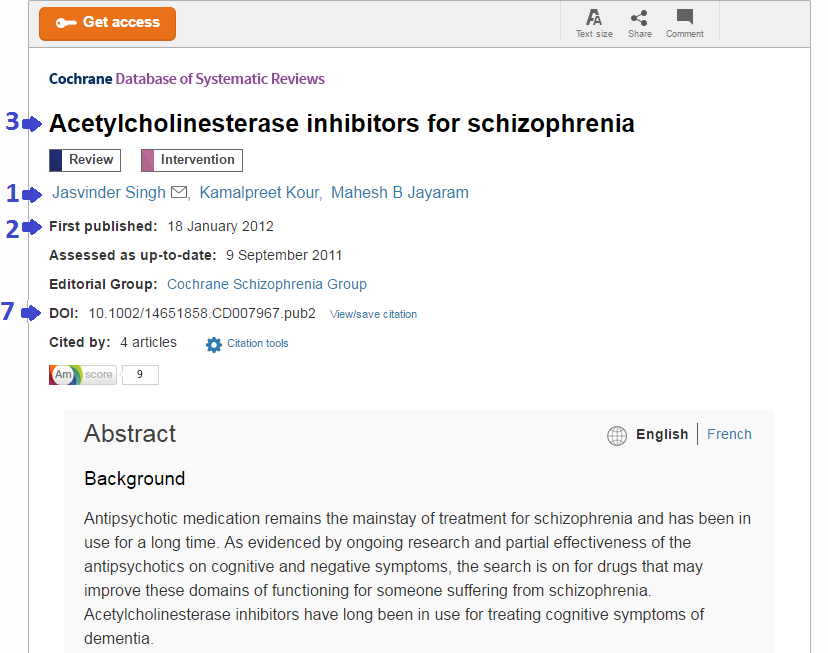
1. The author(s) are listed here.
2. Year the article was published.
3. Article title. Make sure the title is capitalized correctly, according to APA guidelines. Only capitalize the first word at the beginning of the title, the subtitle (if there is one), any proper nouns, and abbreviations.
4. Journal title. For systematic reviews found in Cochrane, the journal title is always Cochrane Database of Systematic Reviews .
7. DOI (Digital Object Identifier)
Joanne Briggs Institute (JBI)is another health sciences database that does not contain a citation button that formats in a specific style. Furthermore, this database contains a specific type of resource, systematic reviews conducted by JBI, that have a unique citation format. JBI is the publisher of the systematic reviews found in the database, and will need to be included in the citation.
APA format:
Example:
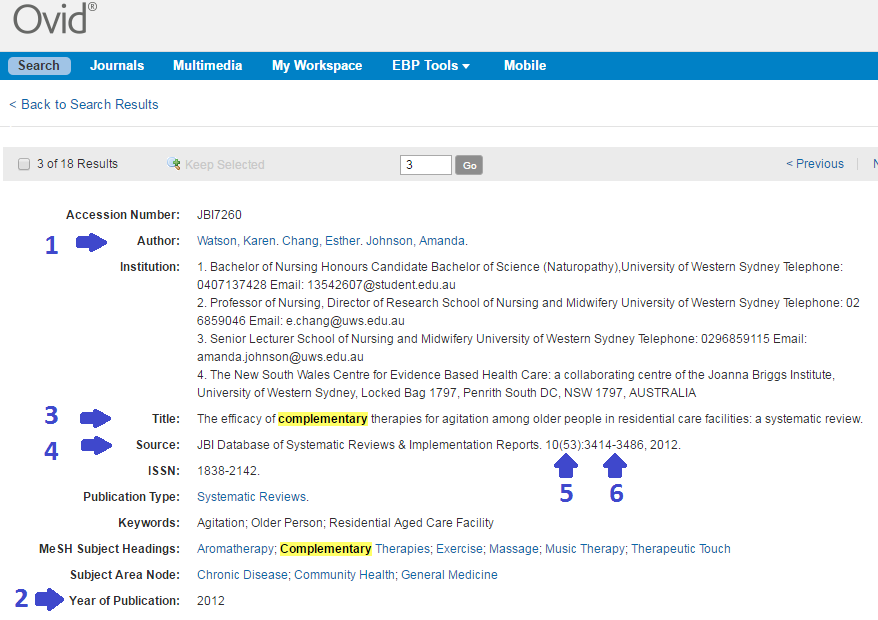
1. The author(s) are listed here.
2. Year the article was published.
3. Article title. Make sure the title is capitalized correctly, according to APA guidelines. Only capitalize the first word at the beginning of the title, the subtitle (if there is one), any proper nouns, and abbreviations.
4. Journal title. Most articles found in the JBI database are published in JBI Database of Systematic Reviews & Implementation Reports.
5. The volume and issue numbers go next, do not put a space between the volume and issue number.
6. Page numbers for the article.
Building Citations for Digital Sources Outside the Library
Building the reference is one of the best ways to check what kind of source you have found.
For internet sources outside the library, you will need to build the reference from the source on your own. These are some of the most common types of sources found on the internet. More source types and examples can be found on the Examplespage.
Locating Citation Information in a Book
Some ebooks and all print books do not have citation tools. You can locate citation information in the catalog or in the book itself.
In a print book, the information will be on the title page and the copyright page, which is usually the page after the title page. Many free online digital books will include scans of the title page as in this one from Project Gutenberg. A title page like this is a sign of a book or book-like item such as a report.

You will need:
- Title.This book is a volume in a series, and the volume has its own title, so the full title (typed here in APA Style) is: Systematic theology: A compendium and common-place book designed for the use of theological students: Vol. 1. The doctrine of God.
- Author.Augustus Hopkins Strong
- Date.1907
- Location. This is a free ebook, so you will need the URL where it can be found online: https://www.gutenberg.org/ebooks/44035
Streaming Video
YouTube is the source you will most often need to write a citation for.

You will need to locate:
- The username/screenname: this is the name of the posting channel. APA treats this as the author.
- The title.
- The date the video was uploaded.
- The URL/Link.
Websites and Webpages
Many websites will not list individual authors.
- For ALL government, association, or company official sites, if there is no individual person's name, use the name of the group as the author.

- If there is an author listed, include it. This article from Starbucks is an example of the kind of corporate information that can have an author and might come up in an assignment.

For websites you will need to find:
- An author, even if it is a group name like American Nurses Association.
- A title--whatever is the most logical.
- A date if there is one--dates may be missing!
- The URL/address--take this directly from your address bar.
Some items on websites are not webpage sources.
- Watch for magazine articles in particular, which are often online but are not cited as webpages

Reports and Other Government Documents
Most government publications are cited as a stand-alone document. The vast majority of government publications appear online on agency websites. These are called 'gray literature', and can be helpful sources for many assignments. Examples of common government documents that you may use for papers include the SAMHSA Treatment Improvement Protocols for counseling, statistical information from the CDC, BLS, or Census Bureau, guidelines from the DOE, or reports from the EPA. Basic information from many government sites is cited as a webpage, but if the source can be downloaded (as a PDF for example), it is probably cited as a report.
One defining feature of agency reports is that they usually have a standardized number, called a report number or publication number.
Two examples of government publications are below.
- A Treatment Improvement Protocol from SAMHSA:

- An Infographic
Even short items like this infographic from the CDC can have assigned publication numbers:
Note the publication number at the bottom:

