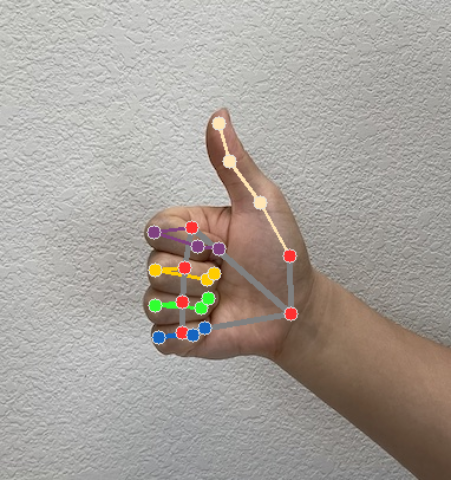
The MediaPipe Hand Landmarker task lets you detect the landmarks of the hands in an image. These instructions show you how to use the Hand Landmarker with iOS apps. The code sample described in these instructions is available on GitHub .
For more information about the capabilities, models, and configuration options of this task, see the Overview .
Code example
The MediaPipe Tasks example code is a basic implementation of a Hand Landmarker app for iOS. The example uses the camera on a physical iOS device to detect hand landmarks in a continuous video stream. The app can also detect hand landmarks in images and videos from the device gallery.
You can use the app as a starting point for your own iOS app, or refer to it when modifying an existing app. The Hand Landmarker example code is hosted on GitHub .
Download the code
The following instructions show you how to create a local copy of the example code using the git command line tool.
To download the example code:
-
Clone the git repository using the following command:
git clone https://github.com/google-ai-edge/mediapipe-samples -
Optionally, configure your git instance to use sparse checkout, so you have only the files for the Hand Landmarker example app:
 cd mediapipe-samples
git sparse-checkout init --cone
git sparse-checkout set examples/hand_landmarker/ios/
After creating a local version of the example code, you can install the MediaPipe task library, open the project using Xcode and run the app. For instructions, see the Setup Guide for iOS .
Key components
The following files contain the crucial code for the Hand Landmarker example application:
- HandLandmarkerService.swift : Initializes the Hand Landmarker, handles the model selection, and runs inference on the input data.
- CameraViewController.swift : Implements the UI for the live camera feed input mode and visualizes the results.
- MediaLibraryViewController.swift : Implements the UI for the still image and video file input mode and visualizes the results.
Setup
This section describes key steps for setting up your development environment and code projects to use Hand Landmarker. For general information on setting up your development environment for using MediaPipe tasks, including platform version requirements, see the Setup guide for iOS .
Dependencies
Hand Landmarker uses the MediaPipeTasksVision
library, which must be installed
using CocoaPods. The library is compatible with both Swift and Objective-C apps
and does not require any additional language-specific setup.
For instructions to install CocoaPods on macOS, refer to the CocoaPods
installation guide
.
For instructions on how to create a Podfile
with the necessary pods for your
app, refer to Using
CocoaPods
.
Add the MediaPipeTasksVision pod in the Podfile
using the following code:
  target

 'MyHandLandmarkerApp'

 do

 use_frameworks!

 pod

 'MediaPipeTasksVision'
 end
If your app includes unit test targets, refer to the Set Up Guide for
iOS
for additional information on setting up
your Podfile
.
Model
The MediaPipe Hand Landmarker task requires a trained model that is compatible with this task. For more information about the available trained models for Hand Landmarker, see the task overview Models section .
Select and download a model, and add it to your project directory using Xcode. For instructions on how to add files to your Xcode project, refer to Managing files and folders in your Xcode project .
Use the BaseOptions.modelAssetPath
property to specify the path to the model
in your app bundle. For a code example, see the next section.
Create the task
You can create the Hand Landmarker task by calling one of its initializers. The HandLandmarker(options:)
initializer accepts values for the configuration
options.
If you don't need a Hand Landmarker initialized with customized configuration
options, you can use the HandLandmarker(modelPath:)
initializer to create an
Hand Landmarker with the default options. For more information about configuration
options, see Configuration Overview
.
The Hand Landmarker task supports 3 input data types: still images, video files
and live video streams. By default, HandLandmarker(modelPath:)
initializes a
task for still images. If you want your task to be initialized to process video
files or live video streams, use HandLandmarker(options:)
to specify the video
or livestream running mode. The livestream mode also requires the additional handLandmarkerLiveStreamDelegate
configuration option, which enables the
Hand Landmarker to deliver hand landmarker results to the delegate asynchronously.
Choose the tab corresponding to your running mode to see how to create the task and run inference.
Swift
Image
 import

 MediaPipeTasksVision
 let
 modelPath
 =
 Bundle
 .
 main
 .
 path
 (
 forResource
 :
 "hand_landmarker"
 ,
 ofType
 :
 "task"
 )
 let
 options
 =
 HandLandmarkerOptions
 ()
 options
 .
 baseOptions
 .
 modelAssetPath
 =
 modelPath
 options
 .
 runningMode
 =
 .
 image
 options
 .
 minHandDetectionConfidence
 =
 minHandDetectionConfidence
 options
 .
 minHandPresenceConfidence
 =
 minHandPresenceConfidence
 options
 .
 minTrackingConfidence
 =
 minHandTrackingConfidence
 options
 .
 numHands
 =
 numHands
 let
 handLandmarker
 =
 try
 HandLandmarker
 (
 options
 :
 options
 )
Video
 import

 MediaPipeTasksVision
 let
 modelPath
 =
 Bundle
 .
 main
 .
 path
 (
 forResource
 :
 "hand_landmarker"
 ,
 ofType
 :
 "task"
 )
 let
 options
 =
 HandLandmarkerOptions
 ()
 options
 .
 baseOptions
 .
 modelAssetPath
 =
 modelPath
 options
 .
 runningMode
 =
 .
 video
 options
 .
 minHandDetectionConfidence
 =
 minHandDetectionConfidence
 options
 .
 minHandPresenceConfidence
 =
 minHandPresenceConfidence
 options
 .
 minTrackingConfidence
 =
 minHandTrackingConfidence
 options
 .
 numHands
 =
 numHands
 let
 handLandmarker
 =
 try
 HandLandmarker
 (
 options
 :
 options
 )
Livestream
 import

 MediaPipeTasksVision
 //
 Class
 that
 conforms
 to
 the
 `
 HandLandmarkerLiveStreamDelegate
 `
 protocol
 and
 //
 implements
 the
 method
 that
 the
 hand
 landmarker
 calls
 once
 it
 finishes
 //
 performing
 landmarks
 detection
 in
 each
 input
 frame
 .
 class

 HandLandmarkerResultProcessor
 :
 NSObject
 ,
 HandLandmarkerLiveStreamDelegate
 {
 func
 handLandmarker
 (
 _
 handLandmarker
 :
 HandLandmarker
 ,
 didFinishDetection
 result
 :
 HandLandmarkerResult
 ?
 ,
 timestampInMilliseconds
 :
 Int
 ,
 error
 :
 Error
 ?
 )
 {
 //
 Process
 the
 hand
 landmarker
 result
 or
 errors
 here
 .
 }
 }
 let
 modelPath
 =
 Bundle
 .
 main
 .
 path
 (
 forResource
 :
 "hand_landmarker"
 ,
 ofType
 :
 "task"
 )
 let
 options
 =
 HandLandmarkerOptions
 ()
 options
 .
 baseOptions
 .
 modelAssetPath
 =
 modelPath
 options
 .
 runningMode
 =
 .
 liveStream
 options
 .
 minHandDetectionConfidence
 =
 minHandDetectionConfidence
 options
 .
 minHandPresenceConfidence
 =
 minHandPresenceConfidence
 options
 .
 minTrackingConfidence
 =
 minHandTrackingConfidence
 options
 .
 numHands
 =
 numHands
 //
 Assign
 an
 object
 of
 the
 class

 to
 the
 `
 handLandmarkerLiveStreamDelegate
 `
 //
 property
 .
 let
 processor
 =
 HandLandmarkerResultProcessor
 ()
 options
 .
 handLandmarkerLiveStreamDelegate
 =
 processor
 let
 handLandmarker
 =
 try
 HandLandmarker
 (
 options
 :
 options
 )
Objective-C
Image
 @import
 MediaPipeTasksVision
 ;
 NSString
 *
 modelPath
 =
 [[
 NSBundle
 mainBundle
 ]
 pathForResource
 :
 @
 "hand_landmarker"
 ofType
 :
 @
 "task"
 ];
 MPPHandLandmarkerOptions
 *
 options
 =
 [[
 MPPHandLandmarkerOptions
 alloc
 ]
 init
 ];
 options
 .
 baseOptions
 .
 modelAssetPath
 =
 modelPath
 ;
 options
 .
 runningMode
 =
 MPPRunningModeImage
 ;
 options
 .
 minHandDetectionConfidence
 =
 minHandDetectionConfidence
 ;
 options
 .
 minHandPresenceConfidence
 =
 minHandPresenceConfidence
 ;
 options
 .
 minTrackingConfidence
 =
 minHandTrackingConfidence
 ;
 options
 .
 numHands
 =
 numHands
 ;
 MPPHandLandmarker
 *
 handLandmarker
 =
 [[
 MPPHandLandmarker
 alloc
 ]
 initWithOptions
 :
 options
 error
 :
 nil
 ];
Video
 @import
 MediaPipeTasksVision
 ;
 NSString
 *
 modelPath
 =
 [[
 NSBundle
 mainBundle
 ]
 pathForResource
 :
 @
 "hand_landmarker"
 ofType
 :
 @
 "task"
 ];
 MPPHandLandmarkerOptions
 *
 options
 =
 [[
 MPPHandLandmarkerOptions
 alloc
 ]
 init
 ];
 options
 .
 baseOptions
 .
 modelAssetPath
 =
 modelPath
 ;
 options
 .
 runningMode
 =
 MPPRunningModeVideo
 ;
 options
 .
 minHandDetectionConfidence
 =
 minHandDetectionConfidence
 ;
 options
 .
 minHandPresenceConfidence
 =
 minHandPresenceConfidence
 ;
 options
 .
 minTrackingConfidence
 =
 minHandTrackingConfidence
 ;
 options
 .
 numHands
 =
 numHands
 ;
 MPPHandLandmarker
 *
 handLandmarker
 =
 [[
 MPPHandLandmarker
 alloc
 ]
 initWithOptions
 :
 options
 error
 :
 nil
 ];
Livestream
@import MediaPipeTasksVision ; // Class that conforms to the `MPPHandLandmarkerLiveStreamDelegate` protocol // and implements the method that the hand landmarker calls once it finishes // performing landmarks detection in each input frame. @interface APPHandLandmarkerResultProcessor : NSObject@end @implementation APPHandLandmarkerResultProcessor - ( void ) handLandmarker: ( MPPHandLandmarker * ) handLandmarker didFinishDetectionWithResult :( MPPHandLandmarkerResult * ) handLandmarkerResult timestampInMilliseconds :( NSInteger ) timestampInMilliseconds error :( NSError * ) error { // Process the hand landmarker result or errors here. } @end NSString * modelPath = [[ NSBundle mainBundle ] pathForResource : @"hand_landmarker" ofType : @"task" ]; MPPHandLandmarkerOptions * options = [[ MPPHandLandmarkerOptions alloc ] init ]; options . baseOptions . modelAssetPath = modelPath ; options . runningMode = MPPRunningModeLiveStream ; options . minHandDetectionConfidence = minHandDetectionConfidence ; options . minHandPresenceConfidence = minHandPresenceConfidence ; options . minTrackingConfidence = minHandTrackingConfidence ; options . numHands = numHands ; // Assign an object of the class to the `handLandmarkerLiveStreamDelegate` // property. APPHandLandmarkerResultProcessor * processor = [ APPHandLandmarkerResultProcessor new ]; options . handLandmarkerLiveStreamDelegate = processor ; MPPHandLandmarker * handLandmarker = [[ MPPHandLandmarker alloc ] initWithOptions : options error : nil ];
Configuration options
This task has the following configuration options for iOS apps:
| Option Name | Description | Value Range | Default Value |
|---|---|---|---|
running_mode
|
Sets the running mode for the task. There are three
modes: IMAGE: The mode for single image inputs. VIDEO: The mode for decoded frames of a video. LIVE_STREAM: The mode for a livestream of input data, such as from a camera. In this mode, resultListener must be called to set up a listener to receive results asynchronously. In this mode, handLandmarkerLiveStreamDelegate
must be set to an instance of a class that implements the HandLandmarkerLiveStreamDelegate
to receive the hand landmark
detection results asynchronously. |
{ RunningMode.image, RunningMode.video, RunningMode.liveStream
} |
RunningMode.image
|
numHands
|
The maximum number of hands detected by the Hand landmark detector. | Any integer > 0
|
1
|
minHandDetectionConfidence
|
The minimum confidence score for the hand detection to be considered successful in palm detection model. | 0.0 - 1.0
|
0.5
|
minHandPresenceConfidence
|
The minimum confidence score for the hand presence score in the hand landmark detection model. In Video mode and Live stream mode, if the hand presence confidence score from the hand landmark model is below this threshold, Hand Landmarker triggers the palm detection model. Otherwise, a lightweight hand tracking algorithm determines the location of the hand(s) for subsequent landmark detections. | 0.0 - 1.0
|
0.5
|
minTrackingConfidence
|
The minimum confidence score for the hand tracking to be considered successful. This is the bounding box IoU threshold between hands in the current frame and the last frame. In Video mode and Stream mode of Hand Landmarker, if the tracking fails, Hand Landmarker triggers hand detection. Otherwise, it skips the hand detection. | 0.0 - 1.0
|
0.5
|
result_listener
|
Sets the result listener to receive the detection results
asynchronously when the hand landmarker is in live stream mode.
Only applicable when running mode is set to LIVE_STREAM
|
N/A | N/A |
When the running mode is set to livestream, the Hand Landmarker requires the
additional handLandmarkerLiveStreamDelegate
configuration option, which
enables the Hand Landmarker to deliver hand landmarks detection results
asynchronously. The delegate must implement the handLandmarker(_:didFinishDetection:timestampInMilliseconds:error:)
method,
which the Hand Landmarker calls after processing the hand landmarks detection
results for each frame.
| Option name | Description | Value Range | Default Value |
|---|---|---|---|
handLandmarkerLiveStreamDelegate
|
Enables Hand Landmarker to receive the hand
landmark detection results asynchronously in livestream mode. The class
whose instance is set to this property must implement the handLandmarker(_:didFinishDetection:timestampInMilliseconds:error:)
method. |
Not applicable | Not set |
Prepare data
You need to convert the input image or frame to an MPImage
object before
passing it to the Hand Landmarker. MPImage
supports different types of iOS image
formats, and can use them in any running mode for inference. For more
information about MPImage
, refer to the MPImage API
.
Choose an iOS image format based on your use case and the running mode your
application requires. MPImage
accepts the UIImage
, CVPixelBuffer
, and CMSampleBuffer
iOS image formats.
UIImage
The UIImage
format is well-suited for the following running modes:
-
Images: images from an app bundle, user gallery, or file system formatted as
UIImageimages can be converted to anMPImageobject. -
Videos: use AVAssetImageGenerator to extract video frames to the CGImage format, then convert them to
UIImageimages.
Swift
 // Load an image on the user's device as an iOS `UIImage` object.
 // Convert the `UIImage` object to a MediaPipe's Image object having the default
 // orientation `UIImage.Orientation.up`.
 let

 image

 =

 try

 MPImage
 (
 uiImage
 :

 image
 )
Objective-C
 // Load an image on the user's device as an iOS `UIImage` object.
 // Convert the `UIImage` object to a MediaPipe's Image object having the default
 // orientation `UIImageOrientationUp`.
 MPImage

 *
 image

 =

 [[
 MPPImage

 alloc
 ]

 initWithUIImage
 :
 image

 error
 :
 nil
 ];
The example initializes an MPImage
with the default UIImage.Orientation.Up
orientation. You can initialize an MPImage
with any of the supported UIImage.Orientation
values. Hand Landmarker does not support mirrored orientations like .upMirrored
, .downMirrored
, .leftMirrored
, .rightMirrored
.
For more information about UIImage
, refer to the UIImage Apple Developer
Documentation
.
CVPixelBuffer
The CVPixelBuffer
format is well-suited for applications that generate frames
and use the iOS CoreImage
framework for processing.
The CVPixelBuffer
format is well-suited for the following running modes:
-
Images: apps that generate
CVPixelBufferimages after some processing using iOS'sCoreImageframework can be sent to the Hand Landmarker in the image running mode. -
Videos: video frames can be converted to the
CVPixelBufferformat for processing, and then sent to the Hand Landmarker in video mode. -
livestream: apps using an iOS camera to generate frames may be converted into the
CVPixelBufferformat for processing before being sent to the Hand Landmarker in livestream mode.
Swift
 // Obtain a CVPixelBuffer.
 // Convert the `CVPixelBuffer` object to a MediaPipe's Image object having the default
 // orientation `UIImage.Orientation.up`.
 let

 image

 =

 try

 MPImage
 (
 pixelBuffer
 :

 pixelBuffer
 )
Objective-C
 // Obtain a CVPixelBuffer.
 // Convert the `CVPixelBuffer` object to a MediaPipe's Image object having the
 // default orientation `UIImageOrientationUp`.
 MPImage

 *
 image

 =

 [[
 MPPImage

 alloc
 ]

 initWithUIImage
 :
 image

 error
 :
 nil
 ];
For more information about CVPixelBuffer
, refer to the CVPixelBuffer Apple
Developer
Documentation
.
CMSampleBuffer
The CMSampleBuffer
format stores media samples of a uniform media type, and is
well-suited for the livestream running mode. Live frames from iOS cameras are
asynchronously delivered in the CMSampleBuffer
format by iOS AVCaptureVideoDataOutput
.
Swift
 // Obtain a CMSampleBuffer.
 // Convert the `CMSampleBuffer` object to a MediaPipe's Image object having the default
 // orientation `UIImage.Orientation.up`.
 let

 image

 =

 try

 MPImage
 (
 sampleBuffer
 :

 sampleBuffer
 )
Objective-C
 // Obtain a `CMSampleBuffer`.
 // Convert the `CMSampleBuffer` object to a MediaPipe's Image object having the
 // default orientation `UIImageOrientationUp`.
 MPImage

 *
 image

 =

 [[
 MPPImage

 alloc
 ]

 initWithSampleBuffer
 :
 sampleBuffer

 error
 :
 nil
 ];
For more information about CMSampleBuffer
, refer to the CMSampleBuffer Apple
Developer
Documentation
.
Run the task
To run the Hand Landmarker, use the detect()
method specific to the assigned
running mode:
- Still image:
detect(image:) - Video:
detect(videoFrame:timestampInMilliseconds:) - Livestream:
detectAsync(image:timestampInMilliseconds:)
Swift
Image
let result = try handLandmarker.detect(image: image)
Video
let result = try handLandmarker.detect(
    videoFrame: image,
    timestampInMilliseconds: timestamp)
Livestream
try handLandmarker.detectAsync(
  image: image,
  timestampInMilliseconds: timestamp)
Objective-C
Image
 MPPHandLandmarkerResult

 *
 result

 =

 [
 handLandmarker

 detectInImage
 :
 image

 error
 :
 nil
 ];
Video
 MPPHandLandmarkerResult

 *
 result

 =

 [
 handLandmarker

 detectInVideoFrame
 :
 image

 timestampInMilliseconds
 :
 timestamp

 error
 :
 nil
 ];
Livestream
 BOOL

 success

 =

 [
 handLandmarker

 detectAsyncInImage
 :
 image

 timestampInMilliseconds
 :
 timestamp

 error
 :
 nil
 ];
The Hand Landmarker code example shows the implementations of each of these modes in more detail. The example code allows the user to switch between processing modes, which may not be required for your use case.
Note the following:
-
When running in video mode or livestream mode, you must also provide the timestamp of the input frame to the Hand Landmarker task.
-
When running in image or video mode, the Hand Landmarker task blocks the current thread until it finishes processing the input image or frame. To avoid blocking the current thread, execute the processing in a background thread using iOS Dispatch or NSOperation frameworks.
-
When running in livestream mode, the Hand Landmarker task returns immediately and doesn't block the current thread. It invokes the
handLandmarker(_:didFinishDetection:timestampInMilliseconds:error:)method with the hand landmarker result after processing each input frame. The Hand Landmarker invokes this method asynchronously on a dedicated serial dispatch queue. For displaying results on the user interface, dispatch the results to the main queue after processing the results. If thedetectAsyncfunction is called when the Hand Landmarker task is busy processing another frame, the Hand Landmarker ignores the new input frame.
Handle and display results
Upon running inference, the Hand Landmarker task returns a HandLandmarkerResult
which contains hand landmarks in image coordinates, hand landmarks in world
coordinates and handedness(left/right hand) of the detected hands.
The following shows an example of the output data from this task:
The HandLandmarkerResult
output contains three components. Each component is an array, where each element contains the following results for a single detected hand:
-
Handedness
Handedness represents whether the detected hands are left or right hands.
-
Landmarks
There are 21 hand landmarks, each composed of
x,yandzcoordinates. Thexandycoordinates are normalized to [0.0, 1.0] by the image width and height, respectively. Thezcoordinate represents the landmark depth, with the depth at the wrist being the origin. The smaller the value, the closer the landmark is to the camera. The magnitude ofzuses roughly the same scale asx. -
World Landmarks
The 21 hand landmarks are also presented in world coordinates. Each landmark is composed of
x,y, andz, representing real-world 3D coordinates in meters with the origin at the hand’s geometric center.
 HandLandmarkerResult:
  Handedness:
    Categories #0:
      index        : 0
      score        : 0.98396
      categoryName : Left
  Landmarks:
    Landmark #0:
      x            : 0.638852
      y            : 0.671197
      z            : -3.41E-7
    Landmark #1:
      x            : 0.634599
      y            : 0.536441
      z            : -0.06984
    ... (21 landmarks for a hand)
  WorldLandmarks:
    Landmark #0:
      x            : 0.067485
      y            : 0.031084
      z            : 0.055223
    Landmark #1:
      x            : 0.063209
      y            : -0.00382
      z            : 0.020920
    ... (21 world landmarks for a hand)
The following image shows a visualization of the task output: