

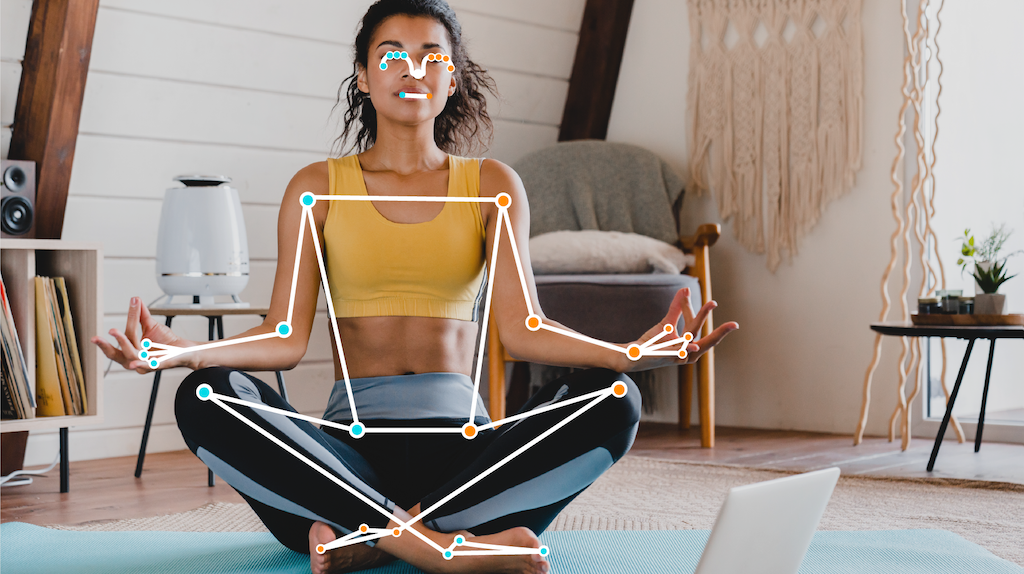
The MediaPipe Pose Landmarker task lets you detect landmarks of human bodies in an image or video. You can use this task to identify key body locations, analyze posture, and categorize movements. This task uses machine learning (ML) models that work with single images or video. The task outputs body pose landmarks in image coordinates and in 3-dimensional world coordinates.
Get Started
Start using this task by following the implementation guide for your target platform. These platform-specific guides walk you through a basic implementation of this task, including a recommended model, and code example with recommended configuration options:
- Android- Code example - Guide
- Python- Code example - Guide
- Web- Code example - Guide
Task details
This section describes the capabilities, inputs, outputs, and configuration options of this task.
Features
- Input image processing- Processing includes image rotation, resizing, normalization, and color space conversion.
- Score threshold- Filter results based on prediction scores.
- Still images
- Decoded video frames
- Live video feed
- Pose landmarks in normalized image coordinates
- Pose landmarks in world coordinates
- Optional: a segmentation mask for the pose.
Configurations options
This task has the following configuration options:
| Option Name | Description | Value Range | Default Value |
|---|---|---|---|
running_mode
|
Sets the running mode for the task. There are three
modes: IMAGE: The mode for single image inputs. VIDEO: The mode for decoded frames of a video. LIVE_STREAM: The mode for a livestream of input data, such as from a camera. In this mode, resultListener must be called to set up a listener to receive results asynchronously. |
{ IMAGE, VIDEO, LIVE_STREAM
} |
IMAGE
|
num_poses
|
The maximum number of poses that can be detected by the Pose Landmarker. | Integer > 0
|
1
|
min_pose_detection_confidence
|
The minimum confidence score for the pose detection to be considered successful. | Float [0.0,1.0]
|
0.5
|
min_pose_presence_confidence
|
The minimum confidence score of pose presence score in the pose landmark detection. | Float [0.0,1.0]
|
0.5
|
min_tracking_confidence
|
The minimum confidence score for the pose tracking to be considered successful. | Float [0.0,1.0]
|
0.5
|
output_segmentation_masks
|
Whether Pose Landmarker outputs a segmentation mask for the detected pose. | Boolean
|
False
|
result_callback
|
Sets the result listener to receive the landmarker results
asynchronously when Pose Landmarker is in the live stream mode.
Can only be used when running mode is set to LIVE_STREAM
|
ResultListener
|
N/A
|
Models
The Pose Landmarker uses a series of models to predict pose landmarks. The first model detects the presence of human bodies within an image frame, and the second model locates landmarks on the bodies.
The following models are packaged together into a downloadable model bundle:
- Pose detection model: detects the presence of bodies with a few key pose landmarks.
- Pose landmarker model: adds a complete mapping of the pose. The model outputs an estimate of 33 3-dimensional pose landmarks.
This bundle uses a convolutional neural network similar to MobileNetV2 and is optimized for on-device, real-time fitness applications. This variant of the BlazePose model uses GHUM , a 3D human shape modeling pipeline, to estimate the full 3D body pose of an individual in images or videos.
Pose landmarker: 256 x 256 x 3
Pose landmarker: 256 x 256 x 3
Pose landmarker: 256 x 256 x 3
Pose landmarker model
The pose landmarker model tracks 33 body landmark locations, representing the approximate location of the following body parts:
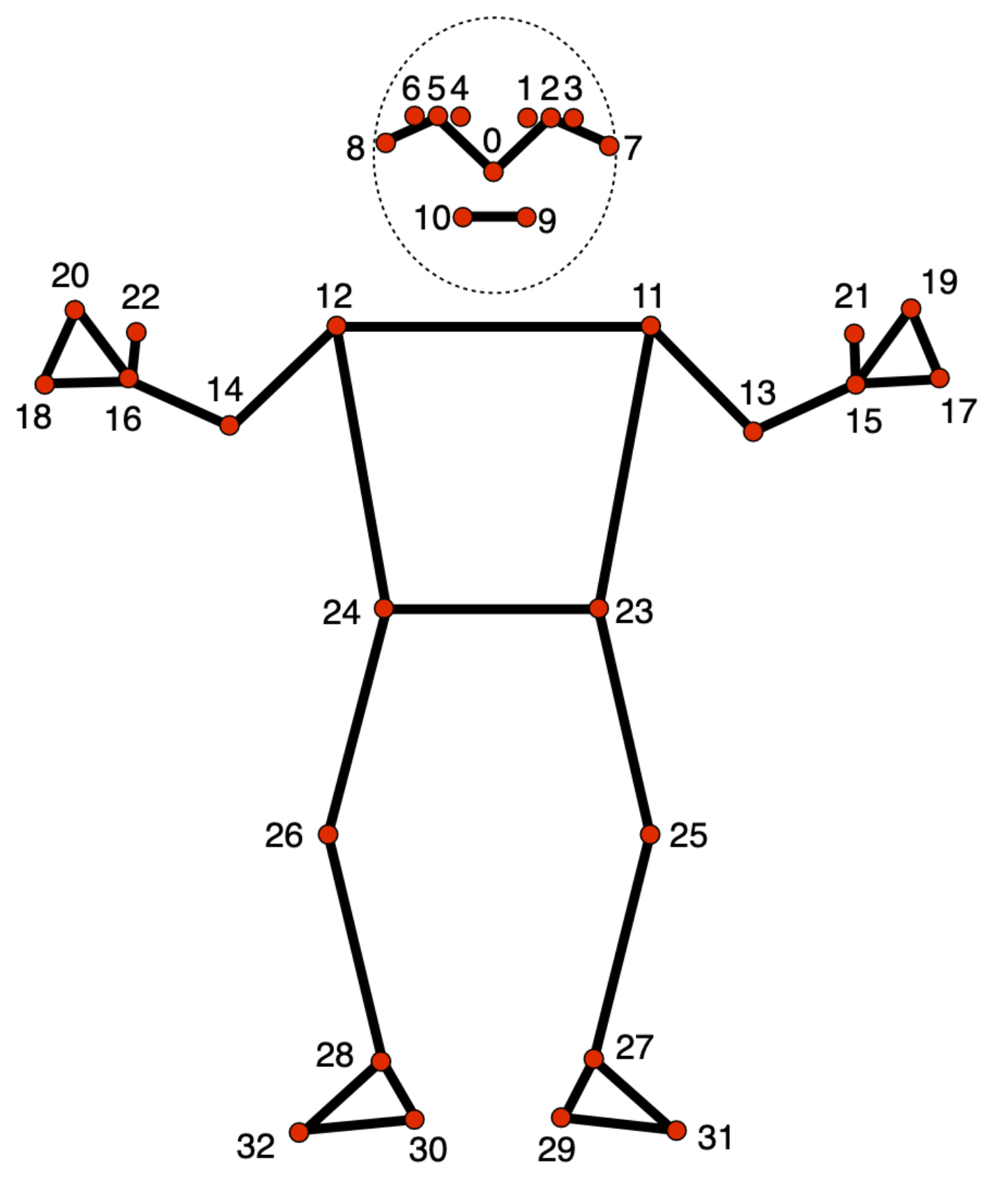
  0

 -

 nose
 1

 -

 left

 eye

 (
 inner
 )
 2

 -

 left

 eye
 3

 -

 left

 eye

 (
 outer
 )
 4

 -

 right

 eye

 (
 inner
 )
 5

 -

 right

 eye
 6

 -

 right

 eye

 (
 outer
 )
 7

 -

 left

 ear
 8

 -

 right

 ear
 9

 -

 mouth

 (
 left
 )
 10

 -

 mouth

 (
 right
 )
 11

 -

 left

 shoulder
 12

 -

 right

 shoulder
 13

 -

 left

 elbow
 14

 -

 right

 elbow
 15

 -

 left

 wrist
 16

 -

 right

 wrist
 17

 -

 left

 pinky
 18

 -

 right

 pinky
 19

 -

 left

 index
 20

 -

 right

 index
 21

 -

 left

 thumb
 22

 -

 right

 thumb
 23

 -

 left

 hip
 24

 -

 right

 hip
 25

 -

 left

 knee
 26

 -

 right

 knee
 27

 -

 left

 ankle
 28

 -

 right

 ankle
 29

 -

 left

 heel
 30

 -

 right

 heel
 31

 -

 left

 foot

 index
 32

 -

 right

 foot

 index
The model output contains both normalized coordinates ( Landmarks
) and world
coordinates ( WorldLandmarks
) for each landmark.
Except as otherwise noted, the content of this page is licensed under the Creative Commons Attribution 4.0 License , and code samples are licensed under the Apache 2.0 License . For details, see the Google Developers Site Policies . Java is a registered trademark of Oracle and/or its affiliates.
Last updated 2026-05-28 UTC.
