


日本のメデイアでは伺い知れない、アメリカのdeep State が仕掛ける、 経済制裁による攻撃力は、 チャベス前大統領が豊富な資源収入を貧しき者達に分配する社会主義的な政策により、豊かさを獲得しつつあったものを破壊し、国外への難民が出ざるを得ないような状態にまで追い込んでいる。傀儡の育成もまたいつものように豊富な資金で怠りなく継続されてきて、一人の傀儡代表者をかつぎあげる段階にきている、というわけですね。
イングランド銀行は、預かっているベネズエラの金塊80億ドルは、現政権には渡さないといっています 。英政府の閣僚も米と同調し、恥知らずの非難を拡散しています。
いつもは、トランプにつべこべ文句をいっている、cnn、nbc等メデイアも「民主主義」を取り戻すとかの浮ついたフレーズの下、一致協力体制のアメリカ・・・・
石油埋蔵量データの 下図で
「オレンジ色」がベネズエラです、「紫色」がサウジアラビアです。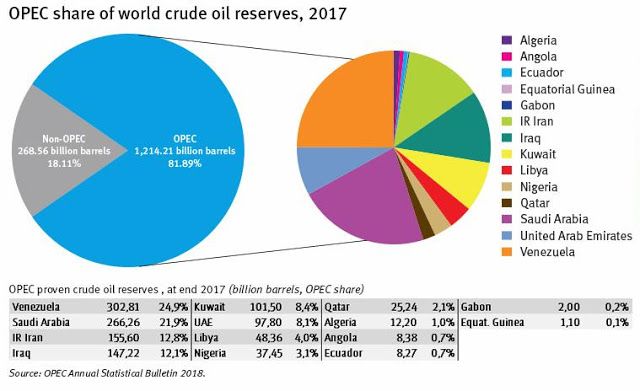
おそらくベネズエラが、全て米ドル決済でoilを輸出していればまだしも、ここまでならなかったのかもしれませんね・・・。反抗しなければ呑み込まれるし・・・。
(以下英文は、センテンスを範囲指定して、右クリック、「Bingで翻訳」で、参考訳が得られます。 この場合、英文中の日本語訳単語は邪魔になりますので、Bingの画面で削除する)
Venezuela’s Orinoco Oil Belt
The world’s fourth largest river, the Orinoco, rises in the Parima Mountains along the Venezuelan-Brazilian border. The Orinoco engraves a 2,000 kilometre north-easterly arc円弧 through Columbia and Venezuela before discharging into the Atlantic Ocean off Venezuela’s coast. The Orinoco Heavy Oil Belt stretches 600 kilometres along the north bank of the Orinoco River’s easterly dash to the sea. The Belt is 70 kilometers wide.
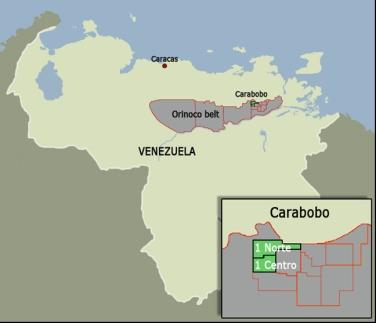
United States Geological Service’s (USGS) Estimate of Recoverable Oil Reserves of the Orinoco Oil Belt (2009) is the go-to source regarding the Orinoco reservoir’s size. After describing how this oil-saturated飽和する bed of sandstone ended up 150 to 1500 metres below the surface of the East Orinoco Basin; the authors’ estimate “oil-in-place” to be up to 1.4 trillion barrels.
A comprehensive study by Petroleos de Venezuela S.A. (PDVSA) established the magnitude of the original oil-in-place
The Feigned見せかける and Future Demise継承終焉 of Big-Oil
(OOIP) at 1,180 billion barrels of oil (BBO), a commonly cited estimate for the Orinoco Oil Belt (Fiorillo, 1987); PDVSA recently revised this value to more than 1,300 BBO (Gonzalez and others, 2006) . In this study the median OOIP was estimated at 1,300 BBO and the maximum at 1,400 BBO. (quoted in USGS, op cit)
The Belt’s “technically recoverable” oil is estimated to be as much as 652 billion barrels
. (see USGC below) Elsewhere, however, the report speculates that by fully exploiting SAGD, and other recovery enhancement processes, 70% of the oil-in-place might be extracted
. Moreover, the report relies on studies published between 2001 and 2008 hence does not contemplate: Solvent溶媒-Assisted SAGD; Downhole Steam Generation; let alone the application of nuclear power. Tackling the Orinoco Belt with these technologies will yield a trillion barrels.

USGS Report p. 1
The report does not discuss production costs. Canadian oilsands companies continued to produce in 2018 even after transportation bottlenecks tanked prices to $20 a barrel. These facilities, however, would not have been built had investors known this might be the price of their wares商品. The business press guesstimates推計する the current breakeven price for an Alberta oilsands project to be around $35 a barrel.
While the Orinoco Belt is not as large as Alberta’s oilsands it has three advantages:
a) its oil is not as heavy;
b) its climate is far hotter; and
c) it’s much closer to a coast.
The Orinoco Belt sits at 9 degrees latitude緯度 and its entire span is a few hundred kilometres from Atlantic shores. Orinoco Belt production costs will be noticeably著しく lower than Alberta’s oilsands.
Let’s place 1 trillion barrels of oil in context.
Global oil consumption is currently 35 billion barrels a year. Thus, the Orinoco Belt alone could satisfy 100% of global demand for almost 30 years!
As for the Orinoco field’s dollar value. World oil prices are currently hovering near $60 … do the math (ブログ注: =do the mathematics=計算してみなはれ・・・の意).
引用 以上です。
冷静に当たり前の感覚で、Maduroマドウーロ大統領の顔を看てください。善人の顔ですよ!
リンカーンでなくたって、私たちはある程度人生経験を積めば、顔をみれば人は大枠わかります。
例えば、竹中平蔵や安倍晋三の顔と比べてみれば一目瞭然でないでしょうか?例えが下劣過ぎてマドウール大統領に申し訳ないと思いますが・・・
リビアのカダフイーも似たような状況で首をとられました。
フセインも、シリアのアサドはあやうくプーチンに助けてもらって・・・
しかし、プーチンだってoil, gasの価格が低値安定にでもなれば、経済的要因から、政治的不安定化が同様に米deep throatによって進められ、いつ火の粉が降りかからないとはいえないのです。ウクライナを使って政治的・物理的にジャブを繰り返しています。対ロ経済制裁も続行中です。攻撃の手綱を緩めることはないのです、deep throatは。ギリシャ正教会本山にも圧力が及んでいると見受けられます、その流れをくむロシア正教との対立を仕掛けているようですね。
経済制裁は、核兵器以上の攻撃力・社会破壊力を持ち得ます。ドル覇権下でアメリカが実行すれば、です。
看ていることしか出来ない無力さをかみしめながら、
また、事実を伝えようとしないメデイア(多分伝えることができない・・・怖くて・・・)をはがゆく思いながら・・・