



2024年08月24日

テーマ: ★資格取得・お勉強★(39332)
カテゴリ: 語学・資格・学び直し
NOVAに通い始めて8ヶ月、このところ公私とも忙しくサボりがちだったが、所属元の三軒茶屋校のスタッフからしきりに「レベルチェックテストを受験せよ」との催促の電話があり、本日オンラインで受験してきた。普段習っている講師からレベルアップの推薦が出ていたのだが、その推薦状の有効期間が8月いっぱいだったのだそうだ。
で、このレベルチェックテスト、私は正直、舐めていた。推薦状が出ているのだから、テストは形式的なものなのだろうととタカを括っていたいたのだが、ネットの情報などによれば、特に最上位のレベル9へは、水準に達していないとみなされれば容赦無く落とされるのだとか。
#そもそもネットで検索しても、レベル9のレベルチェックテストのネタは非常に少なく、事前の十分な情報収集がかなわなかった。
果たして、実際のリスニングの問題などは想像していた以上に難しく、自分の実力のほどを思い知らされた。
今後、同様のテストを受けられる方の参考になると思うので、以下、私が受けた面接の内容を備忘録的にざっと書いておく。
所用時間は20分程度。ZOOMによるオンライン面接形式。といっても自宅からではなく、スクール内にあるオンラインブースで行われる。今回の試験官は四国在住のイギリス人講師だった。遠方の教師が担当するのは、よく知っている講師だと手心が加えられるとかそういう配慮があるのかもしれない。
最初に自己紹介を兼ねて、住んでいるエリアの話とか、どんな仕事をしているとか、趣味はなんだとか、そういった一般的なやりとりが数分間行われる。
結構長いこと話した感覚があったので、すでに試験が始まっているのかと思ったら、じゃあ、これから試験を始めるからと言われて、え、ここまでは試験ではなかったの?と拍子抜けした。
*リスニング1問目:友人間のゴルフの誘い。誘われた女性はほとんど経験がないからと躊躇するのだが、道具はレンタルできるとか、ウエアはカジュアルでいいとか、そんな感じで一緒に行くことになるやり取り。質問は、どのような会話がされたいたかというもので、比較的容易に答えられた。
*次に写真を見ながらの会話:スキューバダイビングと弓道の写真を見せられる。仮に試験官と私が親しい友人だとして、スキューバを始めたいと言っている試験官の人を、私がなんとか引き止めたいとすると、どのように説得(dissuade)するかという、よくわからない設問。おそらく「dissuade」の意味を知っているかどうかが肝だったのだろう。
→スキューバダイビングは大変楽しそうだし私も興味はあるが、万一トラブルにあったときに、水中の事故ということでとりかえしのない事態に陥る可能性もあるので、やめたおいたほうがよいのではないか?代わりにアーチェリーなどはどうだろうか?というようなことを婉曲に伝えた。
〜普段会社にはどのように行っているか?(How do you get to work?)
→この質問を、私はHow do you get works?と取り違えて、まるであさってのやりとりをしてしまった。おそらくget to workの語彙を知っているかを問う質問だったと思われるが、このやりとりで試験官に「やれやれ」というような表情をされて、ああこれは落ちたなぁと心が折れかけた。
〜日本の公共交通機関が発展しているのはなぜだと思うか?
→ひとつには、時間を厳守する日本人の国民性があると思う。その厳しい要求に応えるため、公共交通機関もシビアな運行が求められる。‥というようなことを答えたところ、うん、まあそれもひとつの理由だねと言われて、次に
〜日本の公共交通機関はどのような要改善点があるか?
という質問が続いた。
→咄嗟に答えが思い浮かばなかった。やや的外れだなぁと思いつつ、「たとえば観光地で最近外国人観光客が増えて、地元の住民が公共交通機関を利用するのに難儀するという話をよく聞く。自治体が主導で観光用の循環バスを導入するなどするとよいのではないか。」というようなことを答えた。講師は少し怪訝な顔をして、興味深い意見だね、などと言っていた。
〜自分の趣味で、何か追加したいものはあるか?
→質問の意図がわからず、最近運動不足なので、なにか運動を‥と言いかけたら、そうではなくて、今の趣味をさらに広げるためになにか追加したいものはあるのか?ということのようだった。
〜自分の住んでいるところについて
→最初の雑談の内容が被っていて、ひょっとしてもはや消化試合的な質問なのだろうかと訝りつつ回答。「自分が住んでいるのは東京の23区の西部にある世田谷区というエリアで、23区の中では人口が最も多い。住宅地で比較的富裕な層が住んでいると言われるが、自分は決してそうではない。私が住んでいるのはその中では商業地として栄えている三軒茶屋という街だ。」というような回答。特に追加質問もなく、そのまま面接はそっけなく終了。
試験が終わって、ブースを出ると、結果が送られてくるまでしばらく待ってくれと言われて、フロントで待機した。
結果もなにも、この体たらくではランクアップどころか前回よりもポイントが下がっていてもおかしくないかも、とかなり打ちひしがれていたのが、10分ほどして担当の女性が、「おめでとうございます。」と言ってペーパーを持ってきた。
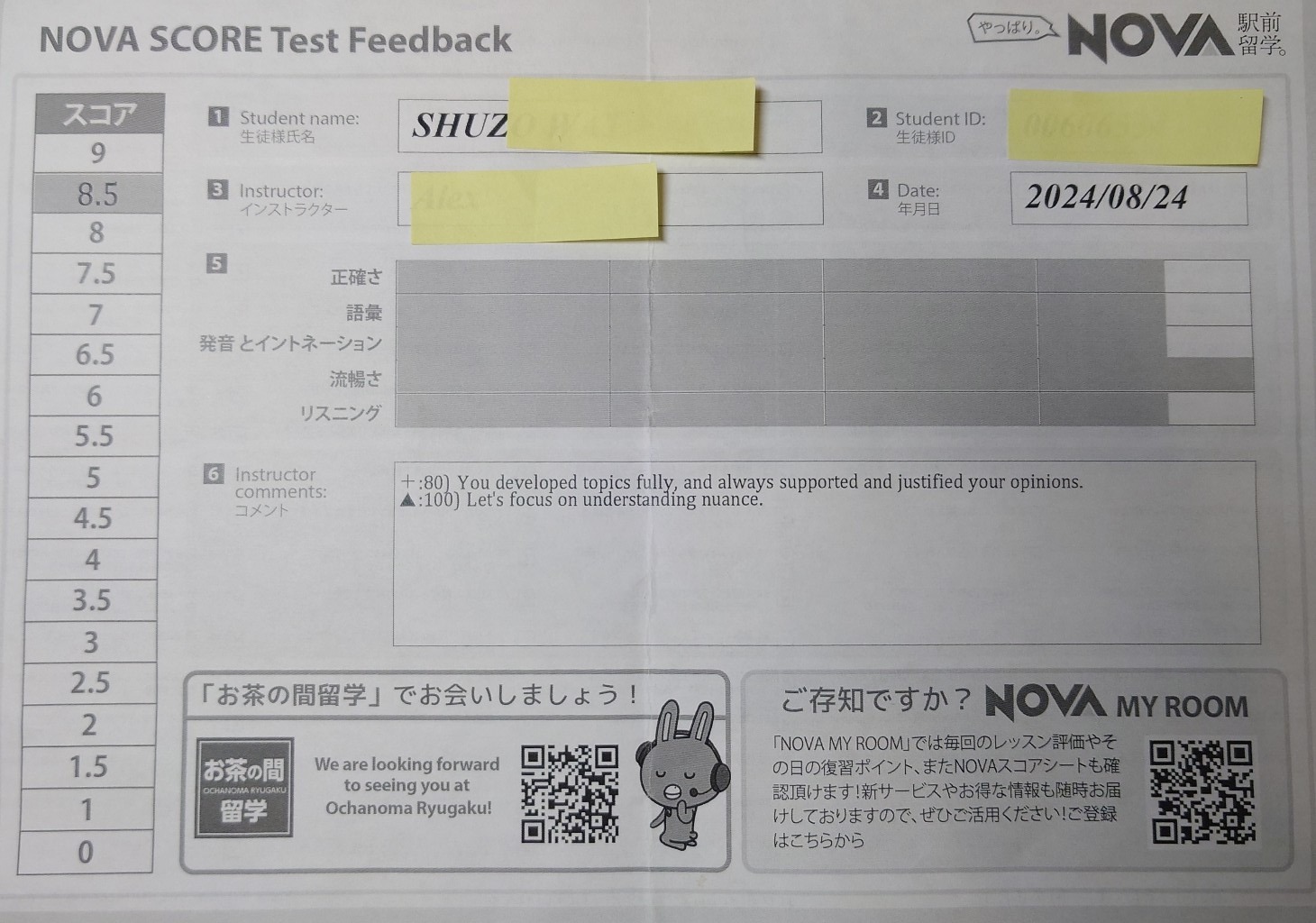
NOVAスコアは8.5、前回は8だったので、スコアはワンランク上昇した。
レベル9=8.5〜9
レベル8=7.5〜8
なので、ギリギリながら、レベル8からレベル9へのランクアップを果たせた。これで推薦してくれた講師にもなんとか顔が立つというものだ。
ちなみにこのNOVAスコアというのは、IELTSのスコアに準拠しているとのことだが、私自身、自分の会話力がIELTS8.5のレベルにあるなどとは到底思っていないので、実際はIELTSのそれよりかなり甘めなのだろう。
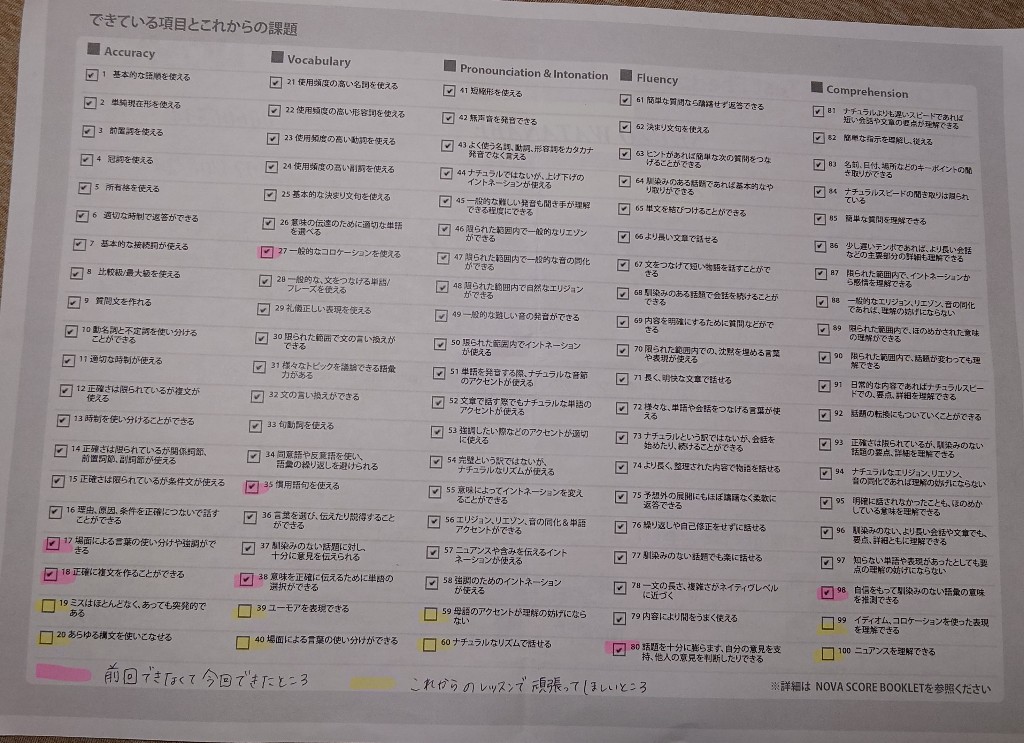
こちらが項目別のチェックリスト。前回(体験レッスン時)は100項目中クリアできていたのが85項目だったが、今回のテストで92項目まで上がった。あれほどリスニングができなかったのに?と、正直やや狐につままれたような気分だった。多分にオマケの面もあるのかもしれない。Fluencyの評価がコンプリートになったが、他の項目はそれぞれ満点にはあと2項目だった。
とまあ、テストが散々な出来だったわりには、かろうじてレベルアップを果たせて、結果オーライと言えなくもないが、私自身、英会話についてはまだまだだという現実をあらためて突きつけられた。今回の20分のテストの中でも、振り返ると、もっとこう話しておけばよかったとか、あの言い方はなかったなぁと思う部分が多々ある。その意味では、嬉しさよりもむしろ悔しさが募る結果だった。
なお、NOVAでは、レベルが8から9に上がると、新たにレベル9のレッスンを受けられるようになるのに加えて、レベル8以下のレッスンを割引で受講できるようになる。ただし、レベル9のレッスン受講に必要なポイント数は1.5ポイントと、それまでの1.1ポイントよりも多くなるため、差し引きであまりお得感はないような気もする。レベル9のレッスンはグループレッスンでも3名までに限定されるが、レベル8までのグループレッスンにおいても、人気講師や週末午前中などの時間帯でない限り、参加人数はおおむね1〜3名程度だった。そんなわけで、しばらくの間はこれまで通りレベル8のレッスンを中心に受講しながら、徐々にレベル9のレッスンを受けてみようかと思っている。
追記:今も引き続きレベル8のグループレッスンを受け続けているが、受講生が2人だけのとき、講師が「君たちはどちらもレベル9だから云々」と言うのを何度か聞き、レベル8にまざってグループレッスンを受けているレベル9の人って結構いるんだなぁと思った(しかも、私がこういうのもなんだが、もうひとりの受講生のレベルはそれほど高いとは感じられなかった)。
おそらく長く通っている年配の受講生の場合、レベル8になってから何年か経つと、推薦をもらえてそれなりに自己表現をできればレベル9に上げてもらえるのではないかと思う。ということで、NOVAのレベル9って、ネットの一部記事に書かれているほど、レアのものでもエクスクルーシブなものでないということに今更ながら気がついた次第。
It’s been eight months since I started taking lessons at NOVA. Lately, I’ve been busy with both work and personal matters, and I’d been slacking off a bit. Then the staff at my home branch in Sangenjaya kept calling me, urging me to take the level check test. So today, I finally took it online.
Apparently, one of the instructors I regularly study with had already recommended me for a level-up, but I didn’t realize that the recommendation letter would expire at the end of August.
To be honest, I underestimated the test. Since I had a recommendation, I assumed it was just a formality. But according to what I’d read online, especially for the highest level—Level 9—if you don’t meet the standard, you’ll be rejected without mercy. In fact, there wasn’t much info online at all about the Level 9 test, so I couldn’t really prepare myself.
As it turned out, the listening section was much harder than I expected, and I quickly realized just how limited my ability still is.
For anyone who may take the same test in the future, I’ll jot down a quick record of what I experienced.
Test Format
About 20 minutes
Online interview via Zoom, conducted in a booth inside the school (not from home)
Examiner: a British instructor living in Shikoku (probably to avoid bias from local teachers)
The session started with small talk—where I live, what I do for work, my hobbies, etc. It went on for a while, so I thought the test had already begun. But then the examiner said, “Okay, let’s start the test now,” and I was a bit thrown off.
Listening Section
Question 1: A casual conversation between friends about going golfing.
One woman hesitates because she’s inexperienced, but is reassured that rentals are available and casual clothes are fine. The question was basically about what the conversation was about—fairly easy.
Question 2: Much tougher. It seemed like a sports news segment. A player suddenly leaving a team, surprising everyone, with several offers already on the table. I couldn’t catch the details at all. Honestly, it was shocking—I usually catch something, but this time I drew a complete blank.
Picture Discussion
Two pictures: scuba diving and archery.
The setup: if the examiner (as my “friend”) wanted to start scuba diving, how would I dissuade them? Clearly this was testing whether I knew the word dissuade.
I said something like: “Scuba diving looks fun and I’d love to try it too, but accidents underwater can be life-threatening. Maybe you should reconsider. How about archery instead?”
Other Questions
How do you get to work?
I misheard it as How do you get works? and gave a completely off-base answer. The examiner gave me a look like, “Oh dear.” That really deflated me.
Why do you think Japan’s public transportation is so well-developed?
I answered: because Japanese people are punctual, and the system needs to meet those high expectations. He said, “Well, that’s one reason.”
What needs improvement in Japan’s public transportation?
Caught off guard, I said something about how foreign tourists crowd local transport in popular destinations, and maybe municipalities should introduce shuttle buses for sightseeing. The examiner looked puzzled, then politely said it was “an interesting idea.”
Would you like to add anything to your hobbies?
At first I misunderstood and said I should exercise more. But what he really meant was something to enhance my current hobbies. I then said I’d like to buy an extra lens to take better photos.
Tell me about where you live.
I explained that I live in Setagaya Ward, the most populous of Tokyo’s 23 wards. It’s considered an upscale residential area, but that doesn’t apply to me—I live in Sangenjaya, which is more of a bustling commercial hub.
And that was it—the interview ended rather abruptly.
Results
After the test, I waited at the front desk, fully convinced I had failed. But ten minutes later, a staff member came back with, “Congratulations!” and handed me the results.
NOVA Score: 8.5 (previously 8.0)
That just clears the threshold for Level 9 (8.5–9.0), up from Level 8 (7.5–8.0).
I was stunned. My listening had felt disastrous, but my checklist results improved from 85/100 items (last time) to 92/100 this time. Fluency was marked as “complete,” though I’m still two short in the other areas.
So despite fumbling through the test, I managed to level up. Still, rather than joy, I mostly feel frustrated, because I can see so many spots where I could have answered better.
Thoughts on Level 9
At NOVA, moving from Level 8 to Level 9 unlocks:
Access to Level 9 lessons
Discounts on Level 8 (and lower) lessons
But Level 9 lessons cost 1.5 points instead of 1.1, so it doesn’t actually feel like a bargain. Group lessons are limited to 3 students, though in Level 8 I usually had only 1–3 classmates anyway. So I’ll probably keep taking mostly Level 8 lessons, while gradually trying out Level 9.
Update: I’ve noticed that some Level 9 students still join Level 8 group lessons. A few times, the instructor even said, “Both of you are Level 9, so…” Honestly, their level didn’t seem that much higher than mine. It seems that for long-time students, once they’ve been at Level 8 for years, a recommendation plus decent self-expression can get them bumped up. So I’ve realized Level 9 at NOVA may not be as exclusive as some online articles make it out to be.
で、このレベルチェックテスト、私は正直、舐めていた。推薦状が出ているのだから、テストは形式的なものなのだろうととタカを括っていたいたのだが、ネットの情報などによれば、特に最上位のレベル9へは、水準に達していないとみなされれば容赦無く落とされるのだとか。
#そもそもネットで検索しても、レベル9のレベルチェックテストのネタは非常に少なく、事前の十分な情報収集がかなわなかった。
果たして、実際のリスニングの問題などは想像していた以上に難しく、自分の実力のほどを思い知らされた。
今後、同様のテストを受けられる方の参考になると思うので、以下、私が受けた面接の内容を備忘録的にざっと書いておく。
所用時間は20分程度。ZOOMによるオンライン面接形式。といっても自宅からではなく、スクール内にあるオンラインブースで行われる。今回の試験官は四国在住のイギリス人講師だった。遠方の教師が担当するのは、よく知っている講師だと手心が加えられるとかそういう配慮があるのかもしれない。
最初に自己紹介を兼ねて、住んでいるエリアの話とか、どんな仕事をしているとか、趣味はなんだとか、そういった一般的なやりとりが数分間行われる。
結構長いこと話した感覚があったので、すでに試験が始まっているのかと思ったら、じゃあ、これから試験を始めるからと言われて、え、ここまでは試験ではなかったの?と拍子抜けした。
*リスニング1問目:友人間のゴルフの誘い。誘われた女性はほとんど経験がないからと躊躇するのだが、道具はレンタルできるとか、ウエアはカジュアルでいいとか、そんな感じで一緒に行くことになるやり取り。質問は、どのような会話がされたいたかというもので、比較的容易に答えられた。
*次に写真を見ながらの会話:スキューバダイビングと弓道の写真を見せられる。仮に試験官と私が親しい友人だとして、スキューバを始めたいと言っている試験官の人を、私がなんとか引き止めたいとすると、どのように説得(dissuade)するかという、よくわからない設問。おそらく「dissuade」の意味を知っているかどうかが肝だったのだろう。
→スキューバダイビングは大変楽しそうだし私も興味はあるが、万一トラブルにあったときに、水中の事故ということでとりかえしのない事態に陥る可能性もあるので、やめたおいたほうがよいのではないか?代わりにアーチェリーなどはどうだろうか?というようなことを婉曲に伝えた。
〜普段会社にはどのように行っているか?(How do you get to work?)
→この質問を、私はHow do you get works?と取り違えて、まるであさってのやりとりをしてしまった。おそらくget to workの語彙を知っているかを問う質問だったと思われるが、このやりとりで試験官に「やれやれ」というような表情をされて、ああこれは落ちたなぁと心が折れかけた。
〜日本の公共交通機関が発展しているのはなぜだと思うか?
→ひとつには、時間を厳守する日本人の国民性があると思う。その厳しい要求に応えるため、公共交通機関もシビアな運行が求められる。‥というようなことを答えたところ、うん、まあそれもひとつの理由だねと言われて、次に
〜日本の公共交通機関はどのような要改善点があるか?
という質問が続いた。
→咄嗟に答えが思い浮かばなかった。やや的外れだなぁと思いつつ、「たとえば観光地で最近外国人観光客が増えて、地元の住民が公共交通機関を利用するのに難儀するという話をよく聞く。自治体が主導で観光用の循環バスを導入するなどするとよいのではないか。」というようなことを答えた。講師は少し怪訝な顔をして、興味深い意見だね、などと言っていた。
〜自分の趣味で、何か追加したいものはあるか?
→質問の意図がわからず、最近運動不足なので、なにか運動を‥と言いかけたら、そうではなくて、今の趣味をさらに広げるためになにか追加したいものはあるのか?ということのようだった。
〜自分の住んでいるところについて
→最初の雑談の内容が被っていて、ひょっとしてもはや消化試合的な質問なのだろうかと訝りつつ回答。「自分が住んでいるのは東京の23区の西部にある世田谷区というエリアで、23区の中では人口が最も多い。住宅地で比較的富裕な層が住んでいると言われるが、自分は決してそうではない。私が住んでいるのはその中では商業地として栄えている三軒茶屋という街だ。」というような回答。特に追加質問もなく、そのまま面接はそっけなく終了。
試験が終わって、ブースを出ると、結果が送られてくるまでしばらく待ってくれと言われて、フロントで待機した。
結果もなにも、この体たらくではランクアップどころか前回よりもポイントが下がっていてもおかしくないかも、とかなり打ちひしがれていたのが、10分ほどして担当の女性が、「おめでとうございます。」と言ってペーパーを持ってきた。
NOVAスコアは8.5、前回は8だったので、スコアはワンランク上昇した。
レベル9=8.5〜9
レベル8=7.5〜8
なので、ギリギリながら、レベル8からレベル9へのランクアップを果たせた。これで推薦してくれた講師にもなんとか顔が立つというものだ。
ちなみにこのNOVAスコアというのは、IELTSのスコアに準拠しているとのことだが、私自身、自分の会話力がIELTS8.5のレベルにあるなどとは到底思っていないので、実際はIELTSのそれよりかなり甘めなのだろう。
こちらが項目別のチェックリスト。前回(体験レッスン時)は100項目中クリアできていたのが85項目だったが、今回のテストで92項目まで上がった。あれほどリスニングができなかったのに?と、正直やや狐につままれたような気分だった。多分にオマケの面もあるのかもしれない。Fluencyの評価がコンプリートになったが、他の項目はそれぞれ満点にはあと2項目だった。
とまあ、テストが散々な出来だったわりには、かろうじてレベルアップを果たせて、結果オーライと言えなくもないが、私自身、英会話についてはまだまだだという現実をあらためて突きつけられた。今回の20分のテストの中でも、振り返ると、もっとこう話しておけばよかったとか、あの言い方はなかったなぁと思う部分が多々ある。その意味では、嬉しさよりもむしろ悔しさが募る結果だった。
なお、NOVAでは、レベルが8から9に上がると、新たにレベル9のレッスンを受けられるようになるのに加えて、レベル8以下のレッスンを割引で受講できるようになる。ただし、レベル9のレッスン受講に必要なポイント数は1.5ポイントと、それまでの1.1ポイントよりも多くなるため、差し引きであまりお得感はないような気もする。レベル9のレッスンはグループレッスンでも3名までに限定されるが、レベル8までのグループレッスンにおいても、人気講師や週末午前中などの時間帯でない限り、参加人数はおおむね1〜3名程度だった。そんなわけで、しばらくの間はこれまで通りレベル8のレッスンを中心に受講しながら、徐々にレベル9のレッスンを受けてみようかと思っている。
追記:今も引き続きレベル8のグループレッスンを受け続けているが、受講生が2人だけのとき、講師が「君たちはどちらもレベル9だから云々」と言うのを何度か聞き、レベル8にまざってグループレッスンを受けているレベル9の人って結構いるんだなぁと思った(しかも、私がこういうのもなんだが、もうひとりの受講生のレベルはそれほど高いとは感じられなかった)。
おそらく長く通っている年配の受講生の場合、レベル8になってから何年か経つと、推薦をもらえてそれなりに自己表現をできればレベル9に上げてもらえるのではないかと思う。ということで、NOVAのレベル9って、ネットの一部記事に書かれているほど、レアのものでもエクスクルーシブなものでないということに今更ながら気がついた次第。
It’s been eight months since I started taking lessons at NOVA. Lately, I’ve been busy with both work and personal matters, and I’d been slacking off a bit. Then the staff at my home branch in Sangenjaya kept calling me, urging me to take the level check test. So today, I finally took it online.
Apparently, one of the instructors I regularly study with had already recommended me for a level-up, but I didn’t realize that the recommendation letter would expire at the end of August.
To be honest, I underestimated the test. Since I had a recommendation, I assumed it was just a formality. But according to what I’d read online, especially for the highest level—Level 9—if you don’t meet the standard, you’ll be rejected without mercy. In fact, there wasn’t much info online at all about the Level 9 test, so I couldn’t really prepare myself.
As it turned out, the listening section was much harder than I expected, and I quickly realized just how limited my ability still is.
For anyone who may take the same test in the future, I’ll jot down a quick record of what I experienced.
Test Format
About 20 minutes
Online interview via Zoom, conducted in a booth inside the school (not from home)
Examiner: a British instructor living in Shikoku (probably to avoid bias from local teachers)
The session started with small talk—where I live, what I do for work, my hobbies, etc. It went on for a while, so I thought the test had already begun. But then the examiner said, “Okay, let’s start the test now,” and I was a bit thrown off.
Listening Section
Question 1: A casual conversation between friends about going golfing.
One woman hesitates because she’s inexperienced, but is reassured that rentals are available and casual clothes are fine. The question was basically about what the conversation was about—fairly easy.
Question 2: Much tougher. It seemed like a sports news segment. A player suddenly leaving a team, surprising everyone, with several offers already on the table. I couldn’t catch the details at all. Honestly, it was shocking—I usually catch something, but this time I drew a complete blank.
Picture Discussion
Two pictures: scuba diving and archery.
The setup: if the examiner (as my “friend”) wanted to start scuba diving, how would I dissuade them? Clearly this was testing whether I knew the word dissuade.
I said something like: “Scuba diving looks fun and I’d love to try it too, but accidents underwater can be life-threatening. Maybe you should reconsider. How about archery instead?”
Other Questions
How do you get to work?
I misheard it as How do you get works? and gave a completely off-base answer. The examiner gave me a look like, “Oh dear.” That really deflated me.
Why do you think Japan’s public transportation is so well-developed?
I answered: because Japanese people are punctual, and the system needs to meet those high expectations. He said, “Well, that’s one reason.”
What needs improvement in Japan’s public transportation?
Caught off guard, I said something about how foreign tourists crowd local transport in popular destinations, and maybe municipalities should introduce shuttle buses for sightseeing. The examiner looked puzzled, then politely said it was “an interesting idea.”
Would you like to add anything to your hobbies?
At first I misunderstood and said I should exercise more. But what he really meant was something to enhance my current hobbies. I then said I’d like to buy an extra lens to take better photos.
Tell me about where you live.
I explained that I live in Setagaya Ward, the most populous of Tokyo’s 23 wards. It’s considered an upscale residential area, but that doesn’t apply to me—I live in Sangenjaya, which is more of a bustling commercial hub.
And that was it—the interview ended rather abruptly.
Results
After the test, I waited at the front desk, fully convinced I had failed. But ten minutes later, a staff member came back with, “Congratulations!” and handed me the results.
NOVA Score: 8.5 (previously 8.0)
That just clears the threshold for Level 9 (8.5–9.0), up from Level 8 (7.5–8.0).
I was stunned. My listening had felt disastrous, but my checklist results improved from 85/100 items (last time) to 92/100 this time. Fluency was marked as “complete,” though I’m still two short in the other areas.
So despite fumbling through the test, I managed to level up. Still, rather than joy, I mostly feel frustrated, because I can see so many spots where I could have answered better.
Thoughts on Level 9
At NOVA, moving from Level 8 to Level 9 unlocks:
Access to Level 9 lessons
Discounts on Level 8 (and lower) lessons
But Level 9 lessons cost 1.5 points instead of 1.1, so it doesn’t actually feel like a bargain. Group lessons are limited to 3 students, though in Level 8 I usually had only 1–3 classmates anyway. So I’ll probably keep taking mostly Level 8 lessons, while gradually trying out Level 9.
Update: I’ve noticed that some Level 9 students still join Level 8 group lessons. A few times, the instructor even said, “Both of you are Level 9, so…” Honestly, their level didn’t seem that much higher than mine. It seems that for long-time students, once they’ve been at Level 8 for years, a recommendation plus decent self-expression can get them bumped up. So I’ve realized Level 9 at NOVA may not be as exclusive as some online articles make it out to be.
お気に入りの記事を「いいね!」で応援しよう

[語学・資格・学び直し] カテゴリの最新記事
-
ChatGPTが嘘情報ばかり返してくる件〜その… 2025年08月26日
-
ChatGPTが嘘情報ばかり返してくる件〜その… 2025年08月22日
-
【胸糞】TOEIC不正受験の中国人が2年で800… 2025年07月11日


【毎日開催】
15記事にいいね!で1ポイント


PR
Comments
shuz1127
@ Re[1]:モーリス・ユトリロ展@SOMPO美術館~その1 Maurice Utrillo Exhibition at the SOMPO Museum — Part 1(11/10)
Henryさん おお、西山美術館に行かれたの…
Henry@ Re:モーリス・ユトリロ展@SOMPO美術館~その1 Maurice Utrillo Exhibition at the SOMPO Museum — Part 1(11/10)
西山美術館、メルカリで無料招待券をお安…
shuz1127
@ Re[1]:ほどよく均整の取れたベリーA~マスカットベリーA2023(白百合醸造) Well-Balanced Berry A – Muscat Bailey A 2023 (Shirayuri Winery)(10/10)
noir-funさんへ 熊本ワインファーム、例…
noir-fun
@ Re:ほどよく均整の取れたベリーA~マスカットベリーA2023(白百合醸造) Well-Balanced Berry A – Muscat Bailey A 2023 (Shirayuri Winery)(10/10)
機会があれば是非、熊本ワインファームの…
shuz@ Re[1]:悪くはないのだけど…エラスリス MAX・カベルネソーヴィニヨン2020 “Not bad, but not quite…” — Errazuriz MAX Cabernet Sauvignon 2020(09/24)
noir-funさん ご無沙汰していますが、お…
Category
カテゴリ未分類
(10)お知らせ・リンク集
(28)ワイン新着情報
(518)ワインコラム
(343)ワインコラム2(話飲徒然草拾遺集)
(75)ワインコラム3(RWGコラム拾遺集)
(28)都内近郊散策
(284)こんな店に行った
(328)B級グルメ・カフェ
(248)健康
(220)エッセイ
(76)ひとりごと・備忘録
(541)カミサン推薦ネタ
(28)語学・資格・学び直し
(95)山歩き・ハイキング
(123)アクアリウム・ガーデニング
(339)育児・教育
(88)PCネット時計カメラ
(129)音楽・オーディオ
(70)リフォーム引越し
(50)こんなワイン買った
(129)ボルドー
(99)ブルゴーニュ・ジュブレシャンベルタン
(90)ブルゴーニュ・モレサンドニ
(40)ブルゴーニュ・シャンボールミュジニー
(45)ブルゴーニュ・ヴォーヌロマネ・ヴジョ
(56)ブルゴーニュ・NSG
(58)ブルゴーニュ・その他コートドニュイ
(63)ブルゴーニュ・コルトン・ポマール・ヴォルネイ
(30)ブルゴーニュ・ボーヌ周辺
(56)ブル・ピュリニー・シャサーニュ・ムルソー
(21)ブルゴーニュ・その他コートドボーヌ
(27)ブルゴーニュ・裾モノイッキ飲み!
(221)ブルゴーニュ・その他地域
(37)ボジョレー再発見プロジェクト
(32)シャンパーニュ
(195)ロワール・アルザス・ローヌ
(54)その他フランス
(16)イタリア
(80)スペイン・ポルトガル
(37)ニュージーランド・オーストラリア
(49)USA
(40)安泡道場(シャンパーニュ以外)
(37)その他地域・甘口など
(44)日本ワイン
(64)ワイン会・有料試飲
(173) アンヌ・エ・ジャン…
 New!
mache2007さん
New!
mache2007さん
【長崎旅行】午前中…
ささだあきらさん
今日の富士山
zzz.santaさん
エマニュエル・レイ…
hirozeauxさん
10年前のルロワのプ…
yonemuさん
EF210-328 EF510-3… musigny0209さん
ワイン&ジョギング … Char@diaryさん
道草日記 旅・釣… 道草.さん
鴨がワインしょって… うまいーちさん
Wine Lover margaux1966さん
New!
mache2007さん【長崎旅行】午前中…
ささだあきらさん今日の富士山
zzz.santaさんエマニュエル・レイ…
hirozeauxさん10年前のルロワのプ…
yonemuさんEF210-328 EF510-3… musigny0209さん
ワイン&ジョギング … Char@diaryさん
道草日記 旅・釣… 道草.さん
鴨がワインしょって… うまいーちさん
Wine Lover margaux1966さん
Keyword Search
▼キーワード検索
Calendar
© Rakuten Group, Inc.
