

Page Summary
-
Issue requests to send events or manage audience members.
-
Check the overall status of each request, modifying and resending if unsuccessful.
-
Send a RetrieveRequestStatus request for successful requests using the captured request_id.
-
Review the RetrieveRequestStatusResponse to confirm uploads are working and identify data issues.
-
Correct data issues and repeat the process until all issues are resolved.
Here's the recommended workflow to verify the health of your event and audience uploads and identify issues with your data.
-
Issue requests to send events or send or remove audience members .
-
Check the overall status of each request. A successful request has a
Statuswithcodeequal to0(enum valueOK, HTTP response200 OK), and returns aIngestEventsResponse,IngestAudienceMembersResponse, orRemoveAudienceMembersResponse.If a request isn't successful, modify the request to address the error and send the request again.
If a request succeeds, capture the response's
request_idso you can use it to retrieve diagnostics in the next step. -
Wait for 30 minutes, then send a
RetrieveRequestStatusrequest for each successfulrequest_id.Periodically repeat this step for each
request_iduntil the destination status for each destination reachesSUCCESS,PARTIAL_SUCCESS, orFAILURE. Use an exponential backoff algorithm to wait between each request. -
Review each
RetrieveRequestStatusResponseto confirm your uploads are working properly and identify any issues with your data. -
Correct data issues.
-
Go back to step 1 and repeat until you've addressed all issues with your uploads.
Send requests
A RetrieveRequestStatusRequest
requires a single request_id
value. Send a separate status request for each request ID you
captured from a successful ingestion request.
Periodically send the RetrieveRequestStatusRequest
using an exponential backoff algorithm
until the request_status
reaches SUCCESS
, FAILURE
, or PARTIAL_SUCCESS
for every destination in the original
request. This may take up to 24 hours, although the Data Manager API may finish
processing some requests in as little as 30 minutes.
Here's an example of a reasonable initial wait time and retry configuration that balances liveness and quota usage:
| Setting | Value |
|---|---|
| Wait time before first diagnostics request (minutes) | 30
|
| Backoff multiplier | 1.3
|
| Maximum backoff (minutes) | 60
(1 hour) |
| Maximum total time (minutes) | 1440
(24 hours) |
Here's a sequence of requests and elapsed time with this configuration:
Graph
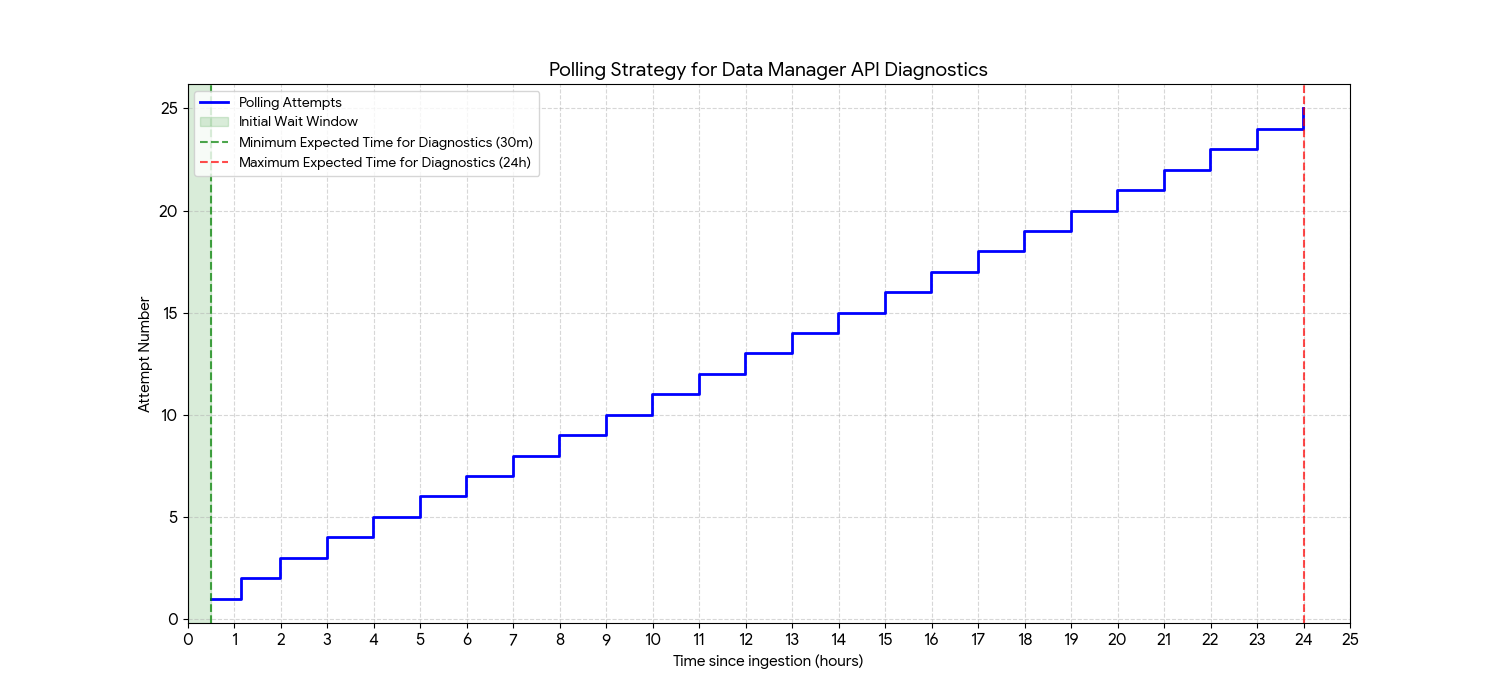
Data
| Attempt | Time Since Ingestion Request (hh:mm) | Delay Before Attempt | Notes |
|---|---|---|---|
|
1
|
00:30 | 30.0 min | First check for status availability |
|
2
|
01:09 | 39.0 min | |
|
3
|
01:59 | 50.7 min | |
|
4
|
02:59 | 60.0 min | Delay is now capped at 1 hour |
|
5
|
03:59 | 60.0 min | |
|
6
|
04:59 | 60.0 min | |
|
7
|
05:59 | 60.0 min | |
|
8
|
06:59 | 60.0 min | |
|
9
|
07:59 | 60.0 min | |
|
10
|
08:59 | 60.0 min | |
|
11
|
09:59 | 60.0 min | |
|
12
|
10:59 | 60.0 min | |
|
13
|
11:59 | 60.0 min | 12-hour mark |
|
14
|
12:59 | 60.0 min | |
|
15
|
13:59 | 60.0 min | |
|
16
|
14:59 | 60.0 min | |
|
17
|
15:59 | 60.0 min | |
|
18
|
16:59 | 60.0 min | |
|
19
|
17:59 | 60.0 min | |
|
20
|
18:59 | 60.0 min | |
|
21
|
19:59 | 60.0 min | |
|
22
|
20:59 | 60.0 min | |
|
23
|
21:59 | 60.0 min | |
|
24
|
22:59 | 60.0 min | |
|
25
|
23:59 | 60.0 min | Last request before the 24 hour maximum total time |
Add a small random amount of jitter to the backoff delays to prevent the "thundering herd" problem where many clients retry simultaneously.
Review responses
The request_status_per_destination
in a RetrieveRequestStatusResponse
contains a separate entry for
each destination in the corresponding ingestion request.
For example, if your IngestAudienceMembersRequest
contained 3 entries in the destinations
list to send data to 3 different
audiences, then the status response would contain 3 entries in request_status_per_destination
(one entry per audience).
Check overall destination status
As a first step, check the request_status
field to determine if the
Data Manager API has finished processing the data for the destination
of the RequestStatusPerDestination
.
Here are the possible values of request_status
:
-
PROCESSING: The data for the destination is still being processed. The warnings and errors aren't populated for the destination at this stage. -
SUCCESS: Request processing for the destination completed without any errors. Check for warnings flagged during processing. -
FAILURE: All of the records for the destination failed due to errors. Check for warnings and errors to determine why all records failed. Also check for warnings flagged during processing. -
PARTIAL_SUCCESS: Some of the records for the destination succeeded, but others failed due to errors. Check for errors to determine why some records failed. Also check for warnings flagged during processing.
Check event or audience status per destination
Inspect the status field that corresponds to the type of ingestion request. Only one
of the following fields is set on each RequestStatusPerDestination
:
Events ingestion status
The events_ingestion_status
field is populated if the request was an IngestEventsRequest
.
Check the record_count
of the IngestEventStatus
to confirm that the total number of records received matches your
expectations. The record_count
includes both successful and failed
records.
Audience members ingestion status
The audience_members_ingestion_status
field is populated if the request was an IngestAudienceMembersRequest
. Here's the IngestAudienceMembersStatus
field to check for
each type of audience data. Only one
of these fields is set.
-
user_data_ingestion_status -
Check the
record_countof theIngestUserDataStatusto confirm that the total number of records received matches your expectations. Therecord_countincludes both successful and failed records.Check the
user_identifier_countto confirm the number of user identifiers received matches your expectations.If the request had a sufficient number of records, the
upload_match_rate_rangecontains the match rate range for records in the request. -
mobile_data_ingestion_status -
Check the
record_countof theIngestMobileDataStatusto confirm that the total number of records received matches your expectations. Therecord_countincludes both successful and failed records.Check the
mobile_id_countto confirm the number of mobile IDs received matches your expectations. -
pair_data_ingestion_status -
Check the
record_countof theIngestPairDataStatusto confirm that the total number of records received matches your expectations. Therecord_countincludes both successful and failed records.Check the
pair_id_countto confirm the number of PAIR IDs received matches your expectations. -
ppid_data_ingestion_status -
Check the
record_countof theIngestPpidDataStatusto confirm that the total number of records received matches your expectations. Therecord_countincludes both successful and failed records.Check the
ppid_countto confirm the number of PPIDs received matches your expectations. -
user_id_data_ingestion_status -
Check the
record_countof theIngestUserIdDataStatusto confirm that the total number of records received matches your expectations. Therecord_countincludes both successful and failed records.Check the
user_id_countto confirm the number of user IDs received matches your expectations. -
composite_data_ingestion_status -
Check the
record_countof theIngestCompositeDataStatusto confirm that the total number of records received matches your expectations. Therecord_countincludes both successful and failed records.Check the
data_type_countsto confirm that the number of identifiers matches your expectations. This list provides a breakdown of all identifiers received (such as email address, phone number, physical address, and IP address) byDataType.If the request had a sufficient number of records, the
upload_match_rate_rangecontains the match rate range for records in the request.
Audience members removal status
The audience_members_removal_status
field is populated if the request was a RemoveAudienceMembersRequest
. Here's the RemoveAudienceMembersStatus
field to check for each
type of audience data. Only one
of these fields is set.
-
user_data_removal_status - Removal status for user data .
-
mobile_data_removal_status - Removal status for mobile data .
-
pair_data_removal_status - Removal status for PAIR data .
-
ppid_data_removal_status - Removal status for PPID data .
-
user_id_data_removal_status - Removal status for User ID data
-
composite_data_removal_status - Removal status for Composite data
Check the record_count
to confirm that the total number of records
received matches your expectations. The record_count
includes both
successful and failed records.
In addition, check the user_identifier_count
, mobile_id_count
, pair_id_count
, ppid_count
, or user_id_count
to confirm the total count of
identifiers received.
For composite data, check the data_type_counts
to confirm that the number of
identifiers matches your expectations. This list provides a breakdown of all
identifiers received (such as email address, phone number, physical address, and
IP address) by DataType
.
Check warnings and errors
In addition to the status fields for the destination and request type, the RetrieveRequestStatusResponse
contains a breakdown of
warnings and errors for the request.
- An error indicates that the API completely rejected the record.
- A warning indicates that the API didn't reject the record, but it had to ignore portions of the record's data.
For example, if an Event
contains encrypted UserIdentifier
data and AdIdentifiers
such as gclid
, and the UserIdentifier
data can't be decrypted, the Data Manager API still processes the
record using the AdIdentifiers
but returns the warning PROCESSING_WARNING_REASON_USER_IDENTIFIER_DECRYPTION_ERROR
.
However, if the Event
doesn't contain AdIdentifiers
and the UserIdentifier
data can't be decrypted, the Data Manager API rejects the entire record and
reports the error PROCESSING_ERROR_REASON_USER_IDENTIFIER_DECRYPTION_ERROR
because a valid Event
must have at least one of ad_identifiers
or user_data
.
Here are the response fields that contain warning and error information. These
fields are populated when the overall destination status
reaches SUCCESS
, PARTIAL_SUCCESS
, or FAILURE
.
-
warning_info -
A list of
WarningCountobjects. EachWarningCountcontains areasonwith the type of warning, and arecord_countindicating the number of records that had that type of warning.Check the
warning_infoeven if the overall destination status isSUCCESS. -
error_info -
A list of
ErrorCountobjects. EachErrorCountcontains areasonwith the type of error, and arecord_countindicating the number of records that failed due to that type of error.
