


PR
令和維新
2004年4月から企業を離れ、コンサルタントや情報起業を試行しなが ら、失われた20年を取り戻し、日本再生をめざす私の歩みをみて一人でも多くの後継者が出てくれることを祈りつつ友達から紹 介されたこのホームページの更新を続け、これまでの活動の記録と今やビッグデータ、AI,、IOT,ブロックチェーン、仮想通貨の時代になってしまいましたが、私の現状認識と関連技術を紹介していきたい。
ソ連は軍事と宇宙開発に予算をつぎ込み、スプートニクで社会主義の成果を誇る一方で、国民は貧困に苦しみ続けた。中国は今、そのスプートニク経済を踏襲中。
ウォーレン・バフェットは市場の暴落を待っていない。彼ははるかに大きな何かを待っている。(Warren Buffett Isn’t Waiting for a Market Crash. He’s Waiting for Something Much Bigger.)
(2)プラズムの上昇傾向(The Plazm Upside)
先端技術情報20261006
「栃木三区の有権者は主権を行使しろ!」と言われなくても小選挙区で落選させるようにしたはずだが、比例復活?やな大臣
2026年でも依然として機能する15のフリーランス収入のアイデア(15 Freelance Income Ideas That Still Work in 2026)
(1)プラズムの上昇傾向(The Plazm Upside)
先端技術情報20261005
主要国の国債金利上昇と中国の国債金利下落
Comments
2026年10月7日の…
 New!
藻緯羅さん
New!
藻緯羅さん源氏物語〔38帖 鈴虫…
New!
USM1さん朝霧の中のD51 吉松…
New!
GKenさん英語に未来時制って…
samito07さんCategory
カテゴリ未分類
(112)連絡
(24)交流会
(27)セミナー
(29)参考情報
(138)オフ会
(36)on-line報告会
(13)翻訳ビジネス
(8)情報開発
(270)ビッグデータ
(89)ブロックチェーン
(255)人工知能
(576)IOT
(309)仮想通貨
(882)コンテンツ
(131)政治経済
(2016)先端技術
(986)DITA
(53)テレワーク
(28)UX
(0)文書管理
(9)テクニカルライテイング
(29)学習
(9)訓練
(1)XMLソリューション
(3)メタバース
(101)Web3
(69)投資
(208)IoT
(34)投資信託
(1)ビットコイン
(841)イーサリアム
(166)NFT
(41)オンライン
(0)受動収入
(14)ソーシャルメデイア
(0)DAO
(2)DeFi
(84)暗号通貨
(168)トークノミクス
(23)アルトコイン
(234)空中投下
(16)スマート契約
(4)ステーブルコイン
(43)金
(5)生成AI
(5)SCM
(4)ウオレット
(9)不労所得
(60)セキュリテイ
(4)ミームコイン
(51)CBDC
(5)PoS
(3)PoW
(1)ETF
(15)仮想通貨ETF
(1)予言
(7)裁定取引
(1)GameFi
(5)マイニング
(11)RWA
(25)DePIN
(22)SWFT
(1)WLFI
(1)アービトラージ
(7)XRP
(69)大統領選
(4)BCH
(1)取引ボット
(17)トレーデイング
(56)不動産
(1)詐欺
(4)貿易戦争
(1)医療
(1)金融
(2)TEZOS
(1)CARDANO
(2)カルダーノ
(3)ステーキング
(5)チェーンリンク
(1)開発
(0)HEDERA
(4)スマートマネー
(0)流動性
(0)AIエージェント
(26)401k
(1)国際送金
(1)solano
(1)AI
(1)暗号資産
(102)機関投資家
(5)量子コンピューター
(8)AIエージェント
(6)ドキュメンテーション
(2)AIトレーデイング
(1)トークン化株式
(1)半導体
(1)フリーランス
(1)Keyword Search
Freepage List


Shopping List

The Freedom Too Heavy to Hold
抱えきれないほど重い自由
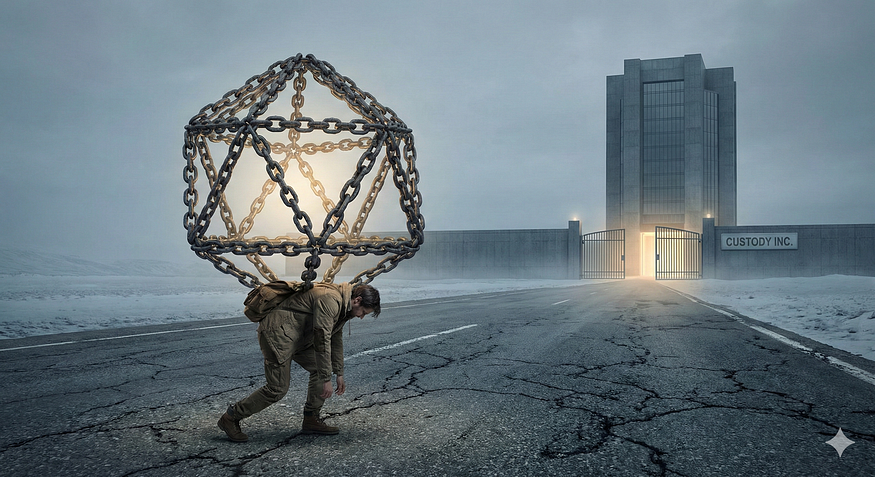
自己保管
──
つまり、鍵を管理するのはあなただけであり、
ゆえに資産もあなただけがコントロールするという考え方は、
ブロックチェーンの最も深い哲学的信念だ。仲介者はいない。
許可もいらない。
口座を凍結したり、資金を押収したり、アクセスを拒否する存在もいない。
This is a real and serious proposition. For people living under governments with unstable banking systems, or histories of capital controls, or records of confiscation, it is not abstract. It is a survival tool.
これは現実的で、非常に重要な提案だ。銀行システムが不安定な国や、資本規制や没収の歴史がある国に住む人々にとって、
これは抽象論ではない。
生き延びるためのツール
だ。
The shadow: most people cannot actually sustain it.
その影:
ほとんどの人は、この自由を維持できない。
This is not an insult. It is empirical.
これは侮辱ではない。経験に基づく事実だ。
Only 46 percent of retail crypto users feel fully confident managing their own key recovery. Despite years of wallet innovation, 41 percent still prefer custodial wallets (meaning they hand their keys to a company) because managing them personally is too burdensome. Centralized exchanges handle nearly 88 percent of all crypto trading volume. A $2 billion custody industry exists for exactly one reason: self-custody is too hard for most people, and they will pay to hand it to someone else.
一般ユーザーのうち、自分で鍵を復旧できると
46
%は完全に自信があると感じる。
41
%は依然として保管サービス型ウォレットを好む。
理由は「自分で管理するのが負担すぎる」から。暗号資産の取引量の約
88
%は中央集権型取引所が扱っている。
20
億ドル規模の保管業務産業が存在する理由はただ
1
つ:
自己保管は大多数の人にとって難しすぎる。
Even Vitalik Buterin, Ethereum’s co-founder, wrote in 2021 that the blockchain ecosystem’s answer to losses and thefts — “12-step tutorials, not-very-secure half-measures, and the occasional semi-sarcastic ‘sorry for your loss’” — is not a path to broad adoption. He acknowledged that his own proposed solution, social recovery wallets requiring seven or more “guardians” among your friends and family, is itself complex enough that almost nobody uses it.
イーサリアムの共同創設者、ヴィタリック・ブテリンでさえ、
2021
年に、「紛失や盗難への対処が
12
ステップのチュートリアル、あまり安全と言えない中途半端な対策、そして時折の半ば皮肉めいたお悔やみでは普及しない」
と書いた。彼は、自身が提案した解決策、つまり友人や家族の中から
7
人以上の「保護者」を必要とするソーシャル回復ウォレットは、それ自体が複雑すぎてほとんど誰も利用していないことを認めた。
The hardest version of this problem is death.
最も厄介な問題は死だ
When QuadrigaCX CEO Gerald Cotten died in 2018, he was allegedly the only person with access to the exchange’s cold wallets. 115,000 customers were owed $190 million. The blockchain recorded every one of those funds. No court order, no death certificate, no legal process could move a single Satoshi without the private keys that died with him.
2018
年、
QuadrigaCX
の
CEO
ジェラルド・コッテンが死亡したとき、
彼は取引所のコールドウォレットにアクセスできる唯一の人物だったと言われている。
11
万
5
千人の顧客に対して、
1
億
9
千万ドルが未払いのまま残った。ブロックチェーンには、その資金のすべてが記録されている。
しかし、どんな裁判所命令も、どんな死亡証明書も、どんな法的手続きも、
彼とともに失われた秘密鍵なしでは、
1
サトシたりとも動かすことはできなかった。
But the story is darker than that, because this problem is not limited to exchanges. It extends to every individual who self-custodies without a viable succession plan. Blockchain assets are not like a bank account, where a death certificate and a probate order eventually grant a family access. The ledger has no concept of a next of kin. The ledger has only the key. If the key is gone, the funds are gone. Both facts will remain permanently visible on-chain, for as long as the chain runs.
だが、この話は取引所だけの問題ではない。
自分で資産を保管しているすべての個人にも当てはまる。
“
継承プラン
”
が存在しない限り。
ブロックチェーン資産は銀行口座とは違う。
銀行なら、死亡証明書と遺産分割の手続きがあれば、家族がアクセスできるようになる。
しかしブロックチェーンには「次の相続人」という概念がない。
あるのは、鍵だけだ。鍵が失われれば、資産も失われる。
そしてその事実は、チェーンが動き続ける限り、永遠にオンチェーンに残り続ける。
The sovereignty that blockchain offers is real. But sovereignty without the ability to sustain it is not freedom — it is a weight. And when it becomes too heavy, people give it back to institutions. They return to centralized exchanges, custodial services, intermediaries. The very structures blockchain was built to make unnecessary.
ブロックチェーンが提供する主権は本物だ。
だが、その主権を維持する力がなければ、それは自由ではなく重荷になる。そしてその重荷に耐えられなくなったとき、人々は再び機関に戻る。
中央集権型取引所、保管業務サービス、仲介者へ。
本来ブロックチェーンが不要にするはずだった構造へ戻るのだ。
This is not a contradiction that better education will solve. It is a structural tension between what the technology offers and what most human beings — not all of them, but most — can carry.
これは教育で解決できる矛盾ではない。
これは、テクノロジーが提供するものと、
大多数の人間が実際に背負えるものとの間にある構造的緊張だ。
The New Landlords
新しい地主たち

Blockchain was built to distribute power. The empirical question is whether it has.
ブロックチェーンは権力を分散させるために作られた。
実証的な問いは達成されたのかだ。
The answer is complicated and specific, and the specifics are not flattering.
答えは複雑で、具体的であり、具体的内容は好ましいものではない。
Bitcoin mining, the process that produces new blocks and />
Ethereum solved its energy problem by moving to Proof of Stake, where validators are chosen based on how much ETH they lock up, rather than how much electricity they consume. The centralization problem followed the solution. Lido, a single liquid staking protocol, currently controls between 25 and 28 percent of all staked ETH — approaching the 33 percent threshold that Ethereum Foundation researchers have identified as the point at which a single entity gains theoretical ability to manipulate block space. Danny Ryan, an Ethereum Foundation researcher, has written that surpassing this threshold “would be a centralization attack on Proof of Stake.” Lido’s DAO voted against capping its own growth.
イーサリアムは
掛け金の証明への移行によってエネルギー問題を解決した。
だが、中央集権化の問題はその解決策の後を追ってきた。
Lido
という単一のリキッドステーキングプロトコルが、全ステーク
ETH
の
25
〜
28%
を保有している。
これは、イーサリアム財団の研究者が「単一主体がブロックスペースを操作できる可能性が生まれる」と指摘する
33%
の閾値に近づいている。イーサリアム財団研究者
Danny Ryan
は、この閾値を超えることは掛け金の証明
に対する中央集権攻撃だと述べている。
しかし
Lido
の
DAO
は、自らの成長を制限する提案に反対票を投じた。
Wealth distribution tells the same story at a different layer. Bitcoin’s Gini coefficient (the standard measure of inequality, applied here to wallet balances) has consistently exceeded 0.92. The top 0.01 percent of Bitcoin addresses contain more than half of all Bitcoin. The United States, frequently cited as a case study in inequality, has an income Gini coefficient of roughly 0.49. Even comparing Bitcoin’s wallet concentration to America’s wealth distribution — which at roughly 0.85 is already severe — blockchain is dramatically more concentrated. The technology built to democratize finance has produced a more unequal distribution of wealth than the system it was supposed to replace.
富の分配状況も、異なるレベルでは同様の傾向を示している。ビットコインのジニ係数(不平等の標準的な指標であり、ここではウォレット残高に適用されている)は、一貫して
0.92
を超えている。上位
0.01%
のビットコインアドレスが、ビットコイン全体の半分以上を保有しているのだ。不平等の事例研究としてしばしば挙げられるアメリカ合衆国の所得ジニ係数は、およそ
0.49
である。ビットコインのウォレット集中度を、すでに深刻な
0.85
という水準にあるアメリカの富の分配状況と比較しても、ブロックチェーンの集中度ははるかに高い。金融の民主化を目指して開発されたこの技術は、本来置き換えるはずだったシステムよりも、より不平等な富の分配を生み出してしまったのだ。
Governance; the mechanism that was supposed to give communities democratic control over their shared infrastructure, has been captured. Academic analysis of leading decentralized autonomous organizations found governance token Gini coefficients ranging from 0.97 to 0.99. One percent of users hold 90 percent of voting power. In Uniswap, the venture capital firm a16z holds exactly the percentage of governance tokens required to pass any proposal — and has used that position to vote against bridge protocols competing with companies in its own portfolio.
ガバナンス、つまりコミュニティが共有インフラを民主的に管理できるようにするはずだった仕組みは、乗っ取られてしまった。主要な分散型自律組織に関する学術分析によると、ガバナンストークンのジニ係数は
0.97
から
0.99
の範囲に及んでいる。
つまり、
ユーザーの
1%
が投票権の
90%
を握っているのだ。
Uniswap
では、ベンチャーキャピタル企業の
a16z
が、あらゆる提案を可決するために必要な割合のガバナンストークンを保有しており、その立場を利用して、自社のポートフォリオ企業と競合するブリッジプロトコルに反対票を投じている。
And then there is the infrastructure layer, which nobody discusses because it is invisible until it fails.
そして、インフラストラクチャ層というものがある。これは、故障するまで目に見えないため、誰も話題にしない。
Infura, a single API provider, routes somewhere between 70 and 80 percent of all Ethereum remote procedure call traffic — the communication layer through which applications talk to the blockchain. In 2022, when Infura experienced an outage, MetaMask, Binance, Polygon, Optimism, and Arbitrum all went down simultaneously. Over a third of all Ethereum nodes run on Amazon Web Services. Three cloud providers together host roughly 69 percent of all Ethereum nodes. When AWS experienced a major outage in October 2025, Coinbase, the Base network, Infura, and Robinhood all stopped functioning at the same time for over 36 hours.
単一の
API
プロバイダーである
Infura
は、アプリケーションがブロックチェーンと通信する通信レイヤーである、イーサリアムのリモートプロシージャコールトラフィックの
70
~
80
パーセントをルーティングしています。
2022
年に
Infura
が障害を起こしたとき、
MetaMask
、
Binance
、
Polygon
、
Optimism
、および
Arbitrum
がすべて同時にダウンしました。イーサリアムノードの
3
分の
1
以上が
Amazon Web Services
上で稼働しています。
3
つのクラウドプロバイダーが合わせて、イーサリアムノードの約
69
パーセントをホストしています。
2025
年
10
月に
AWS
が大規模な障害を起こしたとき、コインベース、
Base
ネットワーク、
Infura
、および
ロビンフッドがすべて同時に
36
時間以上機能しなくなりました。
The decentralization that blockchain offers at the protocol layer — the layer that gets described in whitepapers and conference talks — rests on centralized cloud infrastructure at the physical layer. The architecture of dependence it was designed to eliminate has been reproduced at a different level of the stack, with less regulatory visibility and less accountability than a traditional bank.
ブロックチェーンがプロトコル層(ホワイトペーパーやカンファレンスで説明される層)で提供する分散化は、物理層の中央集権型クラウドインフラに依存している。ブロックチェーンが排除しようとした依存関係のアーキテクチャは、スタックの別のレベルで再現されており、従来の銀行よりも規制上の可視性や説明責任が低い。
Power didn’t disappear. It migrated.
力は消滅したのではなく、移動したのだ。
The Glass House
ガラスの家
Blockchain’s transparency; every transaction visible to everyone, permanently, was framed as accountability. No hidden ledgers. No secret transfers. Trustless verification.
ブロックチェーンの透明性
──
すべての取引が誰にでも、永続的に見える
──
は説明責任として語られてきた。隠された台帳はない。秘密の送金もない。信頼不要の検証。
The shadow: when every transaction is visible to everyone, permanently, the question is not whether you trust the system. It is who has the tools to read it.
しかし影がある。すべての取引が誰にでも永続的に見える世界で重要なのは、システムを信頼するかどうかではなく、それを読み解くツールを誰が持っているかだ。

-
先端技術情報20260916 2026.09.16
-
先端技術情報20260913 2026.09.13
-
先端技術情報20260830 2026.08.30


