

Vol. 42, No. 11
11/01/2026
Enchantment in the Dust
AT A GLANCE
• For the uninformed and unprepared, Burning Man may hold a certain charm.
• It is really part of a global “re-enchantment” that has spirituality at the center.
• Powerful forces have long understood that a new narrative is needed.
• Burning Man, as a neo-pagan culture that claims it’s not a religion, serves that role.
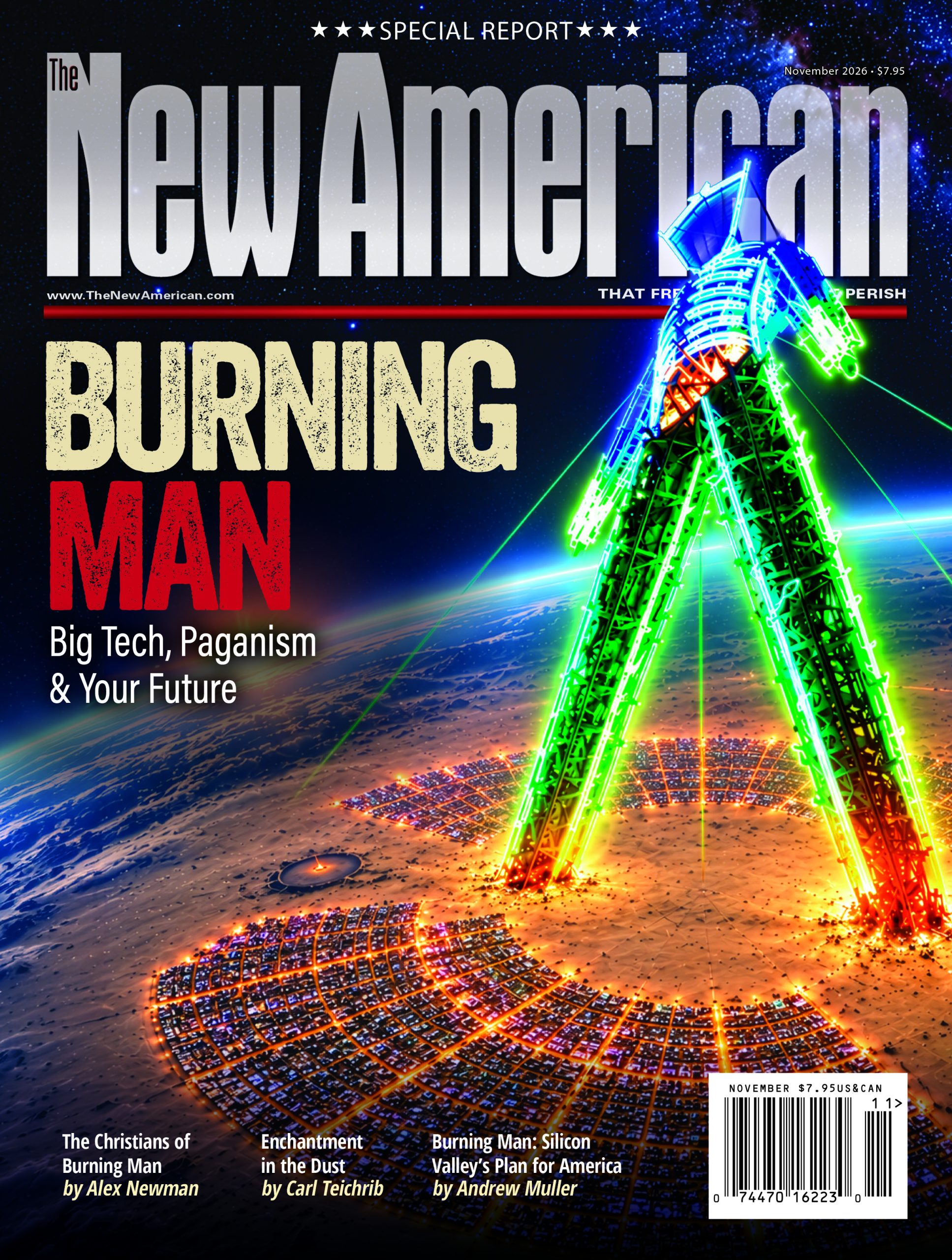
BLACK ROCK CITY, NEV. — The entrance was crammed with people trying to catch a glimpse of something . Peering around and through the crowd, I could see bits and pieces of a ritual: a red-robed figure suspended by ropes, dusty-looking performers rappelling red walls, a red blanket covering — a luminescent egg? No, it was a glowing omphalos , a ritual stone object — historically connected to Delphi — expressing the navel or cosmological center of the universe. Above it was a towering human effigy outlined in neon and flanked by two sets of mechanical, polished gamelan gongs. Directly below the omphalos, hammered into the ground and out of sight, was a golden spike from which a bustling city of 70,000 people had been carefully surveyed, then laboriously constructed on the alkaline desert floor known as the “playa.”
There, at the epicenter, stood the Man.
My campmateand I had accidentally stumbled into the ceremonial heart of Black Rock City, the temporary urban experiment known as Burning Man. That year, 2017, the event’s theme was “Radical Ritual,”and the Man had been erected inside his own hallowed space: the Temple of the Golden Spike. What I had witnessed was a literalizing of my forthcoming book’s subtitle: The Temple of Man in the Age of Re-Enchantment . I was in the right place.
Premium Content
Sign in with your ShopJBS.org account to read the full article, or subscribe below for unlimited digital access.
Log In to Continue Reading
- 12 Issues Per Year
- Digital Edition Access
- Digital Insider Report
- Exclusive Subscriber Content
- Audio provided for all articles
- Unlimited access to past issues
- Cancel anytime
- Renews automatically
- 12 Issues Per Year
- Print edition delivery (USA) *Available Outside USA
- Digital Edition Access
- Digital Insider Report
- Exclusive Subscriber Content
- Audio provided for all articles
- Unlimited access to past issues
- Cancel anytime
- Renews automatically
